
Evaluating UHF RFID Reader Suppliers for Smart Manufacturing: A Capability Checklist
A UHF RFID reader supplier is worth shortlisting when it can evidence six capabilities: conformance to ISO/IEC 18000-6C and the correct regional frequency band, reader hardware that covers every read point in the plant, industrial interfaces that reach your MES or PLC layer, an environmental rating that survives the shop floor, a fast sample and pilot path, and production capacity that scales with the line.
This checklist is written for manufacturing and automation teams at the research and evaluation stage: plant engineers comparing suppliers, procurement leads drafting a reader specification, and system integrators who will have to make the hardware talk to production software.
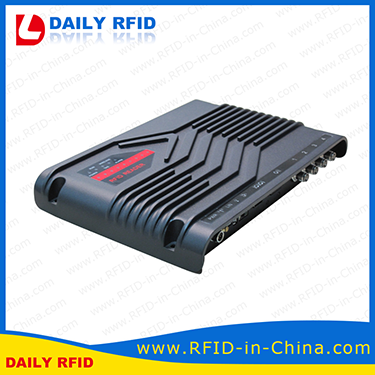
Problem Definition: Why Reader Supplier Evaluation Fails in Factory Projects
Most factory RFQs describe the reader as a line item: model, quantity, unit price. That framing creates three predictable problems.
One reader cannot cover a whole plant. A factory is a collection of different read events. A dock lane takes forklifts through a 4 to 7 metre channel. A bench tray holds small metal components 0.1 to 5 metres from an antenna. An overhead conveyor zone may need 25 to 30 metres of coverage. A handheld route handles exceptions and commissioning. Each of these implies a different antenna architecture, a different transmit power strategy and a different enclosure.
Integration debt compounds. A fixed reader that cannot publish events into the plant software layer becomes a manual process with better hardware. In manufacturing process-control deployments, UHF fixed readers verify components station by station and stream events to MES over MQTT, with read requirements reaching 400 tags per second. Automotive plants in Europe run the same pattern across metal parts at more than 300 tags per second, using dust-proof and shock-resistant hardware.
The environment rewrites the specification. Dusty shop floors and metal racks change both the reader and the tag requirement. IP65-level sealing becomes a baseline, tags need metal-tolerant construction, and systems commonly run an offline cache with scheduled synchronisation to ERP so that a brief network interruption does not stop the line.
A checklist that tests hardware breadth, interface depth, environment rating and delivery reliability therefore produces a better shortlist than a straight price comparison.
Industry Background: A Standardised Market with Uneven Supplier Depth
The technical baseline is settled. UHF RFID readers are standardised under the EPCglobal Gen2 protocol, also published as ISO/IEC 18000-6C, which means a compliant tag from one vendor is designed to be read by a compliant reader from another.
The market around that baseline is still expanding. Third-party estimates place the global UHF RFID reader market at approximately USD 4.8 billion in 2025, projected to reach USD 11.2 billion by 2034 (Dataintelo). UHF RFID accounted for 40.72% of total RFID market revenue in 2025, according to Mordor Intelligence, driven by retail inventory cycles and multi-item read capability. Regionally, the Americas represent more than 60% of global UHF tag usage as of 2025 (IDTechEx), while Asia Pacific is the fastest-growing hardware region with an expected 11.8% CAGR in shipments through 2031 (ABI Research). Market-size estimates vary by scope, because some analysts count UHF reader hardware alone and others the wider RFID ecosystem, so these figures are best read as directional.
For buyers this has a direct consequence. Because the air interface is standardised, protocol compliance is a baseline rather than a differentiator. What separates suppliers is how many station types their hardware covers, how cleanly it connects to production software, and whether customised units can be delivered on a repeatable schedule.
The Capability Checklist: Eight Areas to Verify Before You Shortlist
The checklist below is deliberately hardware-first. Each item is written so that a supplier can answer it with a datasheet, a deployment record or a pilot unit rather than a claim. DAILY RFID CO., LIMITED (www.rfid-in-china.com) is a Guangzhou-based RFID manufacturer founded in 2008 that produces RFID tags, cards and readers, and exports roughly 80% of its output with the EU and USA as its main markets. Its reader portfolio is used below as a worked example of what each checklist item should look like when it is documented.
1. Protocol conformance and frequency planning
Start with the air interface and the region. A reader should state conformance to ISO18000-6C EPC Gen2, and to ISO18000-6B where older assets remain in service, and list the bands it ships with. The DL6960 AI Multi-Antenna 4-Port UHF Reader supports ISO18000-6B and ISO18000-6C EPC Gen2 across UHF 860 MHz to 960 MHz. Fixed readers such as the DL921 Power over Ethernet unit are configured for ISM 860 to 868 MHz, 902 to 928 MHz or 920 to 925 MHz, with frequency customisation available. Confirm band selection for every country you operate in before comparing anything else.
2. Reader form-factor coverage across station types
Ask for a station-by-station mapping rather than a catalogue. In practice a plant reader list looks like this:
- Gate and lane readers. The RFID Gate DL8330U integrates four TX/RX antennas across a main and an auxiliary panel and covers a 4 to 7 metre walkthrough channel, powered from AC 220 V and drawing about 35.2 W.
- Tray and workstation readers. The RFID Tray Reader DL6993 delivers 33 dBm with a 0.1 to 5 metre read window and reads 80 to 100 tags at once inside an IP66 enclosure. Where a bench runs on 13.56 MHz instead of UHF, the DL4130H reader-and-antenna tray unit covers 1 to 50 cm and up to 50 tags within a 410 x 300 x 29 mm footprint.
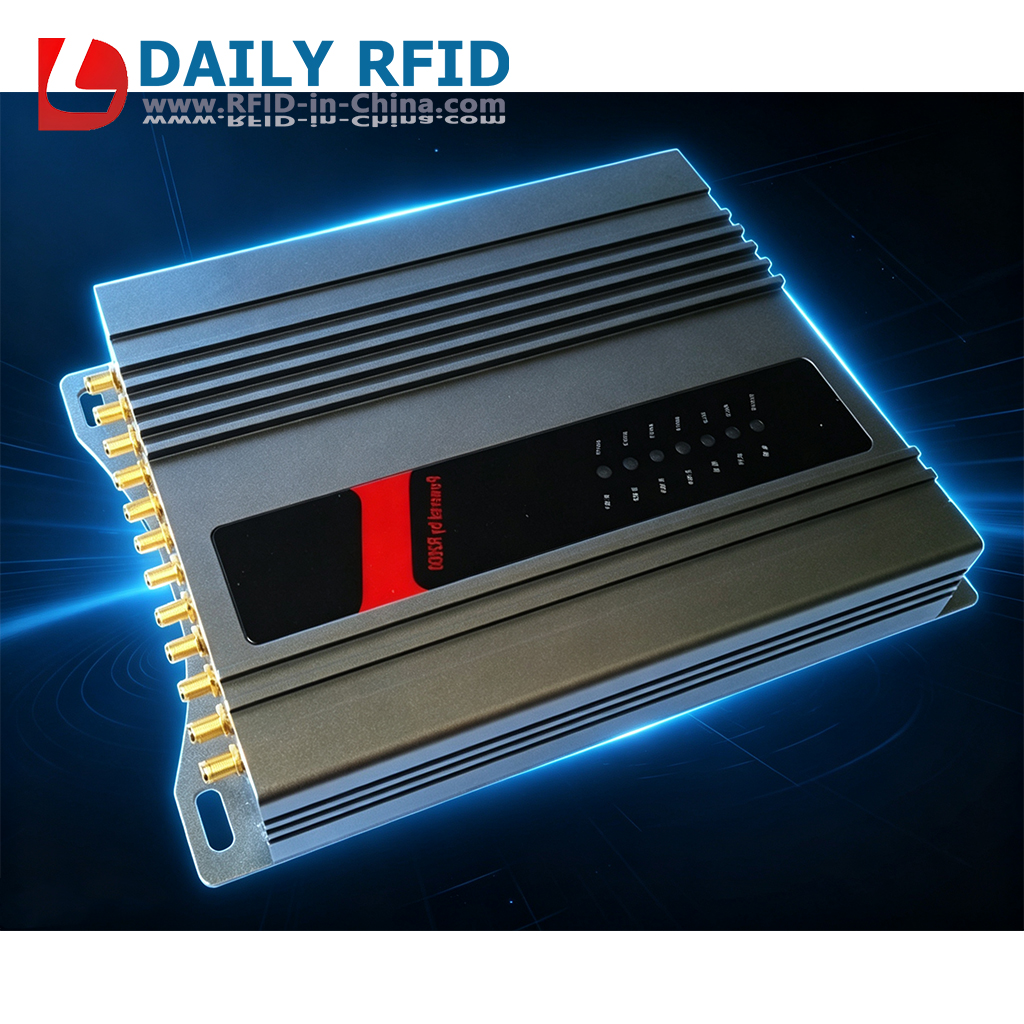
- Multi-port fixed readers. The DL6960 exposes four external TNC/SMA antenna ports for overhead and multi-zone coverage up to 25 to 30 metres.
- Integrated fixed readers. The DL921 PoE reader covers 0.1 to 15 metres with 50-tag anti-collision in an IP65 housing.
- Handheld readers. The DL1280 Industrial PDA handles UHF, HF and LF, with a 0.1 to 20 metre UHF range and 100-tag anti-collision.
- Wireless fixed readers. The DL930B, DL930W and DL930G variants provide Bluetooth, Wi-Fi and GPRS connectivity respectively, at 4 to 8 metres read range with IP65/IP66 protection.
A supplier that covers only one or two of these rows transfers the multi-vendor integration problem to your team.
3. Interface depth and integration path
Count physical interfaces before discussing software. Relevant ports in this class of hardware include RS232, RJ45 TCP/IP, USB, GPIO with trigger and relay, RS485 and Wiegand 26/34. Power over Ethernet is worth asking about specifically: the DL921 delivers power and network connectivity over a single Ethernet cable, which reduces cabling and installation cost in high-bay areas.
Then check SDK coverage, because integration schedules are usually lost there. The DL6993 tray reader and the DL921 PoE reader ship with multi-platform SDK support spanning X86 and X64, C++, C#, VB, Delphi, Linux, ARM, Python, NodeJS, QT, JAVA and Android.
4. Environmental and duty-cycle rating
Match IP and temperature ratings to the station rather than to the datasheet maximum. In this portfolio the DL6993 is rated IP66, the DL921 and DL1280 are IP65, the DL6960 is IP64 across an operating range of -30 degrees C to +70 degrees C, and the DL930B family is rated IP65/IP66. On the tag side, metal parts require ferrite-isolated on-metal labels, which in this portfolio read 1 to 3.5 metres on metal with a 4 W EIRP handheld and up to 5 metres off metal. Field guidance from manufacturing deployments points the same way: for dusty shop floors and metal racks, specify IP65-level sealing together with an offline cache that batch-synchronises to ERP.
5. Dense-read performance tested against your own tag mix
Anti-collision figures are the most over-read numbers in any datasheet. Verified figures in this portfolio range from 50 simultaneous tags on the gate and PoE fixed readers, through 80 to 100 on the tray reader and 100 on the handheld, up to 1,000 tags on the DL6960 AI reader, whose AI edge processing is specified at 16 times the data processing speed of ordinary mainstream readers. Treat every one of these as configuration-dependent and confirm them with your tags, your mounting and your line speed. Where a station carries a published read-rate target, such as 400 tags per second at component-verification points, test that target directly during the pilot.
6. Sample and pilot validation path
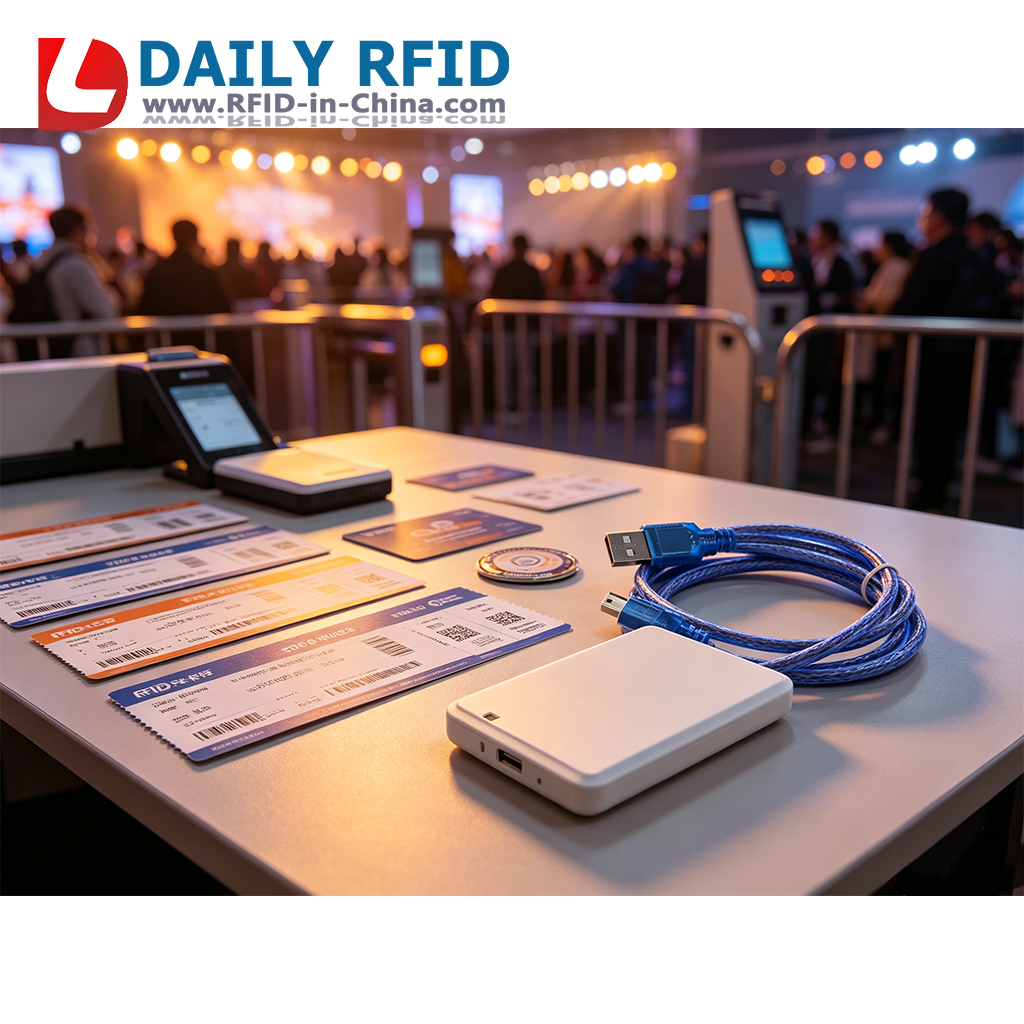
Ask what a supplier will ship for evaluation. A development-kit format is the fastest route: the RFID Development Kit bundles a reader, demo software and sample tags, with a minimum order of one set, a 7 to 15 day lead time, and function plus packing testing before dispatch. Pilot one station with your own parts before committing a line.
7. Production, customisation and delivery capability
Verify the manufacturing base rather than the sales office. DAILY RFID operates a 28,000 square metre factory with 180 to 200 employees, including a 38-engineer R&D team, and annual output of 100,000 readers alongside 50 million tags and 30 million cards. Its ODM/OEM terms for UHF fixed readers cover antenna gain and interface configuration, a monthly capacity of 1,000 units, a lead time of 15 to 45 days, a minimum order of one unit, factory acceptance testing and remote support.
Deployment footprint is a useful cross-check. One distribution centre in Poland installed 360 readers for conveyor-line parcel reading and outbound verification. A railway maintenance operator deployed 145 handheld PDA units for trackside inspection. An airport ground services team equipped 90 handheld units for asset audits, and a smart-cabinet manufacturer integrated 35,000 embedded 13.56 MHz RFID modules into cabinet and self-service terminal designs.
8. Documentation, ownership and lifecycle support
Confirm what arrives with the hardware, including SDK documentation, demo applications and sample code. Then confirm the commercial terms that keep a multi-year rollout stable: OEM/ODM scope, warranty behaviour, and whether remote technical support is included. Finally, establish who owns integration. A supplier that supports commissioning shortens the distance between a successful pilot and a running line.
Step-by-Step: Running the Evaluation in Six Moves
Step 1 - Map every station and define the read event
Walk the plant and list each point where a tag is read: dock doors, receiving, work-in-process trays, line checkpoints, outbound lanes and mobile audit routes. For each point, record read distance, tag quantity, motion speed, tag material such as metal, plastic or textile, and whether the reader will be fixed or mobile.
Step 2 - Convert each station into a written requirement
Translate the walkthrough into a specification: frequency band, minimum read distance, tag density, enclosure rating, operating temperature, power source and required interface list. Written specifications survive supplier changes; model numbers do not.
Step 3 - Request a matched hardware proposal
Ask the supplier to map specific models to specific stations. In the DAILY RFID portfolio that mapping typically runs: DL8330U gate for dock lanes, DL6993 tray reader for benches, DL6960 for overhead and multi-zone coverage, DL921 PoE where cabling is restricted, DL1280 for mobile commissioning and audits, and DL930B/W/G for wireless fixed points.
Step 4 - Score interface and integration fit
Confirm the ports, the protocol output and the SDK languages your team actually uses. If the plant expects event streams in MES, verify the mechanism directly: multiple manufacturing deployments run MQTT event streams to MES, and automotive lines run real-time data streaming to MES.
Step 5 - Pilot one station with the development kit
Run the pilot at the hardest station first, which is usually the one with metal content, dense tags or the shortest read window. Start with the development kit and its bundled sample tags, then repeat the test with your own tags before scoring performance.
Step 6 - Compare delivery and customisation terms, then scale
Before scaling, compare minimum order quantities, lead times, customisation scope and quality gates across candidates. Fixed readers in this portfolio are available at a minimum order of one unit with a 15 to 45 day lead time and factory acceptance testing; confirm how those terms change as volumes grow.
Station-Level Use Cases: Matching Readers to Smart Manufacturing Workflows
Dock doors and inbound verification
At a loading dock the read event is a walkthrough: pallets or containers cross a fixed plane, often while the driver is under time pressure. The requirement is a wide channel with no dead zones and an event that reaches the WMS or MES immediately. A gate reader such as the DL8330U integrates four TX/RX antennas across two panels and supports a 4 to 7 metre channel, with RS232, RJ45 and GPIO available for alarm, indicator and infrared direction sensing. Where a dock already has network cabling but limited power drops, a PoE fixed reader avoids new electrical work.

Workstation and tray-level verification
At a bench, the read event covers a small and dense population: trays of components, tools or high-value parts that must be counted without scanning item by item. Tray readers such as the DL6993 sit flat on the counter, deliver 33 dBm and identify 80 to 100 tags at once within 0.1 to 5 metres, inside an IP66 enclosure that tolerates splashes and cleaning. For metal components, pair the reader with ferrite-isolated on-metal labels, because the tag choice determines whether the read works at all.

Overhead line zones and multi-zone coverage
Overhead coverage is where antenna count matters. A single-port reader cannot cover a long conveyor bend, while a four-port reader can drive separate antenna sets down the line. The DL6960 provides four external TNC/SMA ports, a 25 to 30 metre read range, up to 1,000 simultaneous tags and 16 times the data processing speed of ordinary mainstream readers, at 5 W power consumption with IP64 protection. Mounted above stations, this configuration matches the pattern used in manufacturing process control, where read events stream to MES.
Mobile commissioning, audit and exception handling
Not every read point is fixed. Commissioning, cycle counts and exception handling need a handheld. The DL1280 covers UHF, HF and LF, reads 0.1 to 20 metres on UHF with 100-tag anti-collision, and runs Android 12 on an 8-core 2.0 GHz processor with 4 GB RAM and 64 GB ROM. Its 4,500 mAh host battery plus 6,700 mAh handle battery support long shifts, while Wi-Fi, 4G and Bluetooth 5.0 keep data moving on the floor.

Wireless fixed points and temporary lines
Where a line is temporary, relocated often, or cabling is impractical, wireless fixed readers are the practical option. The DL930B, DL930W and DL930G variants offer Bluetooth, Wi-Fi and GPRS respectively at 4 to 8 metres read range with IP65/IP66 protection and a -30 degrees C to +70 degrees C operating window, with RS232, RJ45, USB, GPIO and Wiegand 26/34 available for downstream integration.
Reader Capability Comparison Table for Smart Manufacturing Stations
The table below consolidates verified specifications from the reader families discussed above, so that station requirements can be matched to documented hardware rather than to marketing descriptions.
| Manufacturing station | Read requirement to verify | Matching reader form factor | Verified headline capability | Interface notes |
|---|---|---|---|---|
| Dock door and inbound/outbound lane | 4 to 7 m walkthrough, dense flow, gate trigger | RFID Gate DL8330U | 4 built-in TX/RX antennas; 4 to 7 m channel width; ISO18000-6C / ISO18000-6B; 30 dBm adjustable; AC 220 V, approx. 35.2 W | RS232, RJ45, GPIO with alarm and optional infrared sensing |
| Workstation tray and small high-value parts | 0.1 to 5 m window, 80 to 100 tags at once | RFID Tray Reader DL6993 | 33 dBm; 0.1 to 5 m; 80 to 100 tags; IP66; RSSI supported | RS232, USB, RJ45, GPIO; multi-platform SDK |
| Overhead line zone and multi-zone coverage | 25 to 30 m reach, up to 1,000 tags | AI Powered RFID Reader DL6940/6960 | 4 external TNC/SMA ports; 25 to 30 m; up to 1,000 tags; IP64; 5 W; -30 to +70 degrees C | RS232, RJ45 TCP/IP, GPIO and RS485, USB |
| Cabling-restricted fixed zone | Up to 15 m reach, approx. 50 tags | RFID Fixed Reader DL921 PoE | 0.1 to 15 m; 50 tags; IP65; PoE single-cable power and data | RS232, RJ45 with PoE, GPIO trigger and relay |
| Mobile commissioning and exception handling | 0.1 to 20 m UHF, 100 tags | RFID Handheld Reader DL1280 | UHF/HF/LF; 20 m UHF; Android 12; IP65; 4,500 mAh plus 6,700 mAh batteries | Wi-Fi 2.4G+5G, 4G, Bluetooth 5.0, GNSS, Type-C |
| Wireless fixed point and relocatable line | 4 to 8 m reach, no fixed cabling | UHF RFID Reader DL930B / DL930W / DL930G | 4 to 8 m; 20 to 30 dBm adjustable; IP65/IP66; -30 to +70 degrees C | RS232, RJ45, USB, GPIO, Wiegand 26/34 |
FAQ
Which standards and frequency bands should a smart manufacturing buyer verify first?
Verify the air-interface standard and the regional band before anything else. UHF RFID readers are standardised under the EPCglobal Gen2 protocol, also published as ISO/IEC 18000-6C (GS1 / ISO), so a compliant tag from one vendor is designed to be read by a compliant reader from another. Readers in the DAILY RFID range, such as the DL6960 AI Multi-Antenna 4-Port UHF Reader, support ISO18000-6C EPC Gen2 and ISO18000-6B and operate across UHF 860 MHz to 960 MHz. Fixed readers such as the DL921 PoE unit are configured for ISM 860 to 868 MHz, 902 to 928 MHz or 920 to 925 MHz, with customisation available. Ask for the exact band configuration for every country in your rollout, plus the tag standard that will be applied at each station.
Can one supplier cover multiple reader stations in a smart factory?
Only if the portfolio spans form factors, not just power levels. A capability check should list at least six rows: gate readers such as the DL8330U with four built-in TX/RX antennas and a 4 to 7 metre channel; tray readers such as the DL6993 at 33 dBm with 0.1 to 5 metre range, 80 to 100 tags and IP66; multi-port fixed readers such as the DL6960 with four external antenna ports, 25 to 30 metre range and up to 1,000 tags; integrated fixed readers such as the DL921 PoE with 0.1 to 15 metre range and IP65; handheld terminals such as the DL1280 covering UHF, HF and LF with 0.1 to 20 metre UHF range; and wireless fixed readers such as the DL930B/W/G at 4 to 8 metres. If a supplier covers only one row, expect to manage integration across several vendors.
How should reader cost be compared when suppliers quote different scopes?
Compare commercial structure and scope rather than a single unit figure. Published terms in the DAILY RFID range give a starting reference: UHF fixed readers are available under ODM/OEM with antenna gain and interface configuration, a minimum order of one unit, a 15 to 45 day lead time and factory acceptance testing; the RFID Development Kit, which includes a reader, demo software and sample tags, has a minimum order of one set and a 7 to 15 day lead time. Build the comparison around the full scope, including reader, antennas, mounting, PoE or power provisioning, SDK development effort, commissioning support and spare parts, because those items usually move total project cost more than the reader unit itself.
What is the fastest way to validate a reader before committing to a rollout?
Start with a development kit and pilot a single station. The RFID Development Kit bundles a reader, demo software and sample tags with a minimum order of one set, a 7 to 15 day lead time and function plus packing testing. Use it at the hardest read point first, then repeat the test with your own tags and metal content, because anti-collision performance and read distance are configuration-dependent and change with tag choice, mounting and line speed.
What lead times and minimum order quantities should a factory plan for?
Plan around the product family rather than a single figure. In this portfolio the RFID Development Kit has a minimum order of one set with a 7 to 15 day lead time, while UHF fixed readers in ODM/OEM configuration run at a minimum order of one unit with a 15 to 45 day lead time and factory acceptance testing. Production capacity supports scale-up from pilot to rollout, based on a 28,000 square metre factory, 180 to 200 employees and annual output of 100,000 readers. For a station list, samples or a quotation, contact DAILY RFID at sales@rfid-in-china.com or +86 15817191372 on WhatsApp, or download the company profile below.
Conclusion: Turning the Checklist into a Shortlist
Reader supplier evaluation for smart manufacturing comes down to evidence. Confirm the standard and the frequency band. Confirm that the supplier can cover gate, tray, overhead, integrated fixed, handheld and wireless stations with documented hardware. Confirm the interfaces and SDK languages that your integration team will actually use, and check that environmental ratings match the dust, temperature and metal content of the floor. Then run one pilot at the hardest station before comparing commercial terms.
A supplier that can answer all eight checklist areas with specifications, deployment records and a shippable development kit removes most of the technical risk from the decision, and leaves the evaluation where it belongs: on the fit between hardware capability and your production stations.
Request reader samples, a station mapping or a quotation
Send your station list and tag requirements and DAILY RFID will map matching readers to each read point. Samples and development kits are available for pilot testing.
- Website: www.rfid-in-china.com
- Email: sales@rfid-in-china.com
- WhatsApp / Tel: +86 15817191372
- Company profile (PDF): Download the DAILY RFID company profile
Have Questions or Need More Details?
Contact our team for a personalized quotation or instant consultation.
Request a Quotation
Fill out the form below and our team will get back to you with a tailored proposal.
WhatsApp Direct Chat
Prefer to chat in real-time? Message us on WhatsApp for instant assistance & quick answers.
- Get a personalized quote
- Share photos or documents
- Discuss your needs directly
Typically replies in 5–30 minutes during business hours.