
From Tag to Reader: A UHF RFID Selection Matrix for Smart Manufacturing Workflows
Reader selection in smart manufacturing is a tag-first constraint problem, not a hardware beauty contest. Five parameters decide whether a UHF RFID reader fits a workflow: form factor, antenna configuration and transmit power, interface and power path, tag compatibility, and environment plus compliance evidence. This technical guide shows how to map those parameters to real tag workflows — on-metal tools, passive LED labels, washable textiles, tire patches, wearables and cards — using published parameters from the DAILY RFID product set.
Most procurement teams begin with a single number: read distance. That number is the least useful starting point, because range is a product of reader power, antenna gain, tag sensitivity, tag orientation and the material the tag is attached to. A reader that reads a pallet label at 12 m may still miss a 25 mm × 9 mm on-metal tool tag two metres away. The evaluation sequence below reverses the usual order — define the tag population and the read event first, then size the reader against the worst case you can actually reproduce on site.

The Problem: One Reader Class, Many Tag Workflows
A single smart manufacturing site rarely runs one tag type. A typical plant floor combines UHF 860–960 MHz passive labels on cartons, on-metal ferrite-backed tags on tools and fixtures, HF 13.56 MHz tags on small precision items, LF 125 kHz wristbands for personnel and access points, plus specialised tags such as passive LED labels, high-temperature laundry buttons and tire patches. Each of those tags imposes a different electrical, mechanical and environmental constraint on the reader.
The consequence is predictable: a reader bought against one demonstration tag fails against the mixed population. Symptoms include misses at the pace line, cross-reads between adjacent zones, tags that read on the bench but not after mounting, and integration delays when the reader's interface set does not match the control layer it must feed.
There is a stable technical baseline to work from. Passive UHF readers are standardised globally under the EPCglobal Gen2 protocol, published as ISO/IEC 18000-6C, which defines the air interface between reader and tag (GS1 / ISO). That standardisation is why interoperability between vendors is possible at all — and why the differences that matter in a factory are physical, not protocol-level.
Commercial scale explains why so many reader classes now exist. According to Mordor Intelligence, UHF RFID technology captured 40.72% of total RFID market revenue in 2025, driven by retail inventory cycles and multi-item read capability. Dataintelo values the global UHF RFID reader market at approximately USD 4.8 billion in 2025, projecting growth toward USD 11.2 billion by 2034. Analysts scope these figures differently — some count the UHF hardware segment alone, others the wider RFID ecosystem — so treat them as directional rather than interchangeable.
Industry Background: What Is Changing in UHF Reader Hardware
Demand geography shapes product roadmaps. IDTechEx reports that the Americas accounted for more than 60% of global UHF tag usage as of 2025, largely because of retail mandates. ABI Research identifies Asia Pacific as the fastest-growing region for UHF RFID hardware, with an expected shipment CAGR of 11.8% through 2031. For manufacturers, that means the same reader family is now evaluated against North American lane-deployment habits and Asia Pacific in-line production habits at the same time.
Three hardware trends matter for selection. First, edge processing: AI-assisted filtering now sits inside handheld and multi-port readers, where it suppresses duplicate reads and interference before data reaches the host system. Second, capture platforms are diversifying — readers are increasingly mounted on autonomous or semi-autonomous platforms rather than fixed structures, and Drones-as-a-Service for RFID inventory collection has been estimated to reach USD 8.2 billion by 2026 (PR Newswire). Third, vendor scale has consolidated: Zebra Technologies reported fiscal 2024 revenue above USD 4.5 billion, with growth in its RFID fixed and handheld reader portfolios, as reported in third-party market research — a reminder that reader procurement now happens inside a mature, competitive supplier landscape rather than a niche one.
The Five Selection Parameters That Decide Whether a Reader Fits
1. Form Factor: Where the Read Event Physically Happens
Form factor is a workflow decision, not a preference. The DAILY RFID set spans five physical classes, each mapping to a different read event.
- Overhead and fixed integrated readers — the DL921 PoE variant measures 450 mm × 450 mm × 70 mm at 4.5 kg with a built-in circular polarised antenna, and the DL6990 ceiling reader measures 180 mm × 180 mm × 28 mm at 1.5 kg with an integrated high-gain antenna. These suit dock doors, lane checkpoints and kitting zones where a tag should be captured with no human action.
- Industrial PDA and AI handheld readers — the DL1280 and DL1380 both weigh 680 g with battery and pistol grip fitted. These suit audit and exception workflows where the read point moves to the item.
- Tray and desktop readers — the DL6993 tray reader measures 400 mm × 300 mm × 35 mm and is designed for counter-side batch reads of stacked items.
- Embedded modules — the DL213 Type-C module measures 45 mm × 30 mm × 6 mm and the DL228 measures 66 mm × 39 mm × 8 mm, for integration into cabinets, terminals and fixtures.
- Cabinet reader components — the RFID Smart Cabinet Component is 180 mm × 140 mm × 30 mm with a slim structure for embedded backboard or flush installation.
2. Antenna Configuration and Transmit Power
Antenna configuration determines zone shape; transmit power determines margin. Mixing the two up is the most common cause of over-specified or under-performing installations.
Integrated single-antenna readers deliver a defined envelope: the DL921 PoE and DL921 GSM variants run 26 dBm with a built-in circular polarised antenna and a stated 0.1 m to 15 m range, reading up to 50 tags simultaneously with an average single-card read time under 10 ms per 64 bits. The DL930B/W/G family is software-adjustable from 20 dBm to 30 dBm with a stated 4 m to 8 m range. The DL920Plus runs up to 30 dBm with a stated 8 m to 15 m range. The DL6990 ceiling reader runs up to 33 dBm with a 0.1 m to 5 m overhead envelope.
Multi-antenna readers trade enclosure size for coverage geometry. The DL6940/6960 has four external TNC/SMA antenna ports supporting multi-antenna array deployment, a stated read range of 25 m to 30 m, and anti-collision performance supporting up to 1,000 tags simultaneously, at 5 W power consumption and IP64 protection.
Handheld and module classes sit at opposite ends of the power scale. The DL1280 and DL1380 handhelds reach up to 30 dBm and 33 dBm respectively, with a stated UHF range of 0.1 m to 20 m. The DL213 Type-C module runs 23 dBm over 0.1 cm to 10 cm, while the DL228 mobile reader runs 12 dBm over the same short range — deliberately limited, because these modules are designed for contact-adjacent identification rather than bulk reading.
3. Interface, Power and Data Path
The reader is not the system. What determines integration effort is the interface set and the SDK coverage behind it.
Across the DAILY RFID fixed and ceiling readers, the recurring interface set includes RS232, RJ45 TCP/IP, GPIO trigger and relay ports, USB, and — on the DL930B and DL920Plus — Wiegand 26/34 and RS485. That matters practically: a trigger port plus a relay port lets a fixed reader raise a barrier, lamp or alarm without an intermediate controller, while RS232 and RJ45 feed the MES, WMS or PLC layer directly.
Power topology is equally decisive. The DL921 PoE variant delivers power and network over one Ethernet cable, which simplifies cabling at dock doors and perimeter lanes; the GSM variant instead carries an integrated 2G/4G cellular module for open yards, wharves and rail areas where physical networking is impractical. The DL920Plus carries an integrated Wi-Fi module for sites that already have stable local wireless coverage. Typical working power consumption is 12 W for the integrated fixed readers, 6 W for the DL930B family and 5 W for the DL6940/6960.
SDK breadth determines how quickly your team can build on the hardware. The ceiling and fixed reader families are documented with support across X86 and X64, C++, C#, VB, Delphi, Linux, ARM, Python, NodeJS, QT, Java and Android. The DL1280 and DL1380 handhelds ship with Android SDK documentation, sample code and demonstration applications.
4. Tag Compatibility: The Parameter That Usually Decides the Purchase
Tag compatibility is where a shortlist collapses into a single viable reader. Start with frequency band, then material, then the physical handling the tag must survive.
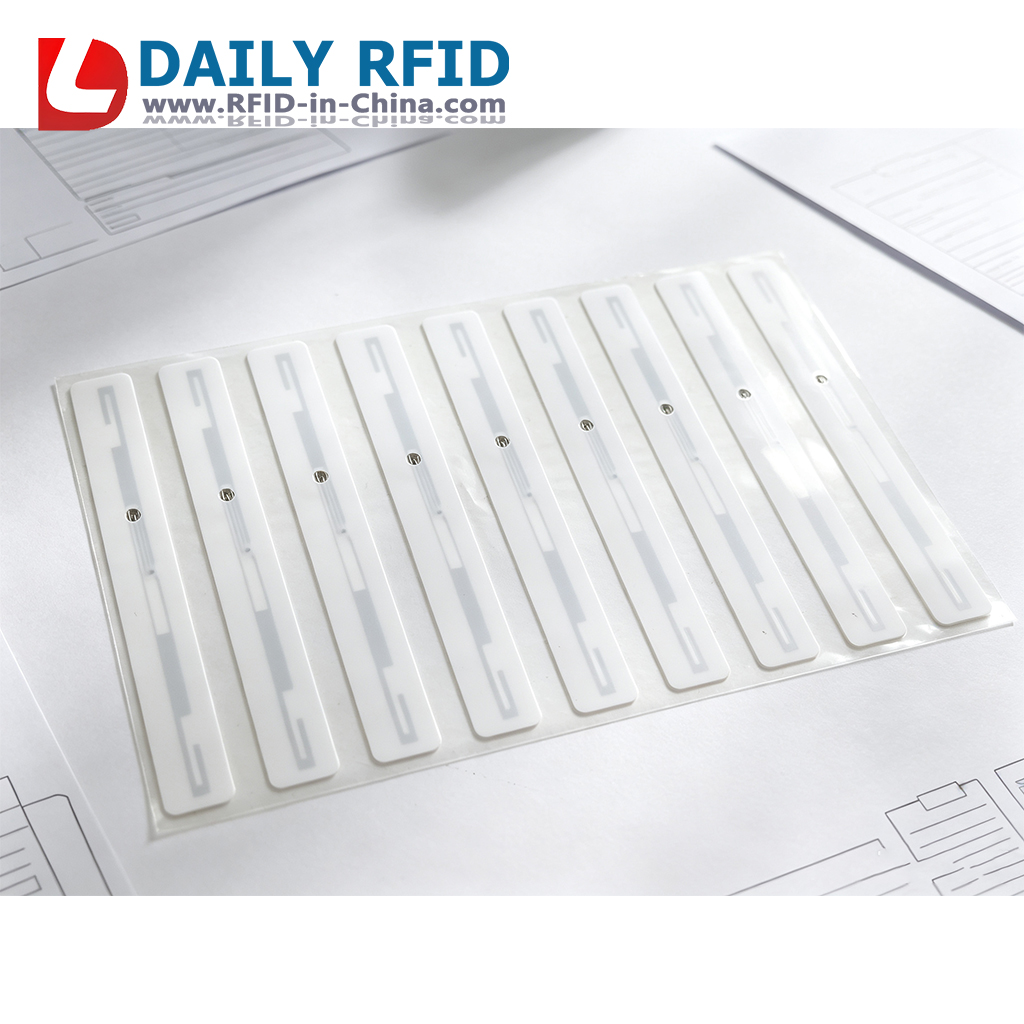
- Passive LED UHF labels. Operating across the 860–960 MHz UHF RAIN RFID band with NXP UCODE 8/9 and Impinj Monza R6-P/M730 options, these labels read in bulk at 2 m to 5 m and light a targeted LED at 1.5 m to 3.5 m. The light is powered by harvested RF energy — no battery — and the targeted anti-collision lighting protocol flashes only the designated tag among dense populations.
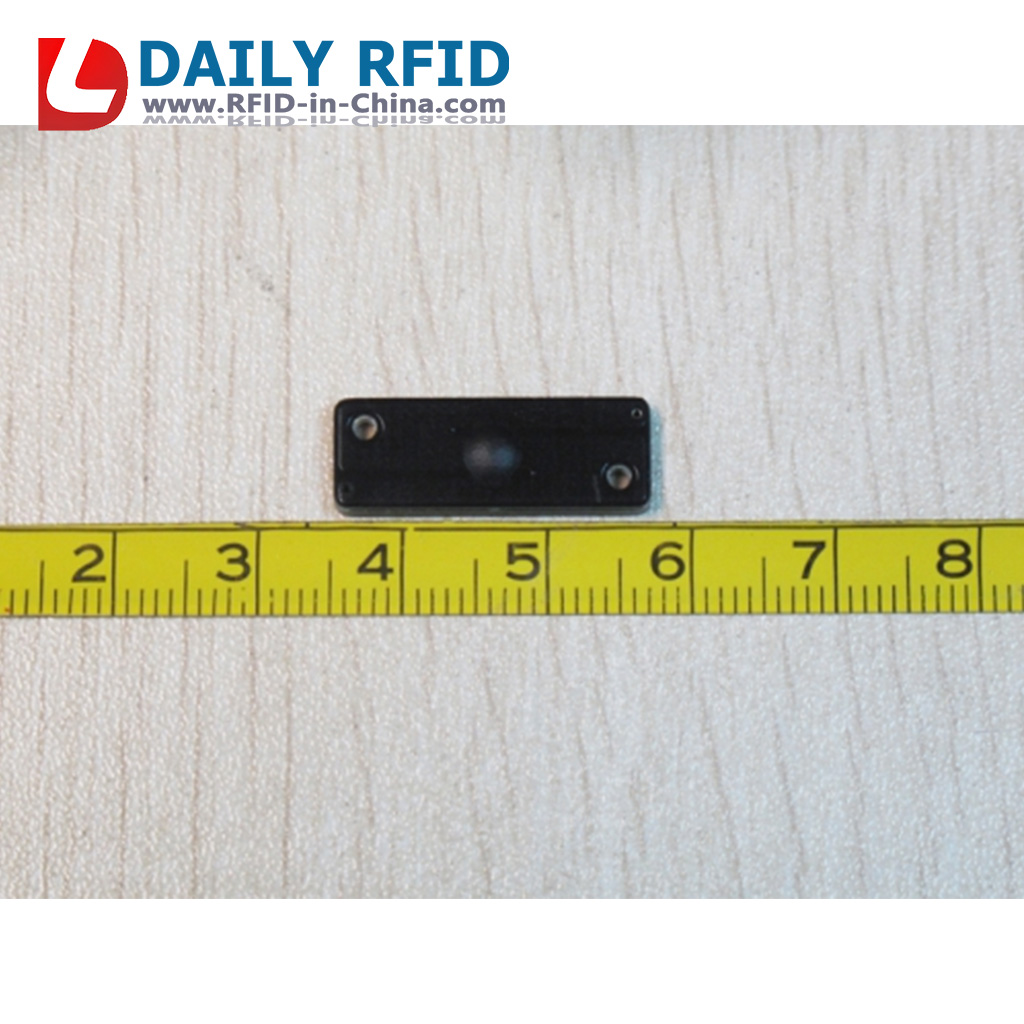
- On-metal tool and fixture tags. The RFID Tool Management Adhesive Tag states 1 m to 3.5 m on metal surfaces using a 4 W EIRP handheld reader, and up to 5 m off metal, using an integrated ferrite isolation layer to prevent the metal surface from detuning the antenna. Operating temperature is −40 °C to +85 °C.
- Laundry and textile tags. The PPS RFID Button Laundry Tag is produced in Ø15/18/20/22/26 mm diameters with two or four stitching holes, reads at 1 m to 3 m in UHF or 1 cm to 5 cm in HF/NFC, and carries a wash/dry certification (number LT100) issued by The Ritz-Carlton Guangzhou, based on 150 cycles at 80 °C wash, 90 °C dry and 162 °C press conditions.
- Tire tags. The RFID Tire Tag Gen 2 measures 80 mm × 1 mm or 68 mm × 1 mm with a stated 0.1 m to 3.5 m read distance, while the patch variant measures 118 mm × 40 mm × 3 mm with 512-bit storage and a stated 1 m to 3.5 m read distance.
- Wearables and cards. The TK4100 LF wristband reads from 5 cm to 50 cm and works while fully submerged, which is why 125 kHz suits wet, humid and high-contact environments. Dual-chip UHF + HF wristbands extend the range to 5–250 cm depending on reader and IC, with IP68 protection.
5. Environment, Protection Rating and Compliance Evidence
Environmental specifications are easy to compare and easy to over-trust. The relevant question is not whether a reader is rated IP65 or IP66 in isolation, but whether the rating applies to the mounting position you are actually using.
The DAILY RFID ranges cover IP54 (jewellery tray reader, smart cabinet component), IP64 (DL920Plus, DL6940/6960, DL228 module), IP65 (DL921 family, DL1280, DL1380) and IP66 (DL6990 ceiling reader, DL6993 tray reader, DL930 family). Operating temperature spans −30 °C to +70 °C for the DL930B/W/G and DL6940/6960 readers, and −20 °C to +60 °C for the DL921, DL1280 and DL1380 classes.
Compliance evidence should be treated as a selection parameter, not a closing document. The DAILY RFID UHF RFID Reader & Writer CE RED Certificate of Compliance (2019), certificate number DGE190109029, was issued by Dongguan NTEK Testing Technology Co., Ltd. under Directive 2014/53/EU, with a scope listing reader models including the DL920, DL930, DL9230, DL950, DL9700, DL6920E, DL6940 and DL6950 families. A separate CE EMC certificate, number ATE20180529, was issued by Shenzhen Accurate Technology Co., Ltd. for RFID Reader-02 (LF Reader-02, HF Reader-02 and Triple Reader-02) against EN 55032:2015 and EN 55024:2010+A1:2015. For the United States, the 2.4 GHz RFID active tracking system holds an FCC Supplier's Declaration of Conformity, certificate number FCSE20015006, issued by Flux Compliance Service Laboratory against FCC Part 15 Subpart B:2018 Class B.
Tag-side documentation matters as much as reader-side. The RFID Label carries RoHS 2.0 certification number SFT23040033 issued by Guangdong Safety Testing Co., Ltd., and the UHF LED Tag carries RoHS certification DGC180421014L and REACH test report DGC170511007T02, both issued by NTEK Testing Technology Co., Ltd. For the US market, the RFID Tiny Tags hold FCC Verification of Compliance number ATE20161983 002 issued by Accurate Technology Co., Ltd. (ATC), and the RFID Tiny Tag also carries RoHS 2.0 certification number AZT250710068C-E0 issued by Shenzhen AZT Technology Co., Ltd. An RFID embedded tag Certificate of Analysis (number SNTEK2026032314501) was issued by North South Precision Testing Technology Service (Shenzhen) Co., Ltd. against ISO/IEC 18000-6C, ISO/IEC 18046-3:2021, IEC 60529 and IEC 62321.
Step-by-Step: Evaluating a UHF RFID Reader for a Tag Workflow
- Inventory the tag population by frequency and material. List every tag type the reader must handle: UHF passive labels on cartons, on-metal tags on tools, HF tags on precision parts, LF wristbands at gates, and any specialised tags such as LED labels, laundry buttons or tire patches. A reader that cannot address the full list is a partial solution.
- Define the read event. Specify what triggers the read, how long the tag stays in the field, how many tags appear in a single event, and what miss rate is tolerable. The DL6940/6960 states support for up to 1,000 tags simultaneously; the DL6990 ceiling and DL921 fixed readers state up to 50; the DL6993 tray reader states 80 to 100; the DL1380 AI handheld states more than 200.
- Size the RF envelope against the worst-case tag orientation. Test with the tag mounted as it will be in production — on a curved handle, under a pallet, behind a windshield — not flat on a bench. Circular polarised antennas are the reason moving tags can be read regardless of mounting angle.
- Choose the form factor that removes human action wherever possible. Overhead coverage at kitting stations, dock-door reading lanes and tool-crib thresholds should be fixed installations. Audit, exception handling and out-of-place search should be handheld.
- Specify interface, power and SDK before signing. Confirm the reader exposes the ports your control layer uses (RS232, RJ45, GPIO, USB, Wiegand, RS485), that the power topology suits the site (PoE, DC, cellular, Wi-Fi, Bluetooth), and that the SDK covers your development stack.
- Validate with samples and file the acceptance test. Run a trial with your own tags, your own mounting and your own tag density, then record the acceptance criteria — tags read per cycle, time per cycle, miss rate and environmental conditions.
Worked Use Cases from the DAILY RFID Product Set
Room-scale kitting and staging verification. A ceiling-mounted reader covers a staging area without floor clutter. The DL6990 provides 33 dBm through an integrated high-gain antenna with a stated 0.1 m to 5 m overhead envelope, IP66 protection, 12 W consumption and support for up to 50 tags per read cycle — enough for a kitting zone where carts pass beneath a fixed point.
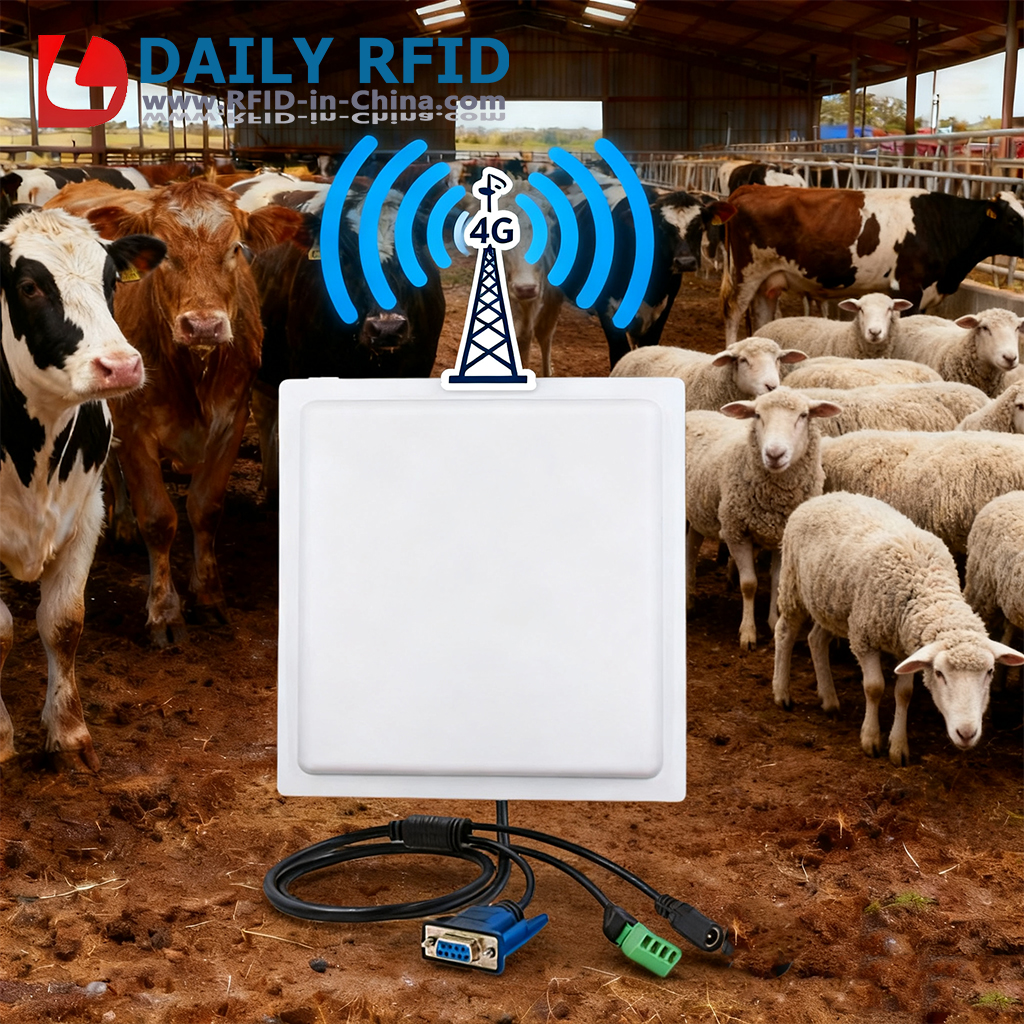
Dock-door and lane verification. The DL921 PoE variant supplies power and network over a single Ethernet cable with RS232, RJ45 and GPIO trigger/relay ports, and reads moving tags at a stated 0.1 m to 15 m through a circular polarised antenna — the orientation-insensitive behaviour needed when forklifts and vehicles pass at speed. Where no network cabling exists, the GSM variant substitutes an integrated 2G/4G cellular module for the same reading envelope.
Line-side component flow at high density. An assembly line with dense tag populations needs anti-collision headroom more than raw range. The DL6940/6960 AI multi-antenna reader states support for up to 1,000 simultaneous tags across four external TNC/SMA antenna ports, with a 25 m to 30 m range, 5 W consumption, IP64 protection and RS232, RJ45, USB and RS485 interfaces — the profile of a line-side checkpoint that feeds an MES or PLC event stream.
Tool and fixture accountability. Tools are metal, so the tag must first be selected for metal. With an anti-metal tool tag, a 4 W EIRP handheld read gives a stated 1 m to 3.5 m on metal, while off-metal assets can be captured at up to 5 m with the same reader. The DL1280 handheld reads up to 100 tags simultaneously with multi-tag processing above 100 tags per second, which keeps a tool-crib audit to a walk-through rather than a checklist.
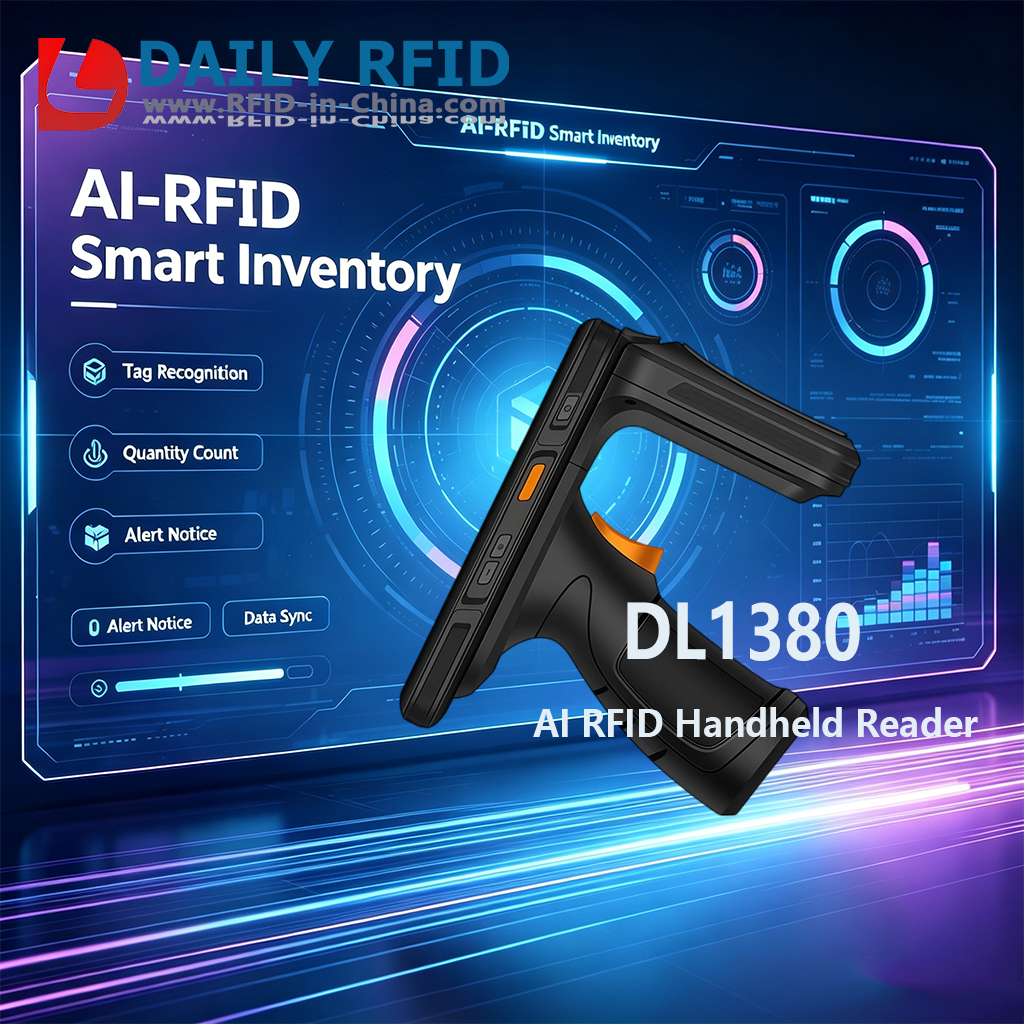
Dense rack and pallet audit. In high-bay storage, duplicate reads and interference waste time. The DL1380 applies edge AI filtering with RSSI-based distance calculation to isolate the target item in stacked goods, supports more than 200 tags simultaneously, verifies an average single tag in under 10 ms, and carries IP65 protection with 1.5 m drop resistance. Its dual battery system — a 3.8 V 4500 mAh host battery plus a 3.6 V 6700 mAh grip battery — is specified for extended shift work.
Embedded identification at short range. Where a reader must live inside equipment, the DL213 Type-C module fits a 45 mm × 30 mm × 6 mm envelope with 23 dBm output over 0.1 cm to 10 cm and up to five tags per read, while the DL228 mobile reader uses 12 dBm in a 66 mm × 39 mm × 8 mm housing with IP64 protection — suitable for cabinet integration, workstation verification and short-range fixture reads.
Personnel, access and wearable layers. Not every tag workflow in a plant is about parts. LF wristbands at 125 kHz read from 5 cm to 50 cm and tolerate full submersion, dual-chip UHF + HF wristbands combine long-range identification with short-range payment or access, and the company's annual production capacity includes 30 million RFID cards and 50 million RFID tags per year, which matters when a plant-wide rollout needs a single supply source for readers, wristbands and cards.
Reader Class Comparison for Smart Manufacturing
| Reader class | Transmit power and antenna | Stated read range | Tags per read cycle | Protection and temperature | Interfaces and typical fit |
|---|---|---|---|---|---|
| DL921 PoE fixed reader (450 × 450 × 70 mm, 4.5 kg) | 26 dBm, built-in circular polarised antenna | 0.1 m – 15 m | Up to 50 | IP65; −20 °C to +60 °C | PoE or DC 9–24 V; RS232, RJ45, GPIO trigger/relay; dock doors and lanes |
| DL921 GSM fixed reader | 26 dBm, built-in circular polarised antenna | 0.1 m – 15 m | Up to 50 | IP65; −20 °C to +60 °C | Integrated 2G/4G GSM module; RS232, GPIO; open yards without cabling |
| DL6990 ceiling reader (180 × 180 × 28 mm, 1.5 kg) | 33 dBm, integrated high-gain antenna | 0.1 m – 5 m overhead | Up to 50 | IP66; −20 °C to +60 °C | DC 12–24 V; RS232, RJ45 optional; room-scale and kitting zones |
| DL930B / W / G fixed reader | 20–30 dBm software adjustable, integrated antenna | 4 m – 8 m | Multi-tag via protocol standard | IP65/IP66; −30 °C to +70 °C | RS232, RJ45, GPIO, USB, Wiegand 26/34; Bluetooth, Wi-Fi or GPRS variants |
| DL920Plus fixed reader | 30 dBm adjustable, integrated antenna | 8 m – 15 m | Supported via protocol | IP64; −30 °C to +70 °C | Integrated Wi-Fi; RJ45, RS232, RS485, USB, Wiegand; flexible layouts |
| DL1280 industrial PDA handheld | 30–33 dBm, circular polarised antenna | UHF 0.1–20 m; HF 0.1–32 cm; LF 0.1–10 cm | Up to 100; over 100 tags/s | IP65; −20 °C to +60 °C | Wi-Fi 2.4+5 GHz, 4G, Bluetooth 5.0, GNSS; Android 12 |
| DL1380 AI-powered handheld | 33 dBm software adjustable, circular polarised antenna | UHF 0.1 m – 20 m | More than 200 | IP65, 1.5 m drop resistance; −20 °C to +60 °C | 2G–5G cellular, dual-band Wi-Fi, Bluetooth 5.0, GNSS; dense audit |
| DL6940 / 6960 multi-antenna reader | Adaptive power, four external TNC/SMA antenna ports | 25 m – 30 m | Up to 1,000 | IP64; −30 °C to +70 °C | RS232, RJ45, GPIO, RS485, USB; 5 W; line-side and multi-zone coverage |
| DL213 / DL228 Type-C modules | 23 dBm (DL213) and 12 dBm (DL228), integrated antenna | 0.1 cm – 10 cm | Up to 5 | DL228 IP64; DL213 desktop envelope | USB Type-C; embedded terminals, cabinets and fixtures |
| DL6993 tray reader (400 × 300 × 35 mm) | 33 dBm, integrated flat-panel antenna | 0.1 m – 5 m | 80 to 100 | IP66; −20 °C to +60 °C | RS232, RJ45, USB, GPIO; counter-side batch reads |
All figures above are the published parameters of the listed DAILY RFID products. Stated read ranges are tag- and environment-dependent, and should be re-verified with production tags and mounting before acceptance.
Compliance Evidence Checklist for Procurement
- Match the certificate scope to the exact SKU. The CE RED certificate DGE190109029 names specific reader models; confirm the model number on your purchase order appears in that list.
- Check the directive and standard mapping. The RED certificate references Directive 2014/53/EU together with EN 301 489-1 V2.2.0:2017-03, EN 301 489-3 V3.1.1:2017-02, EN 300 220-1 V3.1.1:2017-02 and EN 300 220-2 V3.2.1:2018-06.
- Separate radio compliance from EMC compliance. CE EMC certificate ATE20180529 covers RFID Reader-02 models against EN 55032:2015 and EN 55024:2010+A1:2015 — a different document from the RED certificate.
- Confirm market-specific filings. For the US, the FCC Supplier's Declaration of Conformity FCSE20015006 cites FCC Part 15 Subpart B:2018 Class B, ANSI C63.4-2014 and CISPR PUB.22.
- Do not stop at the reader. Tag-level RoHS 2.0 (SFT23040033, DGC180421014L, AZT250710068C-E0), REACH (DGC170511007T02) and Certificate of Analysis (SNTEK2026032314501) evidence complete the file for regulated buyers.
- Re-check validity at purchase. Compliance documents are issued on a specific date; request the current revision rather than relying on a copy from an earlier project.
FAQ: UHF RFID Reader Selection and Certification
Which CE-certified UHF RFID reader families can be sourced for an EU smart manufacturing project?
DAILY RFID holds a UHF RFID Reader & Writer CE RED Certificate of Compliance (2019), certificate number DGE190109029, issued by Dongguan NTEK Testing Technology Co., Ltd. under Directive 2014/53/EU. The certificate scope lists reader models including the DL920, DL930, DL9230, DL950, DL9700, DL6920E, DL6940 and DL6950 families. A separate CE EMC certificate, number ATE20180529, was issued by Shenzhen Accurate Technology Co., Ltd. for RFID Reader-02 (LF Reader-02, HF Reader-02, Triple Reader-02) against EN 55032:2015 and EN 55024:2010+A1:2015. For US deployments, the 2.4 GHz RFID active tracking system holds FCC Supplier's Declaration of Conformity number FCSE20015006 against FCC Part 15 Subpart B:2018 Class B. Always confirm that the certificate scope names the exact model you are purchasing.
How much transmit power and how many antennas does a smart manufacturing read point actually need?
Power and antenna count solve different problems, so specify them separately. Antenna configuration defines the zone: a single integrated circular polarised antenna suits a lane or door, while four external TNC/SMA ports on the DL6940/6960 allow a larger area to be split into zones with a stated 25 m to 30 m range and support for up to 1,000 simultaneous tags. Power defines margin: the DL921 fixed reader runs 26 dBm for a stated 0.1 m to 15 m envelope, the DL930B is adjustable from 20 dBm to 30 dBm for a stated 4 m to 8 m range, the DL6990 ceiling reader runs 33 dBm for a stated 0.1 m to 5 m overhead envelope, and embedded modules are deliberately lower — 23 dBm on the DL213 and 12 dBm on the DL228, both over 0.1 cm to 10 cm. Set antenna geometry first, then add power only if the worst-case tag orientation still fails.
What changes when tags are mounted on metal or read in dense batches?
Metal and density are the two conditions that most often invalidate a bench test. Metal detunes a tag antenna unless the tag is built for it: the RFID Tool Management Adhesive Tag uses an integrated electromagnetic ferrite isolation layer and states 1 m to 3.5 m on metal surfaces with a 4 W EIRP handheld reader, versus up to 5 m off metal, across −40 °C to +85 °C. Density changes the reader requirement instead: the DL6940/6960 states support for up to 1,000 simultaneous tags, the DL6993 tray reader states 80 to 100, the self-checkout reader states 80 to 100, the DL921 and DL6990 state up to 50, and the DL1380 AI handheld states more than 200 with AI-driven tag sorting. Select the tag for the material, then select the reader for the density at the read point.
What drives project cost, and how should minimum order quantity and lead time be budgeted?
Cost in a reader project is driven less by the unit than by configuration and integration scope: antenna port count, enclosure protection class, wireless or cellular options, SDK integration work and the compliance documents a buyer must file. Planning data is available from DAILY RFID's published capability set. UHF fixed readers are offered under OEM/ODM with a minimum order quantity of 1 unit, a lead time of 15 to 45 days and factory acceptance testing as the quality gate; UHF handheld readers also carry a minimum order quantity of 1 unit with a 15 to 30 day lead time and full system burn-in; anti-metal RFID tags carry a minimum order quantity of 50 units with a 7 to 15 day lead time and 100% signal testing. Annual production capacity is stated at 50 million RFID tags, 30 million RFID cards and 100,000 RFID reader units per year, which is relevant when a rollout spans multiple sites.
How should a sample evaluation be run, and what is the next step?
Run the sample as a controlled experiment, not a demonstration. Use your own tags with your own mounting, reproduce the real tag density and trigger conditions, and record tags read per cycle, time per cycle and miss rate against an agreed acceptance threshold. Single-unit order quantities on fixed and handheld readers make a one-site pilot practical, and both the DL1280 and DL1380 ship with Android SDKs including sample code and demonstration applications, so integration effort can be assessed in parallel with the physical test. The next step is to send your workflow description — tag types, read point, density, environment and target market — to the DAILY RFID team at sales@rfid-in-china.com or via WhatsApp at +86 15817191372, and request a sample or quotation matched to that specification, plus the current compliance pack for the models under consideration.
Conclusion and Next Step
Reader selection for smart manufacturing succeeds when the tag comes first. Fix the tag population by frequency and material, define the read event and the density at that read point, then size form factor, antenna configuration, transmit power, interface and power path against the worst case you can actually reproduce. Treat protection rating, operating temperature and certificate scope as selection criteria rather than closing paperwork, and verify that the model number on the purchase order matches the model number on the certificate.
DAILY RFID CO., LIMITED was founded in 2008 and manufactures RFID tags, readers, antennas, cards, chips and labels from a 28,000 m² facility in Guangzhou, China, with 180–200 employees, a 38-engineer R&D team and an export share of approximately 80% across EU and USA markets. Readers, wristbands and cards can be sourced from one manufacturer, which simplifies a multi-site rollout.
Review the full product and capability overview in the company profile, then request a sample or quotation: DAILY RFID company profile (PDF) · www.rfid-in-china.com · WhatsApp: +86 15817191372 · Email: sales@rfid-in-china.com · Mail: rfid8168@vip.163.com.
Have Questions or Need More Details?
Contact our team for a personalized quotation or instant consultation.
Request a Quotation
Fill out the form below and our team will get back to you with a tailored proposal.
WhatsApp Direct Chat
Prefer to chat in real-time? Message us on WhatsApp for instant assistance & quick answers.
- Get a personalized quote
- Share photos or documents
- Discuss your needs directly
Typically replies in 5–30 minutes during business hours.