
RFID Fixed Reader vs Handheld Reader vs Tray Reader: Which UHF Setup Fits Your Smart Factory?
RFID Fixed Reader vs Handheld Reader vs Tray Reader: Which UHF Setup Fits Your Smart Factory?
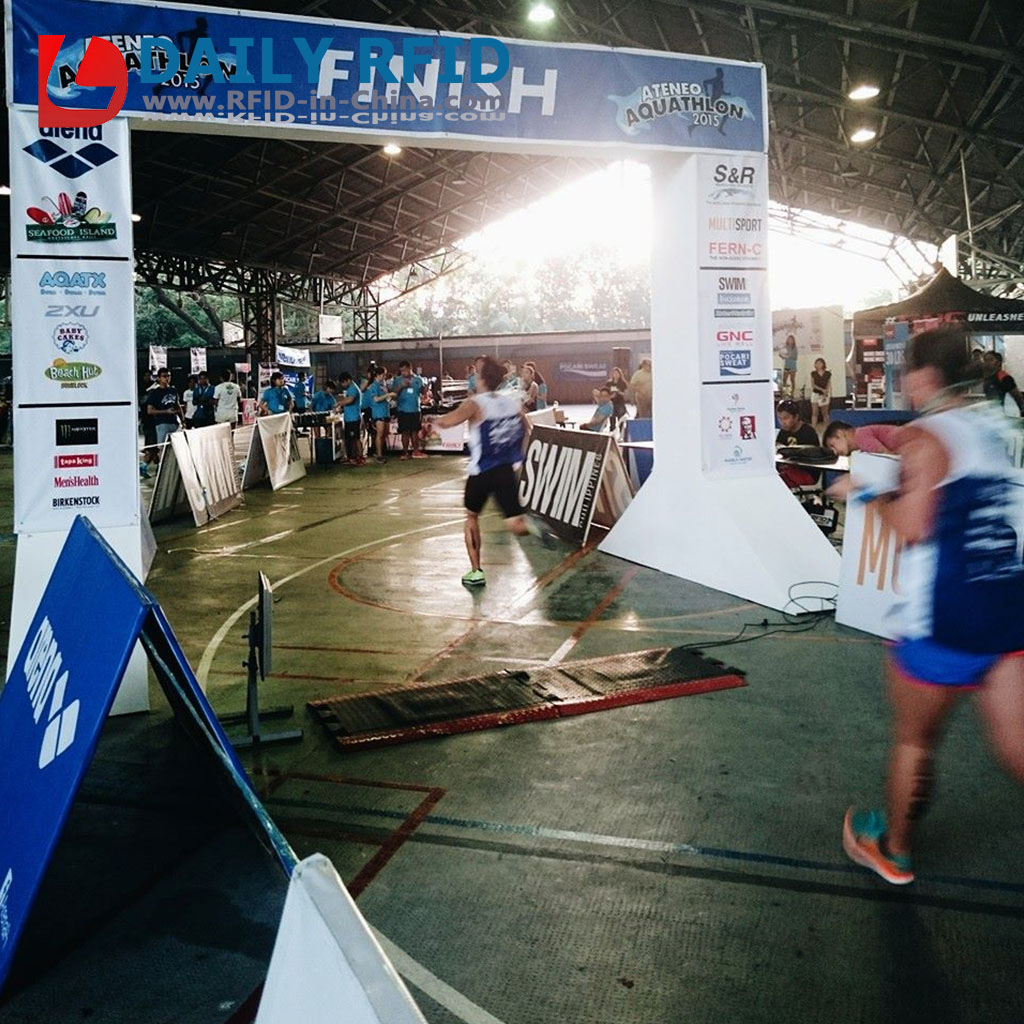
Cover: DL921 Power over Ethernet UHF long range RFID reader — one of the three read geometries compared in this guide.
A smart factory almost never runs on a single type of UHF RFID reader. The workable answer to "fixed reader, handheld reader, or tray reader?" is usually "all three — at different process steps." Fixed readers and RFID gates own the automated read points where parts, pallets or people pass without stopping. Handheld readers own mobile exception handling: cycle counts, misplaced tool searches, unplanned verification. Tray readers own the workstation, where small, high-value items are counted in place.
Because all three typically run on the same UHF air interface — ISO/IEC 18000-6C, also known as EPCglobal Gen2 — the decision is not about which form factor is technically superior. It is about matching read geometry to process step. This guide compares the three setups, shows how each interacts with tag formats such as RFID Tool Tags, RFID Wristbands and hang-tag labels, and gives a selection workflow that smart-manufacturing buyers can run before requesting samples.
Problem Definition: The Real Question Is Which Read Event You Are Buying For
Most reader-selection problems start as a product question — "should we buy fixed or handheld?" — and that framing hides the actual decision. A reader is only useful if it fires at the right moment in the process, captures the right object, and produces data your ERP, MES or WMS can act on.
Three recurring failure patterns show why a single form factor rarely covers a plant:
- Handheld-only deployments fail on throughput. Portable readers are excellent at exceptions, but every read costs labour. As volume grows, so does the headcount required to scan.
- Fixed-only deployments fail on exceptions. A reader mounted over a conveyor or a gate identifies what passes through its field. It cannot walk to a mezzanine, a service yard or a tool crib to find the one asset that never showed up.
- Tray-only deployments fail on movement. Tray readers identify items counted in place at a bench or counter. They do not follow an item between workstations.
The practical reframe is to list read events first: which object, at which step, how often, with what tolerance for a missed read, and who acts on the result. The form factor then follows almost automatically — and so does the tag format, because a reader that cannot hear its tag is an expensive placeholder.
Industry Background: Why UHF Became the Default Layer in Smart Manufacturing
UHF is now the largest single technology block in the RFID market. UHF RFID captured 40.72% of total RFID market revenue in 2025, driven by retail inventory cycles and multi-item read capability (Mordor Intelligence). The same multi-item, no-line-of-sight behaviour is what makes UHF attractive on a shop floor.
Standardisation is what makes mixed deployments safe. UHF RFID readers are standardised globally under the EPCglobal Gen2 protocol, also known as ISO/IEC 18000-6C (GS1 / ISO). A factory can therefore deploy fixed, handheld and tray UHF readers against one tag population, one numbering scheme and one middleware layer.
Market forecasts should be read with care. The global UHF RFID reader market was valued at approximately USD 4.8 billion in 2025 and is projected to reach USD 11.2 billion by 2034 (Dataintelo). Other analysts scope the same market far more narrowly, so the useful signal is the direction of travel rather than any single number. Regionally, Asia Pacific is the fastest-growing area for UHF RFID hardware, with an expected CAGR of 11.8% in shipments through 2031 (ABI Research), while the Americas still account for over 60% of global UHF tag usage as of 2025 (IDTechEx).
Reader form factors are also diversifying. Beyond fixed, handheld and tray hardware, the market for "drones-as-a-service" using RFID for inventory collection is estimated to reach USD 8.2 billion by 2026 (PR Newswire) — a reminder that mobile and automated reading platforms keep expanding the set of possible read points.
For a manufacturing buyer the practical consequence is availability. UHF readers, antennas, modules and tags are a mature, multi-supplier market, so competitive advantage shifts to how well the selected hardware matches your process rather than to whether the technology is ready.
Detailed Solution: How Fixed, Handheld and Tray Readers Actually Differ
1. Fixed readers and RFID gates — the automated read points
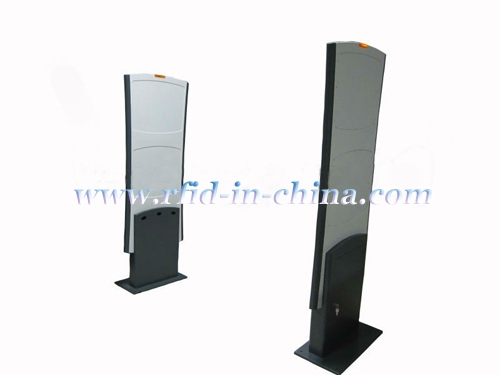
DL8330U Advanced UHF RFID Gater with four built-in TX/RX antennas and a 4–7 m walk-through channel.
Fixed readers are permanently installed devices that identify tags as objects move through a defined zone. In the DAILY RFID range, the DL921 Power on Ethernet UHF Long Range RFID Reader is a representative example: ISO18000-6C / EPC Class 1 Gen 2 and ISO18000-6B support, a 0.1–15 m reading range, up to 50 tags read simultaneously, an average single-tag read time of less than 10 ms per 64 bits, a built-in circularly polarised antenna, IP65 protection, and PoE single-cable power plus network over one Ethernet cable. Operating temperature is -20°C to +60°C, with RS232, RJ45, and GPIO trigger and relay ports, plus a customizable USB configuration.
Where read density is higher, a multi-antenna reader changes the coverage economics. The DL6940/DL6960 AI multi-antenna 4-port UHF reader supports four external TNC/SMA antenna ports, a reading range up to 25–30 m, and simultaneous reads of up to 1,000 tags — useful for wide dock doors, long conveyor runs and assembly bays that a single integrated reader cannot cover.
A step beyond the site reader is the walk-through portal. The DL8330U Advanced UHF RFID Gater uses four built-in TX/RX antennas distributed across a main and an auxiliary panel, a 4–7 m channel width, 30 dBm adjustable transmit power, ISO18000-6C and ISO18000-6B compatibility, and RS232, RJ45 and GPIO interfaces, with optional infrared direction sensing to distinguish entry from exit. Each main panel measures 170 cm × 60 cm × 15 cm, weighs 40 kg, and draws approximately 35.2 W at AC 220 V.
Fixed hardware also comes with alternative backhauls where cabling is the constraint. The DL920Plus WiFi RFID Reader integrates a WiFi module with an 8–15 m reading range, software-adjustable 20–30 dBm power and IP64 protection, while the DL930B Bluetooth UHF reader offers a 4–8 m range for semi-fixed placement and wireless synchronisation with phones and tablets.
What this means for a buyer: a fixed reader removes labour from the read event, but shifts the engineering burden onto installation. Mounting height, antenna selection, read-zone shaping and exception handling become the design questions — not read speed.
2. Handheld readers — mobile exception handling
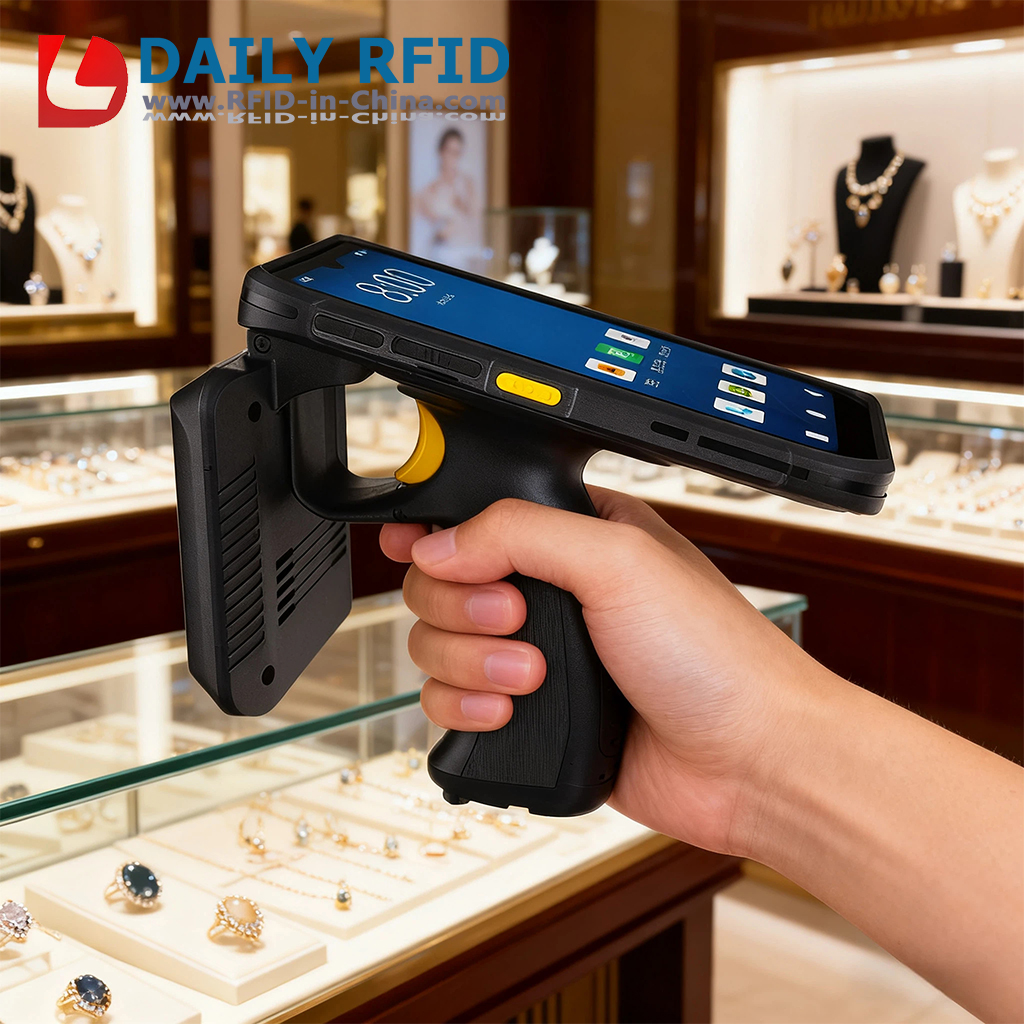
Handheld UHF reader: the flexible read geometry for exceptions, cycle counts and off-line areas.
Handheld readers exist because real factories are not fully instrumented. Something is always outside the read zone: a tool left on a bench, a pallet in the wrong lane, a contractor's equipment, a late delivery.
The DL1280 Industrial PDA UHF/HF/LF Handheld Reader is a tri-frequency terminal: UHF at 860–960 MHz on ISO18000-6C, HF at 13.56 MHz on ISO15693 and LF at 125 kHz. Its UHF reading range reaches up to 20 m, it reads up to 100 tags simultaneously, and it processes more than 100 tags per second. It runs Android 12 on an eight-core 2.0 GHz processor with 4 GB RAM and 64 GB ROM, carries a 4,500 mAh host battery plus a 6,700 mAh handle battery, weighs 680 g with the pistol grip, and is rated IP65 for -20°C to +60°C operation. Wireless options include dual-band Wi-Fi, 4G, Bluetooth 5.0 and GNSS.
For close-range work on small items, a dedicated HF handheld can be a better fit than a UHF gun. The DL995/DL996 handheld reader works at 13.56 MHz under ISO/IEC 15693 and ISO 18000-3M1, reaches up to 40 cm depending on tag specification, processes more than 50 tags per second in standard conditions, and can store up to 80,000 tag records offline for later synchronisation.
The trade-off is explicit. A handheld converts capital cost into operating cost: every additional cycle count consumes operator hours. That is acceptable for exception handling and audits, but it becomes a bottleneck when it is the primary read method for high-volume flows.
3. Tray readers — workstation-level identification
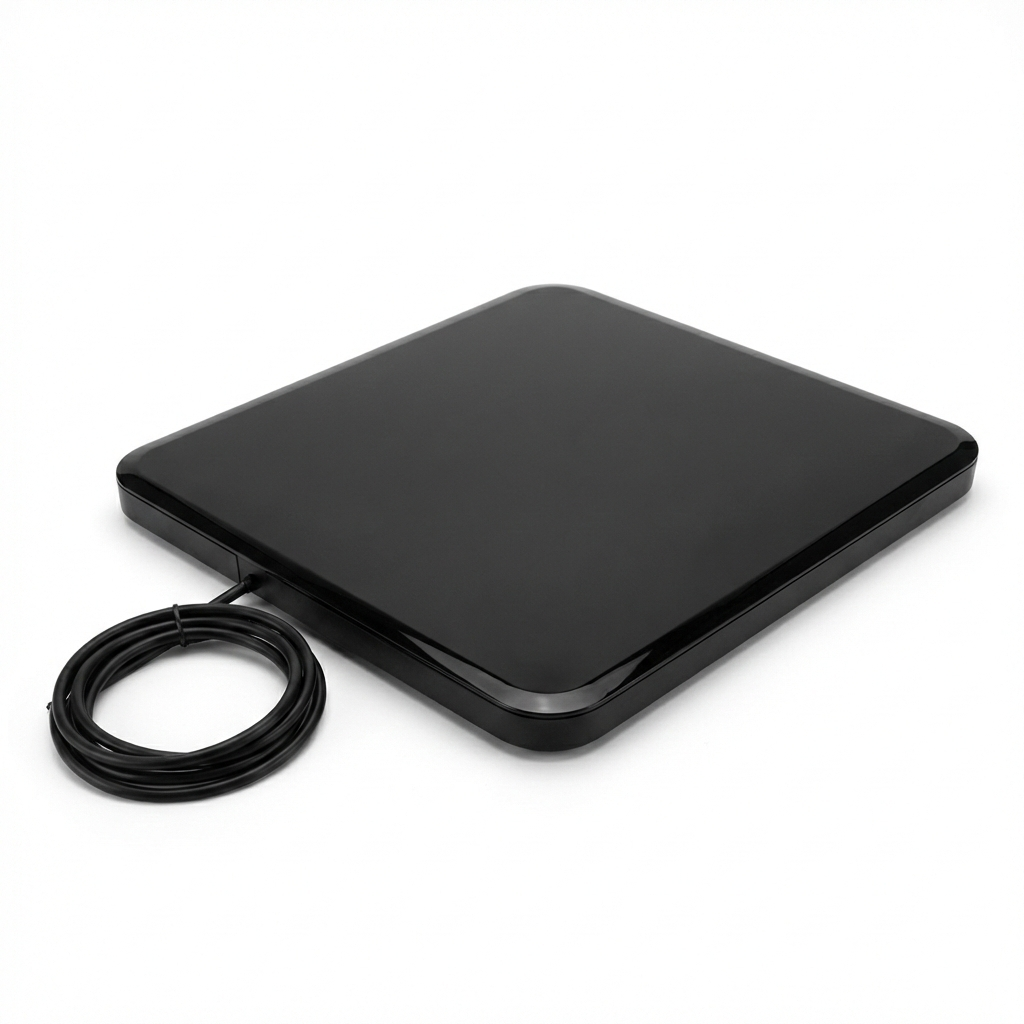
DL6993 UHF RFID tray reader: 80–100 tags read in place with an integrated flat-panel antenna and IP66 protection.
Tray readers sit under or inside a work surface. Instead of asking an operator to scan anything, they identify tagged items placed on the tray — the read happens as a by-product of the work.
The DL6993 RFID Tray Reader is a UHF device: ISO18000-6C / EPC Class 1 Gen 2, ISM 860–868 / 902–928 / 920–925 MHz with frequency customisation, 33 dBm maximum transmit power, an integrated flat-panel antenna, a 0.1–5 m reading range, and simultaneous reads of 80–100 tags with an average single-tag read time below 10 ms per 64 bits. It measures 400 mm × 300 mm × 35 mm, weighs 1,500 g, is rated IP66, and provides RS232, RJ45, GPIO and USB interfaces with an optional wireless module.
For OEMs building identification into their own equipment, an embedded module is a third route. The DL213 Type-C UHF reader module measures 45 mm × 30 mm × 6 mm, reads at 0.1–10 cm, handles up to five tags simultaneously and can emulate a USB keyboard, so tag data can be typed straight into an existing application field without custom software.
4. How tag format changes the answer
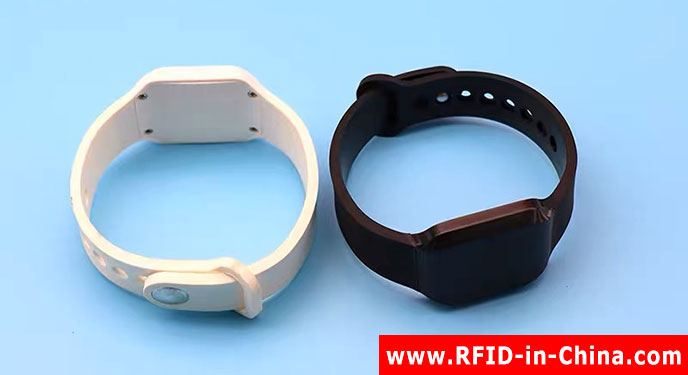
UHF RFID reusable wristband: where the tracked object is a person, not a part.
The reader decision only works if the tag survives the object it is attached to. Three tag families show how the interaction plays out.
RFID Tool Tag. DAILY RFID's tool management adhesive tag is built for metal surfaces: an integrated electromagnetic ferrite isolation layer prevents the metal from detuning the antenna. On metal it reads at 1–3.5 m using a 4 W EIRP handheld reader, and up to 5 m off metal. Standard sizes run from 25 mm × 9 mm to 50 mm × 10 mm, with 1.2–1.5 mm on-metal variants, an operating range of -40°C to +85°C and a 3M industrial structural adhesive backing. In practice, hardened on-metal tool tags pair well with handheld readers and overhead fixed readers — but a low-power tray reader is the wrong instrument for them.
RFID Wristband. Where the tracked object is a person — a worker, a visitor, an event attendee — a dual-chip wristband such as the UHF H3 + HF Mifare 1K model covers both long-range and tap scenarios. It operates on UHF 860–960 MHz and HF 13.56 MHz (with LF options), reads at up to 5–250 cm depending on reader and IC, is IP68 rated and supports 100,000 read/write cycles. Gate readers handle the long-range identification; a tray or desktop reader handles the tap.
RFID Hang Tag. Small high-value items need small tags. DAILY RFID's jewellery management kit ships multiple tag formats including tail tags, loop tags and anti-tamper labels, and a UHF jewellery tag measures 36 mm × 15 mm at 0.86 mm thick with a reading distance up to 50 cm. The same principle applies in a smart factory: gauges, jigs, dies and calibration fixtures benefit from hang-tag or thin-label formats that can be read on a tray but are too small for reliable long-range site reading.
RFID Card. Card-format tags remain practical for tool-crib checkout and personnel access; DAILY RFID manufactures UHF RFID cards with customisable chip, material and printing, with a 100-unit minimum order quantity and a 7–20 day lead time.
Step-by-Step Breakdown: Selecting a UHF Setup in Seven Steps
- List read events, not devices. For each process step, record the object, the read frequency, the acceptable miss rate, and the action the read triggers.
- Classify the object and its surface. Metal, liquid, fabric and human bodies all change read performance. Anti-metal constructions exist for tools, wristbands exist for people, thin labels exist for small items.
- Match geometry to the event. A stop-free flow point (dock door, conveyor, gate) is a fixed-reader or gate application. An unpredictable location is a handheld application. An in-place count at a bench is a tray application.
- Check batch density and speed against peak flow, not average flow. Reference capacities: 50 tags for the DL921 fixed reader, up to 1,000 tags for the DL6940/6960 multi-antenna reader, 100 tags for the DL1280 handheld, 80–100 tags for the DL6993 UHF tray. In a German automotive manufacturing deployment, a fixed reader with an antenna array tracked production-line parts at more than 400 tags per second while streaming data to the MES.
- Verify protection and temperature. In this range, fixed and handheld hardware is typically IP65, the DL6993 UHF tray is IP66, the DL920Plus is IP64, and on-metal tool tags operate from -40°C to +85°C. Cold rooms, wash-down areas and outdoor yards should be checked against the actual datasheet rather than assumed.
- Confirm integration before hardware. PoE simplifies fixed cabling; RS232, RJ45, GPIO, USB and Wiegand determine how the reader talks to a PLC, MES, WMS or access controller. SDK availability matters if your team must write the middleware.
- Pilot, then decide what to customise. Run a small pilot at the highest-risk read point first. Only afterwards should you discuss antenna layout, interface configuration or housing changes — those are ODM/OEM decisions, and they are cheaper to make once the read-rate assumptions are validated.
Use Cases: How Mixed Deployments Look in Practice
Fixed reader plus handheld for plant-wide asset management
In a general asset management deployment in Nigeria, a DAILY RFID configuration combined the DL6960 fixed reader, DL1280 handheld readers and UHF asset tags to centralise equipment records, improving asset visibility to more than 95%. The pattern is typical: the fixed reader captures what crosses a controlled point, and the handheld resolves everything else during scheduled checks.
Fixed readers on high-speed assembly and conveyor lines
In German automotive manufacturing, a UHF fixed reader paired with an antenna array tracked production-line parts in real time — more than 400 tags per second, under metal-part, high-speed flow conditions — with data streamed into the MES. In a distribution-centre deployment in Poland, fixed UHF readers were applied to conveyor-line parcel reading, carton routing and outbound shipment verification, where sorting mistakes fell by 30%–60% and outbound verification became 40%–70% faster.
Fixed reader for heavy equipment utilisation
A heavy-machinery tracking application in France used a DL930 UHF fixed reader with customised equipment tags to record usage hours, improving utilisation reporting accuracy to over 95% in dusty, high-vibration conditions with an IP68 requirement.
Tray readers at the workstation
In jewellery retail in France, tray-based reading made daily tray checks 5–10 times faster and cut manual recounts by 40%–70%. The same hardware logic applies on a factory floor wherever small, high-value items are staged at a bench — calibration tools, dies, small components or medical-grade instruments. In healthcare asset projects, tray readers combined with handhelds have been used for high-value instrument and consumable checks, where search time fell by 50%–80%.
Handheld Bluetooth readers for field and perimeter work
A field-service and utilities deployment equipped teams with Bluetooth handheld readers for on-site asset inspection, meter tag scanning and mobile maintenance confirmation. Inspections were completed 40%–70% faster and manual entry errors dropped 30%–60% — a reminder that a handheld's value is often in data quality, not only in tag reading.
Comparison Table: Fixed vs Gate vs Handheld vs Tray
| Form factor / example hardware | Typical read range | Simultaneous tags | Protection & temperature | Best-fit process step | Buyer trade-off |
|---|---|---|---|---|---|
| Fixed site reader — DL921 PoE UHF Long Range Reader | 0.1–15 m | Up to 50 | IP65; -20°C to +60°C | Dock doors, conveyor runs, assembly checkpoints | No labour per read; requires PoE/network and careful mounting |
| Multi-antenna fixed reader — DL6940/DL6960 (4-port) | Up to 25–30 m | Up to 1,000 | IP64; -30°C to +70°C | Wide dock doors, long lines, large bays | Highest coverage per device; requires antenna engineering |
| Walk-through portal — DL8330U UHF Gater | 4–7 m channel width | Optimised anti-collision for dense mass flow | Not explicitly specified; high-reliability industrial design | Access portals, entry/exit tracking, mass flow | Automates portals and counting; fixed footprint and dedicated power (AC 220 V) |
| Handheld PDA — DL1280 (UHF/HF/LF) | UHF 0.1–20 m; HF 0.1–32 cm; LF 0.1–10 cm | Up to 100 (over 100 tags/second) | IP65; -20°C to +60°C | Cycle counts, exception handling, yards, tool search | Maximum flexibility; labour cost scales with volume |
| HF handheld — DL995/DL996 | Up to 40 cm | 50+ tags per second | Not explicitly specified for handheld use | Small-item counts, archives, jewellery, close-range checks | Reads HF tags only; requires proximity |
| UHF tray reader — DL6993 | 0.1–5 m | 80–100 | IP66; -20°C to +60°C | Workstations, counters, instrument trays | Zero-touch counting in place; UHF tags only |
| HF tray reader — DL4130H | 1–50 cm | Up to 50 | IP54 (indoor counters) | Close-range benches and display counters | HF tags only — will not read UHF tags |
The second table converts the same facts into a deployment rule set, which is usually the fastest way to align operations and IT in one meeting.
| Process step | Recommended form factor | Typical tag format |
|---|---|---|
| Inbound receiving / dock door | Fixed reader or gate | Pallet and carton labels, on-metal tags for returnable containers |
| Conveyor and sorting | Fixed reader with external antenna ports | Carton or parcel labels |
| Assembly confirmation | Overhead fixed reader or antenna array | Workpiece and component tags |
| Tool crib issue and return | Tray reader at the counter, handheld for search | On-metal RFID Tool Tag |
| Small high-value items at a bench | Tray reader | Hang-tag, tail-tag or thin-label format |
| Cycle count and audit | Handheld reader | Any UHF tag already deployed |
| Personnel, visitor or contractor movement | Gate reader (with optional direction sensing) | RFID Wristband or RFID Card |
FAQ: Choosing a UHF RFID Reader for a Smart Factory
Does the frequency band or protocol differ between fixed, handheld and tray UHF readers?
No. UHF RFID readers are standardised globally under the EPCglobal Gen2 protocol, also known as ISO/IEC 18000-6C (GS1 / ISO), and DAILY RFID's fixed (DL921), gate (DL8330U), handheld (DL1280) and tray (DL6993) UHF readers all operate on ISO18000-6C / EPC Class 1 Gen 2. What differs is the regional frequency configuration: these readers support ISM 860–868 MHz, 902–928 MHz or 920–925 MHz, with frequency customisation available on models such as the DL921 and DL6993. Band selection is a market-compliance decision, not a form-factor decision.
UHF RFID reader for smart factory — how do I choose between fixed, handheld and tray?
Choose by read event. Use a fixed reader or RFID gate where the object moves through a controlled point without stopping and no operator should be involved — the DL921 covers 0.1–15 m with up to 50 tags, while the DL6940/DL6960 adds four antenna ports and up to a 25–30 m range for large zones. Use a handheld such as the DL1280 where the location is unpredictable; it reads UHF up to 20 m and up to 100 tags at once, and also covers HF 13.56 MHz and LF 125 kHz. Use a tray reader such as the DL6993, which reads 80–100 UHF tags simultaneously within 0.1–5 m, where items are counted in place at a bench. Most factories need at least two of the three.
What drives the cost of a UHF RFID reader deployment once the form factor is decided?
Rarely the reader alone. Four drivers dominate: reader class (an integrated fixed reader versus a four-port multi-antenna reader versus a walk-through gate), read-zone engineering (antenna count and mounting), tag selection and surface adaptation (an anti-metal tool tag requires more engineering than a standard label, with anti-metal minimum order quantities starting from 50 units), and integration work (PoE, RS232, RJ45, GPIO, Wiegand, and SDK middleware linking to ERP, MES or WMS). Consolidating several read points into fewer multi-antenna readers is usually the largest single lever on total project cost.
Can we test hardware against our own tags and data before committing?
Yes. DAILY RFID offers an RFID Development Kit combining a reader bundle, demo software and sample tags, with a minimum order quantity of one set and a lead time of 7–15 days, which lets a factory validate read rate at the actual read point before scaling. On the tag side, anti-metal tags have a minimum order of 50 units with a 7–15 day lead time. Because read performance depends on the tag, the surface and the reader geometry together, an on-site pilot is more informative than a datasheet comparison.
What are typical lead times for fixed, handheld and tray readers?
Standard configurations run roughly 15–45 days for UHF fixed readers (minimum order 1 unit, factory acceptance test), 15–30 days for UHF handheld readers (minimum order 1 unit, full system burn-in) and 20–45 days for RFID tray readers (minimum order 1 unit, factory acceptance test, remote and on-site support). ODM/OEM customisation — antenna layout, interface configuration or application software — sits at the longer end of those windows, so buyers working to a fixed installation date should agree the customisation scope before the pilot closes. To start a conversation, request a sample and technical review through sales@rfid-in-china.com.
Conclusion: Match the Reader to the Step, Not to the Budget Line
Fixed, handheld and tray readers are not competing answers to one question. They are three different answers to three different questions:
- Where does an object move without stopping? → fixed reader or RFID gate.
- Where must data be captured but nothing can be installed permanently? → handheld reader.
- Where is an item counted in place by someone who is already working there? → tray reader.
Because all of them share the ISO/IEC 18000-6C air interface, a mixed deployment is a normal architecture rather than a compromise: one tag population, one middleware layer, three read geometries. The variable that decides project success is not the reader model but whether the read event, the tag format and the read geometry were defined together.
DAILY RFID CO., LIMITED has manufactured RFID tags, cards and readers from Guangzhou, China since 2008, operating a 28,000 m² factory with 180–200 employees and a 38-engineer R&D team. Annual output reaches 50 million RFID tags, 30 million RFID cards and 100,000 RFID reader units, with roughly 80% of production exported to the EU and USA. Reader programmes are supported with ODM/OEM customisation, factory acceptance testing and SDK-based integration.

Validate the read point before you scale: a reader bundle, demo software and sample tags are enough to test a fixed, handheld or tray configuration on site.
Next step: if you are weighing a fixed reader, a gate, a handheld or a tray reader for a specific workstation, the fastest route to a confident decision is a pilot against your own tags.
Request a sample and technical discussion: www.rfid-in-china.com | Email: sales@rfid-in-china.com | WhatsApp: +86 15817191372
Download the DAILY RFID company profile and catalogue: company profile (PDF)
Have Questions or Need More Details?
Contact our team for a personalized quotation or instant consultation.
Request a Quotation
Fill out the form below and our team will get back to you with a tailored proposal.
WhatsApp Direct Chat
Prefer to chat in real-time? Message us on WhatsApp for instant assistance & quick answers.
- Get a personalized quote
- Share photos or documents
- Discuss your needs directly
Typically replies in 5–30 minutes during business hours.