
Hardware Specs Decoded: A Technical Guide to UHF RFID Reader Selection Parameters
Hardware Specs Decoded: A Technical Guide to UHF RFID Reader Selection Parameters
A UHF RFID reader datasheet and a factory floor decision rarely speak the same language. The datasheet lists dBm, MHz, IP ratings, and anti-collision counts; the production line is asking about dwell time, misreads per shift, integration effort, and whether the same hardware will still be serviceable three years from now. Decoding the parameters correctly is what closes that gap.
This guide explains the parameter families that determine whether a UHF RFID reader actually performs on a manufacturing site: frequency band and regional compliance, air-interface protocol, transmit power versus usable read range, antenna architecture, anti-collision and de-duplication behaviour, RSSI diagnostics, AI-based sensing, interface and power design, and environmental ratings. Every hardware example below is drawn from documented DAILY RFID reader products, and every figure is taken from published product documentation rather than estimated.
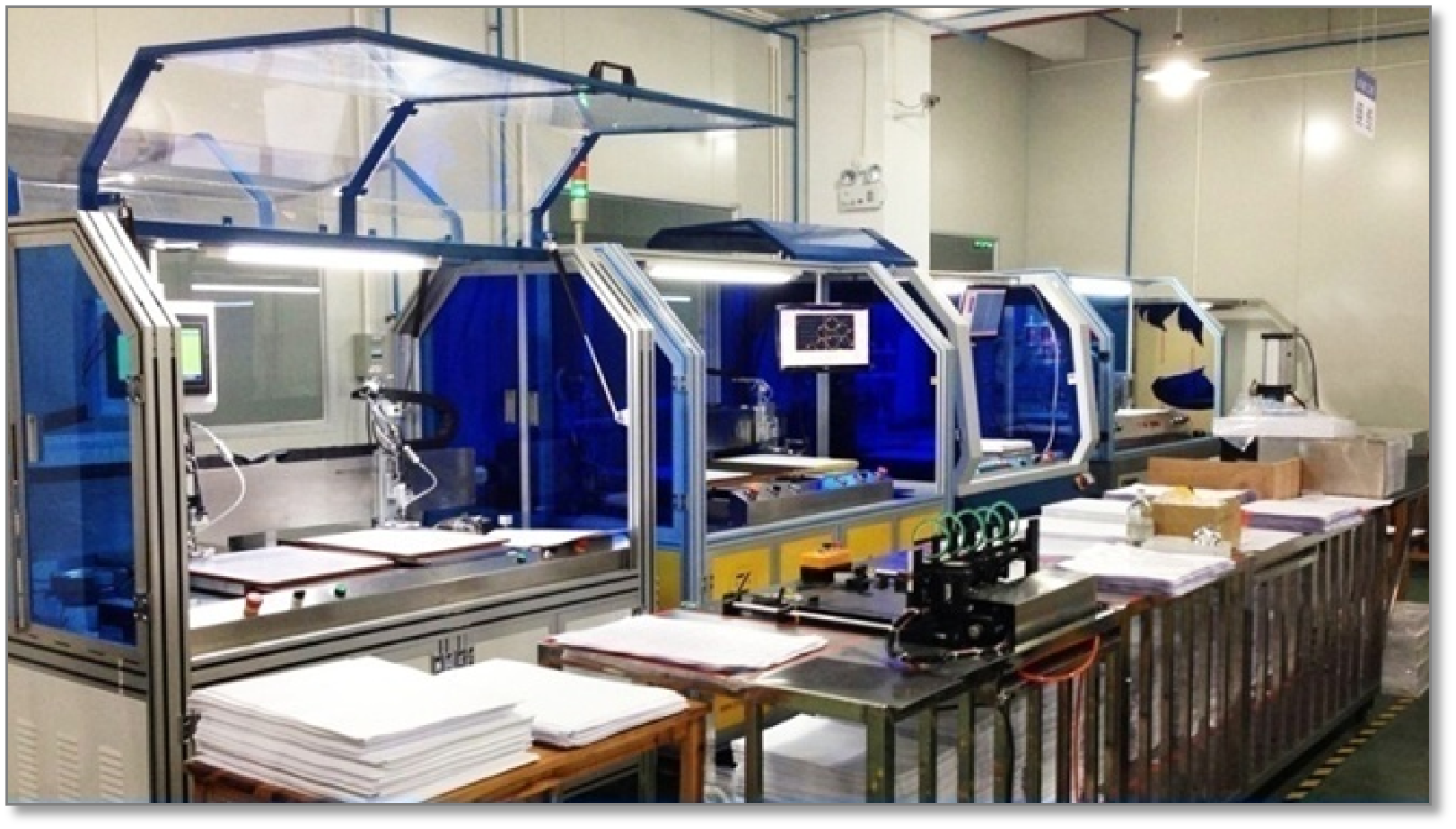
DAILY RFID (DAILY RFID CO., LIMITED) is an RFID hardware manufacturer founded in 2008 and based in Guangzhou, China, producing RFID tags, RFID cards, RFID readers, antennas, chips, and labels. Its documented facility covers 28,000 m² with 180–200 employees and 38 R&D engineers, an annual reader output of 100,000 units, and an export ratio of roughly 80% concentrated on EU and US markets.
Problem Definition: Where Spec-Sheet Comparison Breaks Down
Three failure patterns explain most reader selection problems on factory floors.
1. Transmit power is read as a proxy for read range. It is not. Within the same catalogue, the DL213 Type-C UHF reader module is documented at a maximum transmit power of 23 dBm with a reading range of 0.1 cm to 10 cm; the DL9702 AI RFID tag tester and encoder is documented at 17 dBm with a 10–15 cm range; and the WiFi RFID reader DL920Plus is documented at 20–30 dBm with an 8–15 m range. Lower power does not automatically mean weaker performance — it usually means the device is engineered for near-field isolation rather than wide-area coverage.
2. The form factor is chosen before the read point is defined. A dock-door gate, a tray station, a conveyor trigger point, a handheld route, and an embedded cabinet each impose different constraints on antenna placement, cabling, and wireless links. Selecting the enclosure first forces the read point to adapt to the hardware instead of the other way round.
3. Some “technical” specs are contractual. Frequency version, interface set, antenna configuration, and mechanical format get frozen into a bill of materials. Changing any of them later resets compliance work, mounting design, firmware, and system integration — which is why reader specification is a long-term supply decision, not only a hardware decision.
Industry Background: UHF RFID Is Plant Infrastructure
Reader selection now carries more weight than it did when RFID was a pilot technology; the category has moved into the same planning conversations as PLCs, MES connectivity, and warehouse management systems.
The global UHF RFID reader market was valued at approximately USD 4.8 billion in 2025 and is projected to reach USD 11.2 billion by 2034 (Dataintelo). UHF RFID accounted for 40.72% of total RFID market revenue in 2025, supported by retail inventory cycles and multi-item read capability (Mordor Intelligence). Regionally, the Americas represent more than 60% of global UHF tag usage as of 2025, largely driven by retail mandates (IDTechEx), while Asia Pacific is the fastest-growing region for UHF RFID hardware, with shipments forecast to grow at an 11.8% CAGR through 2031 (ABI Research).
The technical anchor for all of this is a single global air interface: EPCglobal Gen2, standardised as ISO/IEC 18000-6C (GS1 / ISO). That standardisation is why a factory can mix tags, antennas, and readers from different suppliers. It does not standardise power classes, antenna design, interface sets, or environmental ratings — those remain engineering choices that vary by supplier and by model.
The supplier landscape reflects that split. Large general-purpose vendors compete alongside specialists; Zebra Technologies, for example, reported fiscal 2024 revenue exceeding USD 4.5 billion with growth in its fixed and handheld reader portfolios (Dataintelo / Zebra financials). For factory buyers the practical consequence is that comparing headline hardware is no longer enough. The differentiator increasingly sits in how deeply a supplier can configure a reader to a specific read point — and support that configuration over the life of the line.
The Nine Parameter Families, Decoded
1. Frequency band and regional compliance
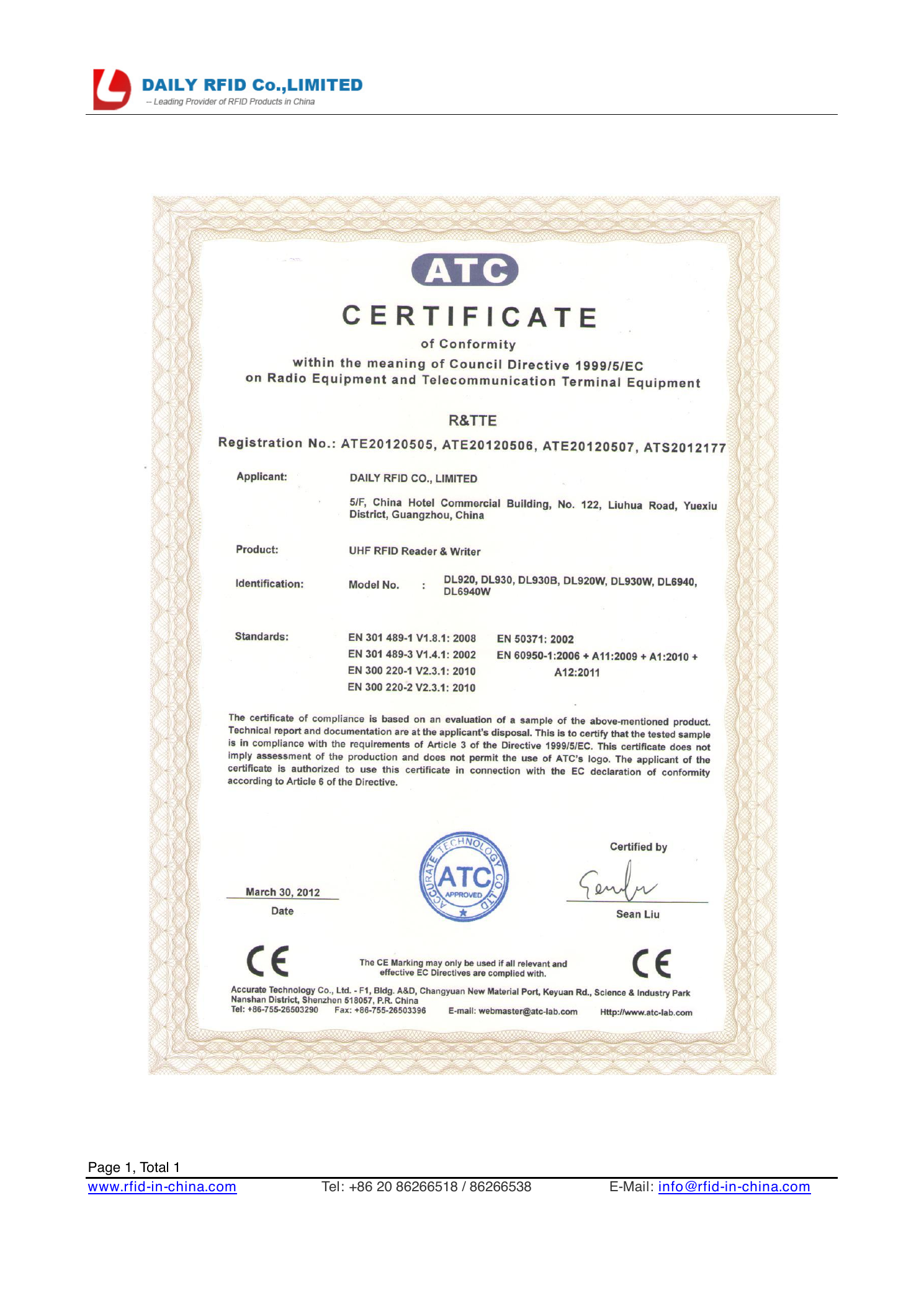
UHF RFID readers operate in the ISM band, but the permitted sub-band differs by region. DAILY RFID reader documentation lists ISM 902–928 MHz and 920–925 MHz operation, with 860–960 MHz customisation available on request. For a manufacturer that ships products or replicates the same system across countries, the frequency version is a compliance item rather than a configurable preference: readers, modules, and tags are configured according to regional frequency bands such as EU, US, and China, and the frequency version, hopping parameters, and certification requirements should be locked into the BOM before shipment.
What to verify: the exact band for each deployment country; whether the firmware supports FHSS or fixed-frequency pulse transmission; and which certification documents ship with the unit. CE documentation published for UHF reader/writer products is a typical example of the evidence to request before freezing the BOM.
2. Air-interface protocol
ISO/IEC 18000-6C (EPC Gen2) is the baseline every UHF reader must support. Beyond that, check whether legacy 6B support is required — the DL930B Bluetooth reader, the DL920Plus WiFi reader, and the DL9702 AI tester all document support for both ISO18000-6B and ISO18000-6C EPC Gen2. Also confirm memory-bank operations: EPC, TID, and user memory reads, plus write verification, password protection, and locking where data integrity matters. Readers and encoding tools that support post-write read-back comparison and batch encoding records reduce the risk of silently corrupted EPC data entering a production database.
3. Transmit power versus usable read range
Transmit power is the most misread parameter on a reader datasheet. Documented examples show why the two should never be treated as interchangeable: DL920Plus at 20–30 dBm adjustable with an 8–15 m range; DL930B at 20–30 dBm adjustable with a 4–8 m range; the DL6993 tray reader at 33 dBm with a 0.1–5 m range; and DL9702 at 17 dBm with a 10–15 cm range. Same technology family, radically different usable fields.
Adjustability matters as much as maximum power. Software power control within a 20–30 dBm window is how integrators narrow a read zone without moving or shielding antennas, which is often the cheapest fix for a gate reader that captures tags on a neighbouring shelf. Documented range figures are also routinely stated as tag- and environment-dependent, so a range printed on a datasheet should be read as a starting hypothesis, not a guaranteed result.
4. Antenna architecture, ports, and polarisation
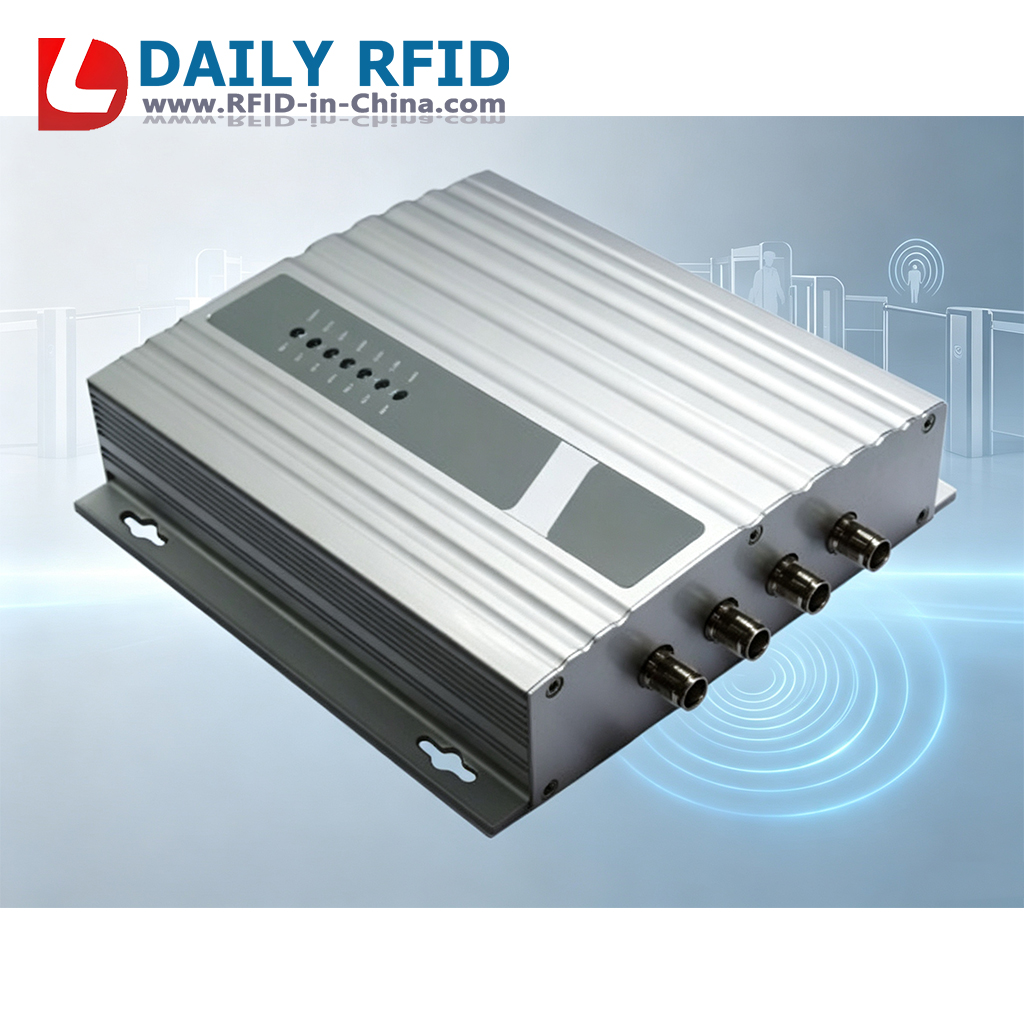
Reader classes differ most visibly in how the antenna is delivered. Integrated formats — the DL930B with a built-in circular/linear polarised antenna, the DL920Plus with an integrated internal antenna, the DL6993 tray with an integrated flat-panel antenna, and the DL213 and DL228 modules with integrated antennas — reduce cable loss and installation time. Multi-port fixed readers, such as the DL6940 documented with four antenna ports, trade that simplicity for coverage shaping across several zones. Near-field formats, including the DL9702 with a built-in near-field localised antenna, are engineered for precise short-range isolation rather than distance.
Polarisation is the second half of this decision. A circular-polarised antenna is generally more tolerant of tag orientation, which matters when parts arrive at a read point at unpredictable angles; a linear antenna is typically chosen where tags are consistently aligned and maximum forward range is the priority. Buyers should ask which polarisation is used, whether the antenna is replaceable, and whether the mounting hardware supports the angle the read point needs.
5. Anti-collision, read speed, and de-duplication
Peak tag density decides the anti-collision specification. Documented single-tag read time across the DL930B, DL920Plus, DL6993, self-checkout reader, and DL9702 is less than 10 ms per 64 bits. Anti-collision capacity varies far more: the DL213 and DL228 modules read up to 5 tags simultaneously, while the DL6993 tray reader and the self-checkout reader are documented at 80–100 tags simultaneously.
Raw anti-collision is only half of it. Dense-reading deployments also depend on RSSI filtering, time-window de-duplication, and zone-based scanning; tag spacing for dense goods is a specification decision, and handheld scanners or multi-antenna readers should be chosen according to inventory density rather than convenience.
6. RSSI and signal diagnostics
RSSI — received signal strength indication — is the parameter that turns a reader from a tag detector into a positioning and validation tool. It is documented on the DL930B, the DL6993 tray reader, the self-checkout reader, and the DL9702, which adds integrated signal diagnostics. In practice, RSSI enables proximity filtering so a counter-mounted reader validates only the items actually in the zone, and it enables zone control so a reader ignores tags at the edge of its field. If the datasheet does not expose RSSI, expect to solve those problems mechanically instead of in software.
7. AI-based sensing: what it means in hardware terms
The DL9702 AI Powered RFID Reader — documented as an AI RFID tag tester and encoder — shows what “AI” should mean on a reader datasheet. Its AI-enhanced single-tag lock filtering prevents adjacent-tag misreading during high-intensity batch encoding; its AI diagnosis and filtering algorithm analyses tag response signals to identify defective, damaged, and weak tags; and it runs an AI-optimised dynamic testing mode. The rest of the specification is refreshingly ordinary: 17 dBm maximum transmit power, a 10–15 cm near-field range, USB power at 0.25 W, 107 × 70 × 10 mm, 80 g, IP54-equivalent enclosure protection, 10 ms read time, and 30 ms block write time.
The buyer rule is simple. AI claims should resolve to a named function — filtering, defect classification, dynamic tuning behaviour. If a supplier cannot name the function in the specification, the claim cannot be evaluated, tested, or written into an acceptance criterion.
8. Interfaces, protocol stack, and power design
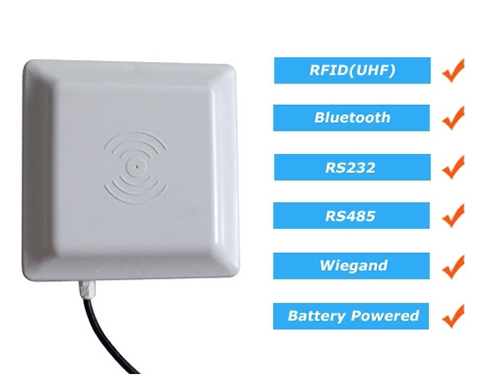
Interfaces decide how much integration work the reader creates. The DL930B documents RS232, RJ45 (TCP/IP), USB, and GPIO including a trigger port and Wiegand 26/34 output; the DL920Plus documents RS232, RJ45, GPIO with Wiegand 26/34, trigger and RS485, and USB; the DL6993 tray and self-checkout readers document RS232, USB, RJ45, and GPIO. Wiegand output suits gate controllers, GPIO triggers suit conveyor sensors, and RJ45/TCP-IP suits direct MES or WMS connectivity.
Wireless variants extend the same platform: DL930B (Bluetooth), DL930W (Wi-Fi), and DL930G (GPRS) target different site conditions, and the DL920Plus integrates a WiFi module. For power, documented configurations range from DC +9V/4A at 6 W (DL930B and DL920Plus) and DC 12–24V at 12 W (DL6993 tray) to USB-powered 0.25 W (DL9702). For critical fixed read points, PoE or wired Ethernet is the more robust choice; remote points are better served by Wi-Fi or GPRS links with local buffering.
Software integration should be specified at the same time as the hardware: SDKs, serial and TCP/IP protocol documentation, demo software, and development kits for ERP, WMS, MES, and custom software. Multi-platform SDK coverage — x86 and x64, C++, C#, VB, Delphi, Linux, ARM, Python, NodeJS, QT, JAVA, and Android — is documented for the tray and self-checkout reader families, which shortens the path from single-device read/write tests to multi-reader deployments.
9. Environmental rating, temperature, and duty cycle
Protection ratings and temperature windows are not marketing details on a factory floor. Documented values across the range include IP65/IP66 for the DL930B, IP66 for the DL6993 tray reader, IP64 for the DL920Plus and the DL228 module, and IP54-equivalent enclosure protection for the desktop DL9702. Operating temperature ranges span -30°C to 70°C for the DL930B, DL920Plus, and DL9702; -20°C to 60°C for the DL6993; and -10°C to 60°C for the DL213 module.
For readers that run continuously, connection reliability belongs in this category too. Network heartbeat monitoring, automatic reconnection, and local data buffering keep scan records traceable during temporary network interruptions, with PoE or wired Ethernet recommended for mission-critical fixed points and queued upload with breakpoint-resume for remote sites.
Step-by-Step: From Spec Sheet to Signed-Off Configuration
- Define the read point before the reader. Record zone length, tag travel speed and direction, peak tag population in the field, mounting height, and the material the tag sits on. These five inputs eliminate most unsuitable form factors immediately.
- Lock the frequency band and compliance evidence per country. Fix the frequency version, hopping parameters, and certification requirements in the BOM, and confirm which certification documents travel with the shipment.
- Choose the antenna architecture. Integrated antennas for fast installation and predictable coverage; multi-port fixed readers where several zones must be shaped independently; near-field antennas where only one tag should ever be read.
- Match the power class to the zone, not to the datasheet maximum. Confirm software adjustability in the 20–30 dBm range, and plan to reduce power before adding shielding or relocating hardware.
- Verify anti-collision, read speed, RSSI, and de-duplication against peak tag density. Check the simultaneous-tag figure, the per-64-bit read time, the availability of RSSI, and the filtering rules the software exposes.
- Confirm interfaces and power against the control layer. Match GPIO and Wiegand outputs to gates and sensors, RJ45/TCP-IP to the network, and RS232/RS485 to legacy equipment. Decide PoE or wired versus wireless per read point.
- Validate with a sample-based POC before freezing the BOM. Test read distance, mounting environment, and interface protocol with matched sample tags, readers, antennas, and demo software — then convert the confirmed configuration into an acceptance criterion for production.
Use Cases: Matching Reader Classes to Factory-Floor Tasks
Line-side and in-process identification on metal parts. Metal surfaces compromise tag signals, so the practical approach combines on-metal tags and rugged tool tags with multi-antenna read-point layouts; tags should sit on non-grip, non-wear areas, and cabinet or gantry antenna polling should be tuned to reduce missed and cross-layer reads.
Dense tray and pallet batch reading. A tray reader documented at 33 dBm with a 0.1–5 m range, 80–100 tag anti-collision, and IP66 protection suits stacked, densely placed high-value items. Where tag angles inside the tray vary, multi-directional antenna coverage plus standardised tag orientation improves repeatability.
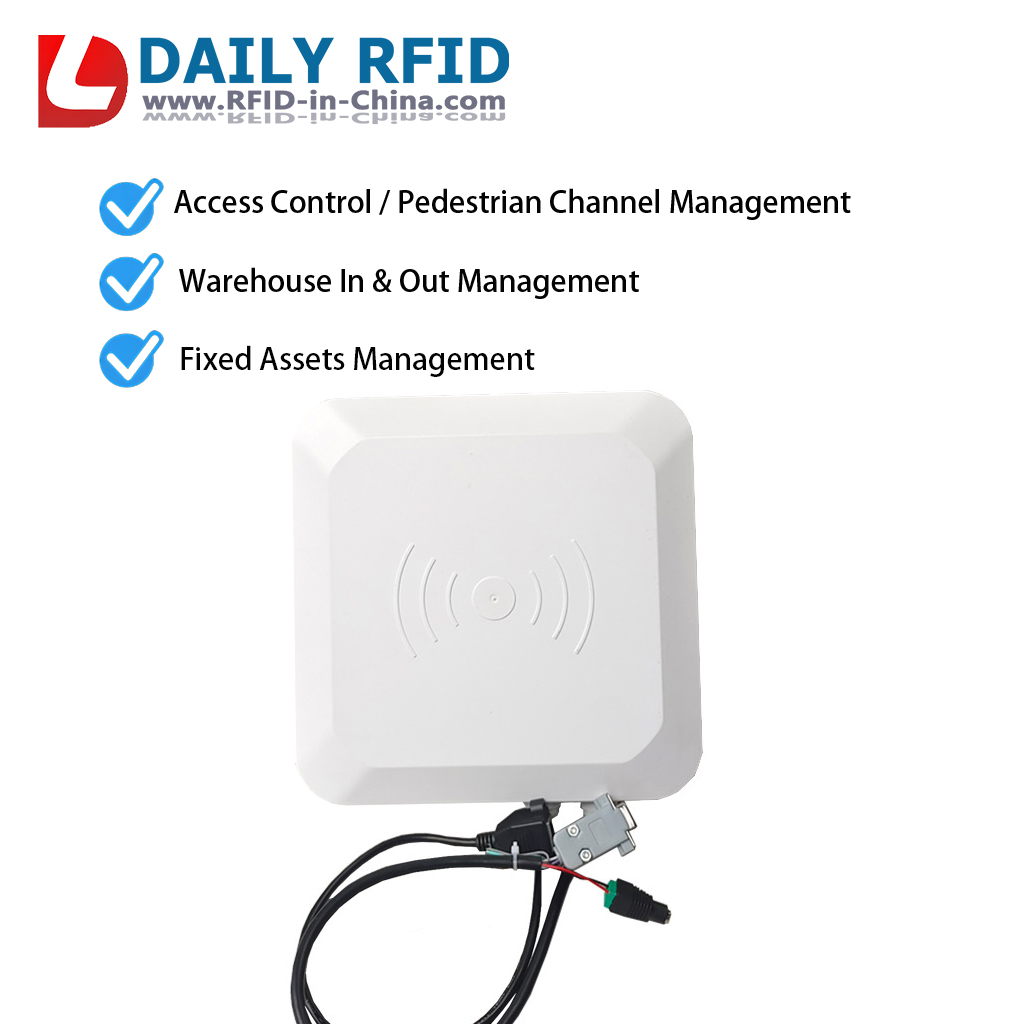
Dock doors, gates, and yards. Long-range integrated readers documented at 8–15 m, with write distance up to 7 m, handle pallet and vehicle identification. Where a gate reader risks capturing tags on nearby shelves, read zones can be narrowed with antenna placement, RF power control, shielding panels, RSSI filtering, and event-triggered read windows.
Cold storage and washdown areas. Readers documented to operate from -30°C, combined with IP66-rated tray hardware, allow identification stations in low-temperature and cold-chain environments where consumer-grade equipment would not be specified.
Mobile routes and automated inventory. UHF handheld readers support OS, software, and housing customisation with a documented minimum order of 1 unit and a 15–30 day lead time, which makes pilot deployments practical. Bluetooth readers add connection-status prompts, local record caching, and queued upload after reconnection, so records stay traceable when a phone, tablet, or field network drops. The same logic applies to moving platforms: the market for Drones-as-a-Service using RFID for inventory collection is estimated to reach USD 8.2 billion by 2026 (PR Newswire), and RFID robots and RFID drones depend on readers with dependable wireless links and offline buffering rather than fixed wiring.

Tag encoding and quality screening before mass production. The DL9702 AI tag tester and encoder screens defective, damaged, and weak tags before they reach a production run, using a 10–15 cm near-field range and AI-enhanced single-tag lock filtering to avoid cross-reading adjacent tags on a crowded bench.
Embedded equipment and smart cabinets. Modules such as the DL213 (23 dBm, 0.1–10 cm) and the DL228 Type-C mobile reader (12 dBm, 0.1–10 cm, IP64) are designed for embedded integration, with attention to power filtering, grounding, antenna spacing, and enclosure layout, plus EMC pre-scan and read-distance retesting before mass production.
Comparison: Documented Reader Classes Side by Side
| Reader class (documented example) | Antenna architecture | Documented transmit power | Documented read range | Documented anti-collision | Typical factory role |
|---|---|---|---|---|---|
| Integrated long-range reader — DL920Plus (WiFi) | Integrated internal antenna | 20–30 dBm, software adjustable | 8–15 m; write distance up to 7 m | Supported (multi-tag) | Dock doors, yards, pallet and vehicle identification |
| Integrated reader — DL930B / DL930W / DL930G | Built-in circular/linear polarised antenna | 20–30 dBm, software adjustable | 4–8 m | Supported via protocol | Flexible and mobile read points with wireless site conditions |
| Tray reader — DL6993 | Integrated flat-panel antenna | 33 dBm | 0.1–5 m | Up to 80–100 tags simultaneously | Dense tray, counter, and small-item batch identification |
| Desktop AI tester and encoder — DL9702 | Built-in near-field localised antenna | 17 dBm | 10–15 cm | AI-enhanced single-tag lock filtering | Tag encoding, quality screening, serialisation before production |
| Embedded modules — DL213 / DL228 | Integrated antenna | 23 dBm (DL213) / 12 dBm (DL228) | 0.1–10 cm | Up to 5 tags simultaneously | Embedded devices, kiosks, cabinets, desktop encoding |
| UHF handheld reader family | Handheld integrated unit | Model-dependent — refer to the product datasheet | Model-dependent — refer to the product datasheet | Model-dependent — refer to the product datasheet | Mobile inventory routes, field verification, on-site checks |
All values above are taken from published product documentation and are stated as tag- and environment-dependent where the source documentation says so. They describe the hardware class, not a guaranteed result at a specific read point.
| Parameter | What it actually tells you | What it does not tell you |
|---|---|---|
| Transmit power (dBm) | Available RF energy and how finely it can be adjusted in software | Whether a specific tag at a specific angle will be read at that distance |
| Read range (m / cm) | An upper-bound behaviour under the supplier’s test conditions | Performance on metal, through liquid, or at high tag density |
| Anti-collision count | How many tags the reader is documented to read simultaneously | Reading accuracy in stacked or randomly oriented tag populations |
| RSSI support | Whether the software can filter reads by signal strength | The filtering rules the middleware must implement |
| Read time (per 64 bits) | Raw single-tag read speed | End-to-end processing time through MES or WMS |
| IP rating and temperature | Where the enclosure can physically be installed | Connector sealing, cable routing, or condensation behaviour |
| SDK and protocol documentation | How much integration work the supplier removes | Whether your integrator has the capacity to use it |
Why Reader Specs Are Also Long-Term Supply Decisions
Once a reader configuration is frozen, it usually stays in service for years — which means the specification decision is also an ecosystem decision. Several parameters deserve to be evaluated specifically for their long-term behaviour.
Frequency version and BOM locking. Regional frequency configurations, hopping parameters, and certification requirements should be fixed in the BOM, so that a later production batch cannot silently change the radio behaviour of an approved device.
Mechanical and firmware continuity. Embedded modules are supplied in customised sizes and shapes; an embedded design that depends on a specific module outline needs a supplier that can keep that outline stable across production runs, not just across a sample order.
Integration continuity. SDKs, protocol documentation, demo software, and development kits — with multi-platform support documented for the major reader families — protect the integration investment. Changing reader families later means re-qualifying the software layer, not only the hardware.
Reliability engineering for multi-year uptime. Heartbeat monitoring, automatic reconnection, and local buffering are documented for industrial readers precisely because fixed read points are expected to run continuously. For remote installations without wired networks, queued upload and breakpoint-resume protect data continuity.
Capacity and lead-time scaling. A long-term partner has to scale with the rollout. DAILY RFID documents annual reader output of 100,000 units and monthly capacities that range from 1,000 units for UHF fixed readers to 2,000 units for UHF handheld readers, with lead times of 15–45 days for fixed readers and 15–30 days for handheld readers; across its wider product range, monthly capacity reaches up to 1,000,000 units with lead times of 7–45 days depending on the product.
Low-friction evaluation. Minimum order quantities start from 1 unit for UHF fixed and handheld readers, so a specification can be validated before a rollout commitment is made. Commercial terms documented for the range include EXW, FOB, and CIF delivery, and payment by T/T, D/P, or sight L/C negotiated against order quantity, chip type, and customisation requirements.
Quality control matched to the product type. Documented procedures include 100% functional testing, signal testing, visual inspection, batch sampling, peel tests, and full system burn-in — with burn-in specifically applied to reader products.
After-sales as an engineering function. Remote and on-site technical support, replacement warranty, and customisation technical support are documented across global markets including the EU, Asia, and the Middle East. For a factory, this is what determines whether a specification deviation in year three is resolved as a support ticket or as an unplanned capital project.
DAILY RFID’s documented R&D team of 38 engineers and its OEM/ODM service model, spanning readers, tags, antennas, cards, and modules, are the structural reason this list can be addressed by one supplier rather than split across several. Buyers who evaluate these dimensions at the specification stage are effectively specifying the supply relationship at the same time.
Frequently Asked Questions
How do we verify frequency-band compliance before committing to a long-term UHF RFID reader supply partner in China?
Treat the frequency version as a BOM item rather than a configuration detail. DAILY RFID configures UHF readers, modules, and tags according to regional frequency bands such as EU, US, and China, and locks the frequency version, hopping parameters, and certification requirements into the BOM before shipment to reduce compliance risk. Reader documentation lists ISM 902–928 MHz and 920–925 MHz operation with 860–960 MHz customisation available, and the air interface is anchored by ISO/IEC 18000-6C (EPC Gen2). Ask for the certification documentation that travels with the shipment — CE documentation is published for the UHF reader/writer range as an example — and confirm the permitted band for each country where the line will be replicated.
What customisation can a factory expect from a UHF RFID reader supplier?
Documented customisation for UHF fixed readers covers antenna gain and interface options; UHF handheld readers support OS, software, and housing customisation with a minimum order of 1 unit and a 15–30 day lead time; embedded modules are supplied in customised sizes and shapes. On the software side, the supplier provides SDKs, serial and TCP/IP protocol documentation, demo software, and development kits for ERP, WMS, MES, and custom software integration. DAILY RFID operates a 28,000 m² facility with 180–200 employees and 38 R&D engineers, an annual reader output of 100,000 units, and OEM/ODM production services across readers, tags, antennas, cards, and modules.
What commercial terms should be planned into a reader budget?
Plan around minimum order quantity, lead time, capacity, and payment terms rather than a single unit price. Documented minimums start at 1 unit for UHF fixed and handheld readers, 2 units for the WiFi reader DL920Plus and the tray reader DL6993, and 5 units for the self-checkout reader. Typical production lead times are 15–45 days for UHF fixed readers, 15–30 days for UHF handheld readers, and 7–15 days for tray, WiFi, and AI tester products. Monthly capacity is documented at 1,000 units for UHF fixed readers and 2,000 units for UHF handheld readers. Delivery is offered EXW, FOB, or CIF, with payment by T/T, D/P, or sight L/C negotiated against order quantity, chip type, and customisation requirements.
Can reader specifications be validated with samples before bulk purchase?
Yes, and it is the recommended sequence. DAILY RFID provides matched sample tags, readers, antennas, and demo software for structured POC testing, so read distance, mounting environment, interface protocol, and expected ROI are confirmed by field data before bulk production. Documented quality procedures support that approach: 100% functional testing, signal testing, visual inspection, batch sampling, peel tests, and full system burn-in for readers, with sample confirmation or factory acceptance test as the acceptance basis depending on the product type.
How do we keep a multi-year UHF RFID reader supply relationship stable?
Anchor the relationship in three things: frozen specifications, continuity engineering, and support coverage. Freeze the frequency version, interface set, and mechanical format in the BOM; verify that firmware and module outlines remain stable across production runs; and confirm the support model — DAILY RFID documents remote and on-site technical support, replacement warranty, and customisation technical support across global markets. For readers running continuously, heartbeat monitoring, automatic reconnection, and local data buffering protect read records during network interruptions, and queued upload with breakpoint-resume covers remote sites. To start that validation process, request a matched reader sample kit and a configuration review via sales@rfid-in-china.com or +86 15817191372.
Conclusion: Specs Are the Contract
The parameters that matter most in UHF RFID reader selection are rarely the ones printed largest in a brochure. Transmit power must be read together with range, antenna architecture, and adjustability. Anti-collision counts must be read together with tag density and de-duplication rules. AI claims must resolve to named functions such as single-tag lock filtering and signal diagnosis. Interfaces, power design, protection ratings, and temperature windows decide whether the reader survives the environment it is installed in — and frequency version, mechanical format, and SDK continuity decide whether it can still be supported three years later.
Read that way, a spec sheet stops being a comparison table and becomes the acceptance criteria for a read point: what must be read, how fast, in what environment, through which control layer, and under which supply agreement. That is the version of the datasheet worth signing off on.
Next Step: Validate the Configuration Before It Becomes a Commitment
DAILY RFID supplies matched sample tags, readers, antennas, and demo software for structured POC testing, so distance, mounting, protocol, and ROI are confirmed before bulk production. Send your read-point requirements for a configuration review, sample kit, or quotation: sales@rfid-in-china.com · +86 15817191372 (WhatsApp available).
Download the company profile: DAILY RFID company profile (PDF) · Product documentation: www.rfid-in-china.com
Have Questions or Need More Details?
Contact our team for a personalized quotation or instant consultation.
Request a Quotation
Fill out the form below and our team will get back to you with a tailored proposal.
WhatsApp Direct Chat
Prefer to chat in real-time? Message us on WhatsApp for instant assistance & quick answers.
- Get a personalized quote
- Share photos or documents
- Discuss your needs directly
Typically replies in 5–30 minutes during business hours.