
Regional UHF RFID Rules for Factories: A Buyer's Compliance Map
Regional compliance decides which UHF RFID Reader a manufacturing plant may install, how that reader has to be configured, and where it can physically be mounted on the line. For a buyer working at evaluation stage, the whole question reduces to three variables: the UHF band the deployment market permits, the radio and electromagnetic-compatibility approvals that name the exact reader model, and the frequency, power and installation envelope that the reader itself supports.
This guide maps those variables against the reader types and documented evidence available for DAILY RFID hardware, including the RFID Fixed Reader family and the UHF RFID Reader Bluetooth model, so that compliance becomes an input to selection rather than a surprise after the order is placed.
Short answer for evaluation-stage buyers: treat frequency configuration and model-specific approval documents as selection criteria, not as paperwork collected after the purchase order. DAILY RFID reader specifications state three ISM bands - 860-868 MHz, 902-928 MHz and 920-925 MHz - and several models offer frequency customization across 860-960 MHz. That configurability is what allows one reader family to serve factories operating under different regional rule sets.
Problem definition: where regional rules break a factory rollout
Most UHF RFID projects do not fail because the air-interface protocol is wrong. UHF RFID readers are standardized globally under the EPCglobal Gen2 protocol, also known as ISO/IEC 18000-6C, published by GS1 and ISO. Interoperability between tags and readers is therefore largely a solved problem. What is not standardized is where in the radio spectrum a factory is permitted to operate, at what power, and with which approval document covering which model.
Three practical failure modes recur in manufacturing sourcing:
- A reader locked to the wrong band. Reader specifications quote specific ISM ranges - 860-868 MHz, 902-928 MHz and 920-925 MHz appear repeatedly across the DAILY RFID reader line. A unit ordered for one band is not automatically usable in a market that assigns another.
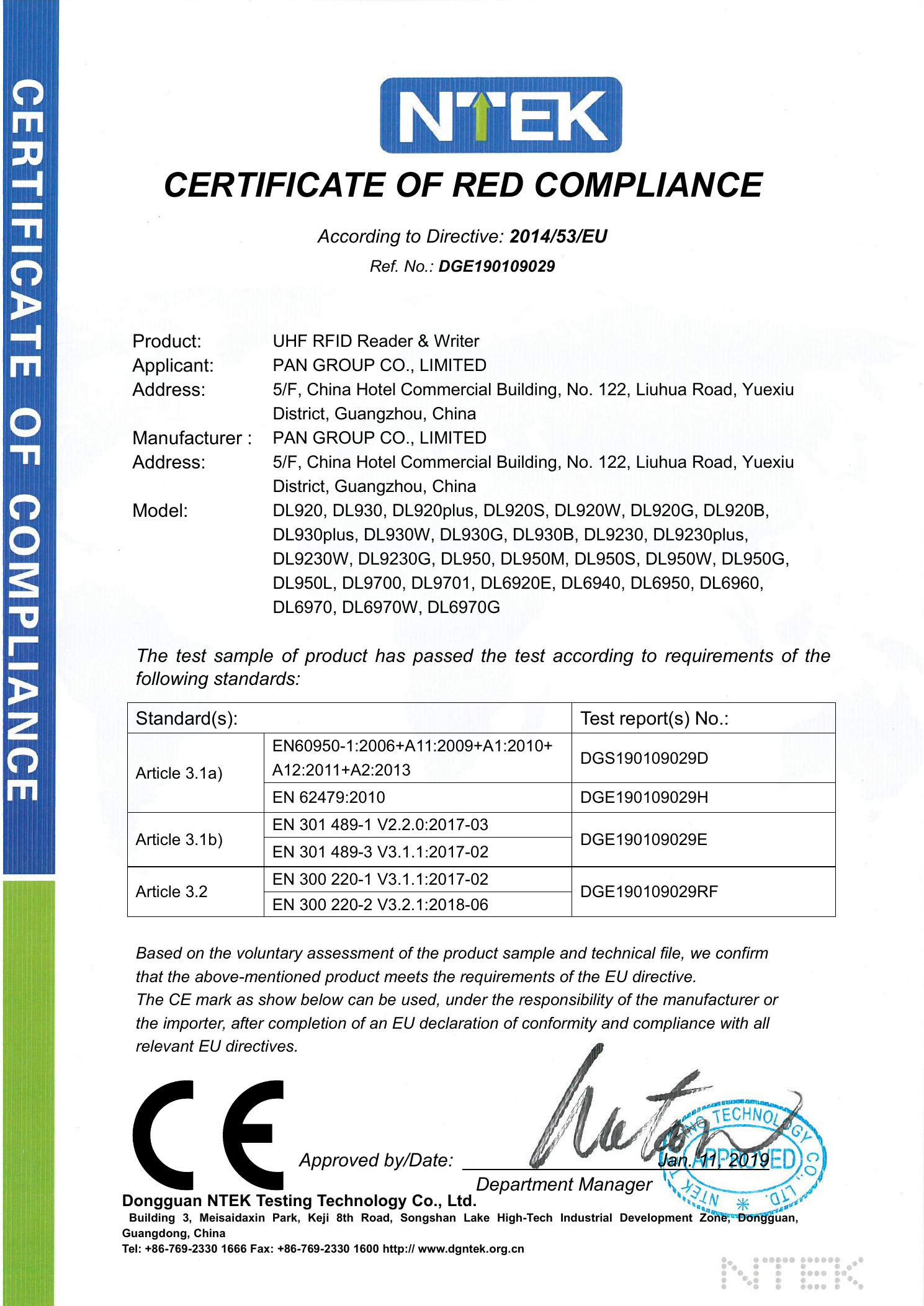
- An approval that does not name the ordered model. Certificates list models individually. The CE RED Certificate of Compliance DGE190109029, issued by Dongguan NTEK Testing Technology Co., Ltd. under Directive 2014/53/EU, names UHF RFID Reader & Writer models including DL920, DL930, DL920plus, DL920S, DL920W, DL920G, DL920B, DL930plus, DL930W, DL930G, DL930B, DL9230, DL9230plus, DL9230W, DL9230G, DL950, DL950M, DL950S, DL950W, DL950G, DL950L, DL9700, DL9701, DL6920E, DL6940 and DL6950. If the model on your purchase order is not inside a document scope, you do not yet hold that approval for that unit.
- Installation assumptions that ignore the power and spectrum envelope. What a site may radiate determines the read zone, and the read zone determines whether a dock door needs one fixed reader or a multi-antenna configuration.
Industry background: one protocol, several rule sets
The commercial weight behind UHF RFID makes regional differences expensive to ignore. Dataintelo values the global UHF RFID reader market at approximately USD 4.8 billion in 2025 and projects it to reach USD 11.2 billion by 2034. Mordor Intelligence reports that UHF RFID technology captured 40.72% of total RFID market revenue in 2025, driven by retail inventory cycles and multi-item read capability. Regional distribution is uneven: IDTechEx reports that the Americas accounted for over 60% of global UHF tag usage as of 2025, largely on the back of retail mandates, while ABI Research identifies Asia Pacific as the fastest-growing region for UHF RFID hardware with an expected 11.8% CAGR in shipments through 2031.
For a manufacturer with plants, suppliers or distribution centres in more than one of those regions, the consequence is straightforward: the same physical process - inbound pallet verification, work-in-progress tracking, tool control - has to be delivered under more than one set of radio rules, and often with more than one approval file. DAILY RFID CO., LIMITED is a Guangzhou-based RFID manufacturer founded in 2008 that produces RFID tags and RFID readers and exports roughly 80% of its output with main markets in the EU and USA. That export profile is why its reader portfolio is specified with explicit band options, and why its conformity documents enumerate models instead of claiming one blanket certificate.
How to read a UHF RFID reader specification for compliance
Compliance information in a reader datasheet is not a separate section. It is embedded in four specification lines, and each one carries a regional consequence.
1. Operating frequency: the band and the customization option
The frequency line tells you whether the reader can be set to the band your market permits. In the DAILY RFID range this line typically reads ISM 860MHz~868MHz, 902MHz~928MHz, or 920MHz~925MHz, with a note such as frequency customization optional or customizable 860MHz~960MHz. The RFID Fixed Reader DL921 family and the Ceiling RFID Reader DL6990 both quote the three-band ISM set with optional customization. The UHF RFID Reader DL930B quotes ISM 902-928 MHz or 920-925 MHz with customization from 860 to 960 MHz. The WiFi RFID Reader DL920Plus and the DL6940/6960 four-port reader quote the full 860-960 MHz span. A customization option matters at evaluation stage because it determines whether a single spare-parts and firmware strategy can cover plants in different regions.
2. Transmit power: what the site is allowed to radiate
Maximum transmit power varies by model and must sit inside regionally permitted limits. Within the DAILY RFID portfolio, stated maximums range from 12 dBm on the DL228 Type-C mobile reader and 23 dBm on the DL213 Type-C module, through 26 dBm on the DL921 fixed reader family, 30 dBm on the DL920Plus WiFi reader and the DL8330U gate reader, up to 33 dBm on the DL6990 ceiling reader and the Self-Checkout RFID Reader. Several models are software-adjustable within a window: the DL920Plus and the DL930B from 20 to 30 dBm, the DL921 family at 26 dBm maximum, the ceiling reader up to 33 dBm. Adjustability is the practical compliance feature, because coverage can be shaped at the lower end of a permitted range instead of pushing power to compensate for poor antenna placement.
3. Enclosure, temperature and mains: the installation envelope
Regional differences also surface in installation hardware. Enclosures across the portfolio are rated IP64 to IP66, with several models operating from -30 C to +70 C and 5% to 95% non-condensing humidity. Power delivery differs by model: the DL921 fixed reader accepts DC +9V~24V, the DL921 Power on Ethernet variant delivers power and data over one Ethernet cable, and the DL8330U gate reader states AC 220 V / 50 Hz - a specification that buyers in markets running different mains characteristics should confirm before ordering, because the power supply is part of the installation, not an accessory.
4. Approval documents: which models they actually cover
DAILY RFID holds reader-related conformity documentation for both EU and US deployment:
- EU radio equipment: CE RED Certificate of Compliance 2019, certificate DGE190109029, issued by Dongguan NTEK Testing Technology Co., Ltd. under Directive 2014/53/EU, with standards including EN60950-1, EN 62479:2010, EN 301 489-1 V2.2.0, EN 301 489-3 V3.1.1, EN 300 220-1 V3.1.1 and EN 300 220-2 V3.2.1.
- EU radio equipment, earlier R&TTE route: certificates ATE20120505, ATE20120506, ATE20120507 and ATS2012177 issued by Accurate Technology Co., Ltd. under Council Directive 1999/5/EC, covering DL920, DL930, DL930B, DL920W, DL930W, DL6940 and DL6940W.
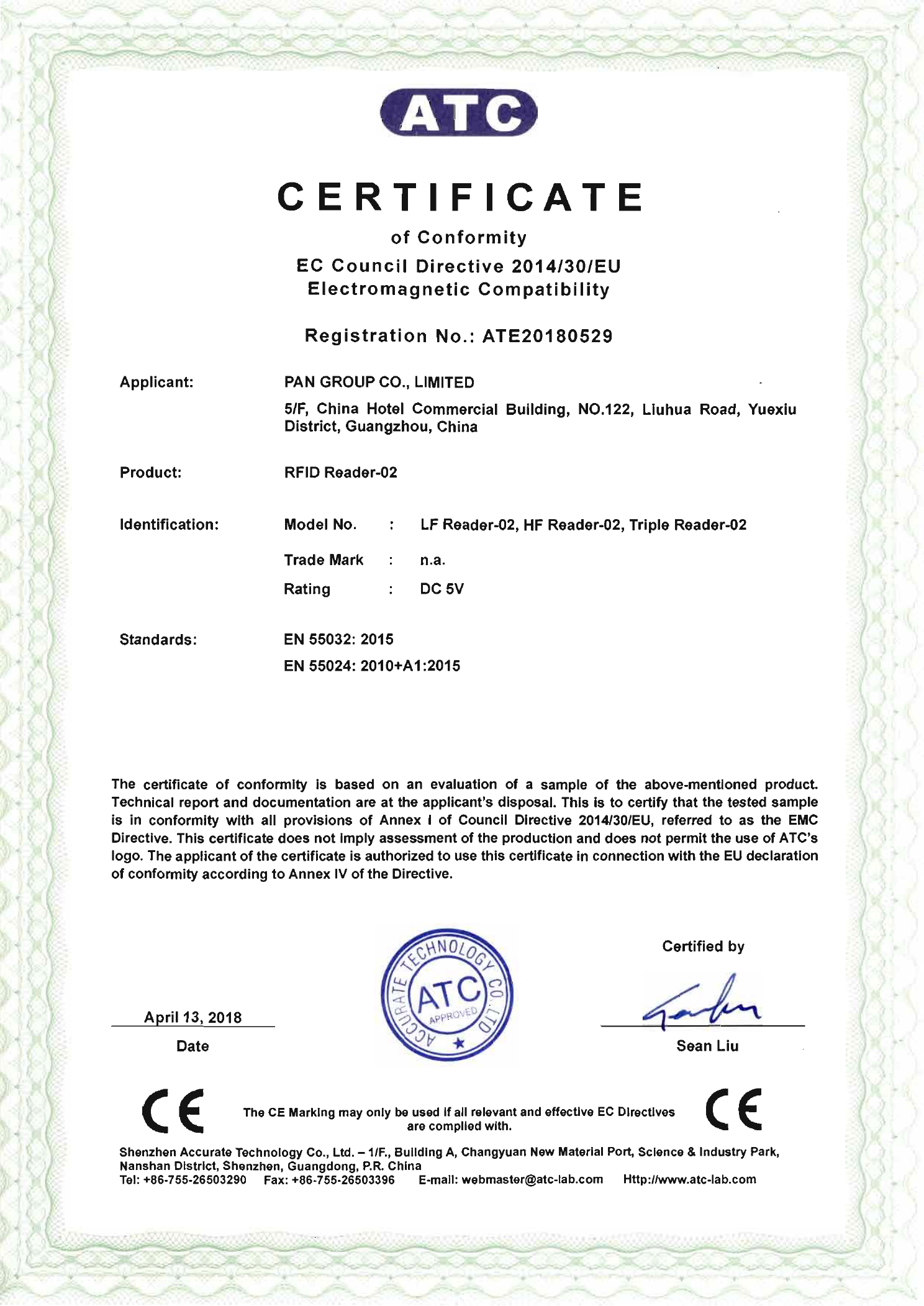
- EU EMC: Certificate of Conformity ATE20180529 issued by Shenzhen Accurate Technology Co., Ltd. under Directive 2014/30/EU with EN 55032:2015 and EN 55024:2010+A1:2015, covering RFID Reader-02 in its LF Reader-02, HF Reader-02 and Triple Reader-02 versions.
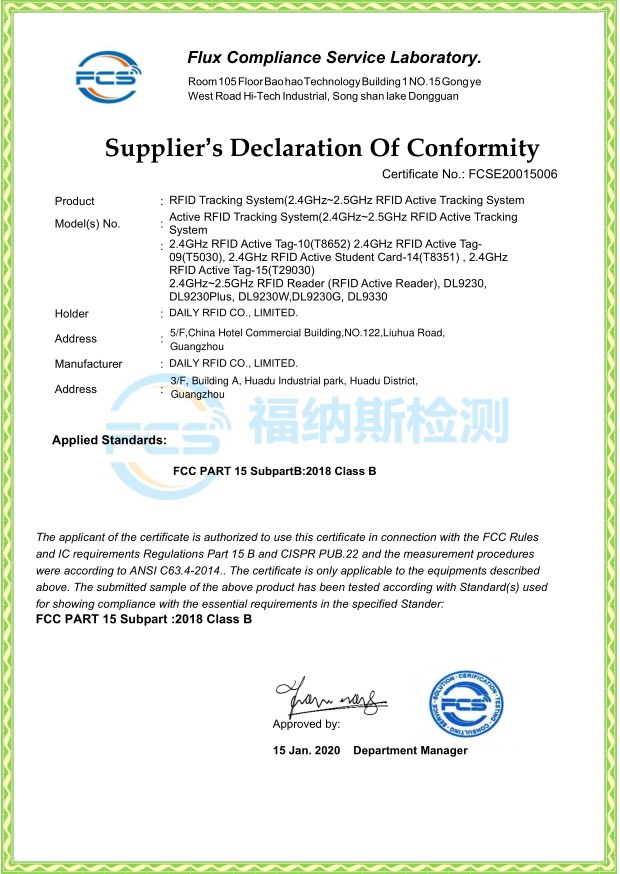
- US: FCC Supplier's Declaration of Conformity FCSE20015006 issued by Flux Compliance Service Laboratory under FCC Part 15 Subpart B Class B with ANSI C63.4-2014, covering the 2.4GHz-2.5GHz RFID active tracking system and the active reader models DL9230, DL9230Plus, DL9230W and DL9230G. A separate FCC Verification of Compliance, ATE20161983 002, covers RFID Tiny Tags under FCC Part 15 Subpart B Class B.
- Substance rules: RoHS 2.0 documentation exists for tag and label lines, for example test report AZT250710068C-E0 for RFID Tiny Tags and certificate SFT23040033 for RFID Label, alongside REACH test report DGC170511007T02 screening against the ECHA candidate list.
Two conclusions follow for buyers. First, approval coverage differs between the UHF reader line, the 2.4 GHz active reader line, and the tag and label lines, so a manufacturing project that combines readers with tags will draw on several documents. Second, because each document names models, the verification step is a name match rather than a trust statement.
Step-by-step: a compliance-first selection sequence
- Map every site to its permitted band. List the markets where readers will be installed and record the UHF range each one assigns. Where more than one range appears, work only with models whose specification lists those bands or offers frequency customization.
- Choose the reader family by zone, not by price first. Dock doors and gateways point to the RFID Fixed Reader family; wide bulk zones point to the multi-port DL6940/6960; overhead room-scale counting points to the Ceiling RFID Reader DL6990; mobile and exception counting points to the DL1280 handheld reader; embedded cabinets and tool drawers point to the DL213 or DL228 Type-C modules or the RFID Smart Cabinet component.
- Confirm the frequency configuration on the quotation. The customization option has to be written into the order line with the requested band stated explicitly, never assumed from the catalogue band list.
- Match approval documents to the model name. Compare each certificate scope against the exact model and variant on the purchase order. If the model is absent from the scope, request the correct document before confirming lead time.
- Check power, mains and mounting against the site. Confirm the permitted power setting, the power supply arrangement (DC 9-24 V, Power over Ethernet, or AC mains as stated for the DL8330U), the enclosure rating for the area, and the physical footprint - from a 45mm x 30mm x 6mm module to a 450mm x 450mm x 70mm fixed reader.
- Confirm substance and material documentation for the tags as well. Readers are only half of a factory deployment; the tags that travel with parts or containers fall under separate RoHS 2.0 and REACH documentation.
- Validate with a sample on the real tags and the real mounting position. Band, power and antenna behaviour cannot be predicted reliably from a datasheet alone on a metal-heavy factory floor.
- Agree lead time and MOQ before committing. The UHF handheld reader line is quoted at 15-30 days with MOQ 1 unit, and the RFID development kit - reader bundle, demo software and sample tags - at 7-15 days with MOQ 1 set.
Use cases: compliance decisions in real manufacturing deployments
Germany - industrial tool and fixture tracking (EU). An industrial deployment used 120,000 RFID tags to track metal tools, fixtures, containers and production assets. Tool and fixture search time fell by 40% to 70%, and audit preparation time dropped by 50% to 80%. The tags were selected for metal surfaces with rugged housing, a reminder that a regionally approved reader configuration is only useful if the tag survives the same environment.
Poland - distribution centre conveyor reading (EU). A distribution centre runs 360 DL920S readers for conveyor-line parcel reading, carton routing and outbound shipment verification, achieving a 30%-60% reduction in parcel sorting mistakes and a 40%-70% faster outbound verification process, in operation for at least five years. Read alongside the CE RED scope, which names DL920S among its covered models, this is the pattern to look for at evaluation stage: a high-throughput line whose exact model appears inside an approval document.
Spain - automotive parts warehouse (EU). An automotive parts warehouse installed 420 UHF long-range readers with four antenna ports for inbound pallet reading, dock-door verification and returnable container tracking. Manual inbound receiving was reduced by 40% to 70%, and missed pallet scans fell by 30% to 60%. The four-port architecture is the compliance-relevant part: zoned antennas deliver the coverage instead of a single high-power unit.
Taiwan - embedded modules in smart cabinets (APAC). A smart cabinet manufacturer deployed 35,000 RFID modules for embedded reading in smart cabinets, tool drawers and self-service terminals, reaching 95%-99% item identification reliability while cutting reader integration space by 20% to 40%. Embedded modules move the compliance question from the installation site to the host equipment, because the module's configured band and power must match the market where the finished cabinet is sold.
Chile - long-range active identification (LATAM). A mining and heavy equipment operator uses 130 DL9330 2.45GHz active readers for equipment location, personnel safety zones and vehicle movement monitoring, reporting 50% to 80% better moving-equipment visibility and 30% to 60% faster restricted-zone monitoring response. The case shows why the band decision comes first: when a site needs very long-range active identification, the technology moves from UHF into the 2.4-2.5 GHz ISM range, and the approval route changes with it - the 2.4 GHz active reader family is covered by FCC Supplier's Declaration of Conformity FCSE20015006.

Comparison table: reader families, frequency configuration and installation form
| Reader family | Example model | Stated operating frequency | Max transmit power | Reading range | Installation notes |
|---|---|---|---|---|---|
| RFID Fixed Reader | DL921 UHF Long Range RFID Reader with GSM | ISM 860-868 / 902-928 / 920-925 MHz; frequency customization optional | 26 dBm | 0.1-15 m | Built-in circular polarized antenna; IP65; 450mm x 450mm x 70mm; trigger and relay GPIO; integrated 2G/4G GSM module |
| RFID Fixed Reader | DL921 Power on Ethernet UHF Long Range RFID Reader | ISM 860-868 / 902-928 / 920-925 MHz; frequency customization optional | 26 dBm | 0.1-15 m | Power over Ethernet or DC +9V~24V; IP65; single-cable installation at loading bays and assembly checkpoints |
| UHF RFID Reader | UHF Bluetooth RFID Reader DL930B | ISM 902-928 or 920-925 MHz; customizable 860-960 MHz | 20-30 dBm, software adjustable | 4-8 m | Built-in circular/linear polarized antenna; IP65/IP66; RS232, RJ45, GPIO with Wiegand 26/34, USB |
| WIFI RFID Reader | WiFi RFID Reader DL920Plus | 860-960 MHz | 30 dBm (20-30 dBm adjustable) | 8-15 m | Integrated antenna and WiFi module; IP64; RJ45, USB, RS232, RS485, Wiegand, trigger port |
| AI Powered RFID Reader | DL6940/6960 AI Multi-Antenna 4-Port UHF Reader | UHF 860-960 MHz | Adaptive power delivery | 25-30 m | Four external TNC/SMA antenna ports; up to 1,000 tags anti-collision; IP64; RS232, RJ45, GPIO, USB |
| Ceiling RFID Reader | DL6990 UHF Ceiling RFID Reader (Integrated Antenna) | ISM 860-868 / 902-928 / 920-925 MHz; frequency customization optional | 33 dBm | 0.1-5 m | Overhead mount 180mm x 180mm x 28mm; IP66; RS232 standard, optional RJ45, GPIO, USB |
| RFID Gate | DL8330U Advanced UHF RFID Gater | 902-928 MHz, adjustable according to various national regulations | 30 dBm adjustable | 4-7 m channel width | Four built-in TX/RX antennas; AC 220 V / 50 Hz; RS232, RJ45, GPIO |
| RFID Handheld Reader | DL1280 Industrial PDA UHF/HF/LF Handheld Reader | UHF 860-960 MHz; HF 13.56 MHz; LF 125 kHz | Up to 30/33 dBm | UHF 0.1-20 m; HF 0.1-32 cm; LF 0.1-10 cm | Android 12; IP65; up to 100 tags simultaneously, over 100 tags per second; Wi-Fi, 4G, Bluetooth 5.0, GNSS |
| RFID Module | DL213 Type-C UHF Reader Module / DL228 Type-C UHF Mobile Reader | ISM 860-868 / 902-928 / 920-925 MHz; customization optional | 23 dBm / 12 dBm | 0.1-10 cm | Plug-in Type-C; embedded integration in cabinets, terminals and production fixtures |
| 2.4GHz RFID Active Reader | DL9230 RFID TCP/IP Active Reader | ISM 2.4-2.5 GHz | Software adjustable RF power | 0-100 m | Industrial aluminium alloy casing; 15 dBi vertical polarization antenna; up to 200 tags; covered by FCC SDoC FCSE20015006 |
Values in this table are taken from the published DAILY RFID specifications for the listed models. Where a specification does not state a figure, the table does not supply one.
FAQ
Three rule sets matter most. First, the permitted UHF band: DAILY RFID reader specifications state ISM 860-868 MHz, 902-928 MHz and 920-925 MHz configurations, with frequency customization available on several models. Second, the radio and EMC approvals that name the exact model: the CE RED Certificate of Compliance DGE190109029 issued under Directive 2014/53/EU covers named UHF RFID Reader & Writer models such as DL920, DL930, DL920S, DL920W, DL930B, DL9230, the DL950 family and DL6940/DL6950, while FCC Supplier's Declaration of Conformity FCSE20015006 covers the 2.4GHz-2.5GHz active tracking system under FCC Part 15 Subpart B Class B. Third, the permitted transmit power and installation envelope, which determine how far a reader can read and therefore how many units a zone requires.
Yes, where the specification provides frequency customization. Models that state band options with a customization note include the RFID Fixed Reader DL921 family (ISM 860-868, 902-928, 920-925 MHz), the UHF RFID Reader DL930B (902-928 or 920-925 MHz, customizable 860-960 MHz), the WiFi RFID Reader DL920Plus (860-960 MHz), the DL6940/6960 four-port reader (UHF 860-960 MHz), the Ceiling RFID Reader DL6990 (ISM 860-868, 902-928, 920-925 MHz) and the DL213/DL228 Type-C modules. Standardizing on one family across regions still requires per-region approval documents that name the model, because approval coverage is model-specific rather than product-line-wide.
There is no single best model, because the answer is defined by the zone being counted. For dock doors, gateways and loading bays, the RFID Fixed Reader DL921 reads 0.1-15 m with a built-in circular polarized antenna and an IP65 enclosure. For wide bulk zones and high-volume areas, the DL6940/6960 four-port reader covers 25-30 m using four external TNC/SMA antenna ports and supports up to 1,000 tags in anti-collision reading. For overhead room-scale counting, the DL6990 ceiling reader delivers 33 dBm and 0.1-5 m coverage from a 180mm x 180mm x 28mm unit. For mobile counting, the DL1280 handheld reads UHF at 0.1-20 m, up to 100 tags simultaneously and over 100 tags per second. For cabinets and tool drawers, the DL213 and DL228 Type-C modules integrate directly into the host equipment. The compliance qualifier applies to every option: the variant must be frequency-configured and approved for the region where the plant operates.
Installation planning starts from what the site is permitted to radiate, then flows into antenna choice and mounting. Readers with built-in circular polarized antennas, such as the DL921 family at 0.1-15 m and IP65, can be mounted without separate antenna runs, which shortens installation and reduces the number of components that must be documented. Multi-port readers such as the DL6940/6960 instead use four external TNC/SMA antenna ports to build zoned coverage up to 25-30 m, so coverage comes from antenna placement rather than from raising power. Power delivery belongs to the same decision: the DL921 Power on Ethernet variant carries power and data over one Ethernet cable, the standard DL921 accepts DC +9V~24V, and the DL8330U gate reader states AC 220 V / 50 Hz, which buyers in markets with different mains characteristics should confirm before ordering. Enclosure ratings from IP64 to IP66 and operating ranges such as -30 C to +70 C determine which areas of a plant a unit can be mounted in.
Request three things in writing. First, the model-specific approval document, and check that the certificate scope names the exact model and variant on the purchase order, because these documents are enumerated by model rather than by product family. Second, confirmation of the frequency configuration and transmit power setting for the destination market, since these are configurable parameters on models such as the DL921 family, DL930B, DL920Plus and DL6990. Third, a sample for on-site validation with the actual tags and mounting positions, because read performance on metal-heavy factory floors cannot be predicted from a datasheet. Commercial terms differ by family: the UHF handheld reader line is quoted at 15-30 days lead time with MOQ 1 unit, and the RFID development kit - reader bundle, demo software and sample tags - at 7-15 days with MOQ 1 set. To move from evaluation to validation, request a sample or quotation by email at sales@rfid-in-china.com or by WhatsApp and telephone at +86 15817191372.
Conclusion
Regional rules for UHF RFID in manufacturing are not a single approval stamp. They are a chain: which band the market permits, which models a conformity document names, how much power the site may radiate, and how those limits map onto antenna placement, power delivery and enclosure rating. Buyers who work the chain in order - band, model, document, installation - select readers that can be deployed and documented without re-ordering.
DAILY RFID CO., LIMITED manufactures RFID tags and RFID readers in Guangzhou, China, with a 28,000 m2 factory, an R&D team of 38 engineers and annual reader capacity of 100,000 units, exporting approximately 80% of production with main markets in the EU and USA. Reader specifications, band options and model-specific conformity documents can be reviewed at www.rfid-in-china.com, and an RFQ starts with the frequency configuration your region requires.
Next step for evaluation-stage buyers: send your destination market, the target counting zone and the tag type, and request a sample unit configured to the band your region permits, together with the model-specific conformity document and a quotation.
Email: sales@rfid-in-china.com | WhatsApp / Tel: +86 15817191372 | Web: www.rfid-in-china.com
Company profile and product brochure: download the DAILY RFID company profile (PDF)
Have Questions or Need More Details?
Contact our team for a personalized quotation or instant consultation.
Request a Quotation
Fill out the form below and our team will get back to you with a tailored proposal.
WhatsApp Direct Chat
Prefer to chat in real-time? Message us on WhatsApp for instant assistance & quick answers.
- Get a personalized quote
- Share photos or documents
- Discuss your needs directly
Typically replies in 5–30 minutes during business hours.