
UHF RFID Reader Application Guide for Smart Manufacturing: Station-Level Deployment Scenarios
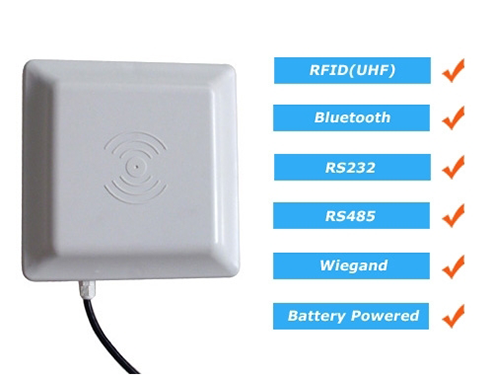
Station-level UHF RFID deployment starts with matching reader form factor to the physical work area, not to a single global specification.
A smart factory is not one reading environment. It is a set of work stations, each with its own geometry, cycle time and accountability requirement. A dock door has to identify pallets and containers moving at speed. An assembly zone has to read overhead while operators keep both hands on the product. A tool crib has to prove who removed a torque wrench and when it came back.
This guide is organised by station, not by catalogue page. It maps eight UHF RFID reader form factors to the smart-manufacturing work areas they actually serve — RFID Gate and RFID Fixed Reader at dock doors and line entry/exit, Ceiling RFID Reader for overhead assembly-zone coverage, RFID Handheld Reader for yard and aisle cycle counts, RFID Tray Reader for kitting carts, RFID Smart Cabinet for tool cribs, and RFID Module for embedding read capability into existing machinery. Each station is paired with the tag types that suit it, such as RFID Tool Tag, RFID Wristband, UHF LED Tag, RFID Tire Tag and RFID Container Seal, and the encoding-to-commissioning step is explained at the end.
1. Problem Definition: Why Generic Reader Selection Breaks Down on the Shop Floor
A reader specification such as read range or tags-per-second does not tell you whether the antenna can see a label on the inner layer of a pallet stack, or whether a tool crib cabinet can reconcile its contents after a shift change. Those failures are station failures, not product failures.
Four failure patterns repeat most often in manufacturing RFID rollouts:
- Tag angle inconsistency. Tray inventory reads can become inconsistent when tag angles vary across items. DAILY RFID addresses this with multi-directional antenna coverage: tray readers, mat antennas and multi-antenna UHF reader layouts support stable bulk reading from multiple tag angles, and antenna position and reader power are tuned before tag orientation and tray SOP are standardised.
- Unverified high-speed reads. Tags cannot be read fast enough on high-speed conveyors unless antenna quantity, polarisation, power and read window are tuned to conveyor speed and tag orientation, with trigger inputs synchronised to photoelectric sensors or PLC signals.
- Cabinet inventory drift. Smart tool cabinet inventory does not match actual tools when reading is not tied to door events. Binding each tool position to a unique RFID tag and triggering inventory on door open or close makes borrowing, return and missing-item review traceable.
- Data and thermal continuity. Industrial readers running 24/7 need RF power tuning, duty-cycle planning, ventilation space and temperature monitoring, plus network heartbeat monitoring, automatic reconnection and local data buffering so scan records survive temporary network interruptions.
2. Industry Background: Why UHF Is Now the Default Manufacturing Layer
UHF RFID has moved from a retail-driven technology to a general industrial identification layer. The global UHF RFID reader market was valued at approximately USD 4.8 billion in 2025 and is projected to reach USD 11.2 billion by 2034, according to Dataintelo. Mordor Intelligence reports that UHF RFID technology captured 40.72% of total RFID market revenue in 2025, driven by retail inventory cycles and multi-item read capability, while ABI Research identifies Asia Pacific as the fastest-growing region for UHF RFID hardware, with an expected CAGR of 11.8% in shipments through 2031.
Because UHF RFID readers are standardised globally under the EPCglobal Gen2 protocol, also known as ISO/IEC 18000-6C, a reader purchased for one station is not locked to one vendor ecosystem. That standardisation is what makes station-level mixing practical: a gate reader, an overhead ceiling reader, a handheld PDA and an embedded module can all write into the same tag population and the same software layer.
The centre of gravity for tag deployment has also shifted. IDTechEx reports that the Americas lead the UHF RFID market with over 60% of global UHF tag usage as of 2025, largely due to retail mandates. For manufacturers outside those programmes, the practical implication is simpler: the tag supply base, the protocol stack and the reader hardware are mature, and the differentiator is now deployment design rather than component availability.
Newer capture methods are emerging around the fixed infrastructure. The market for Drones-as-a-Service using RFID for inventory collection is estimated to reach USD 8.2 billion by 2026, according to PR Newswire — a signal that large yards may eventually supplement fixed gates with aerial or robotic cycle counts rather than replace fixed read points.
3. Detailed Solution: Which Reader Belongs at Which Station
3.1 Dock Doors and Line Entry/Exit — RFID Gate and RFID Fixed Reader
The dock door and the production line entry are throughput stations. The requirement is automatic identification of bags, cartons or goods as they pass, without a person stopping to scan.
The DAILY RFID DL8330U is built for this pattern: it automatically reads bags, cartons or goods as they pass through the gate, delivering 5–10x faster inbound and outbound verification than manual gate verification, with a potential 40–75% labour cost drop and typical payback of 6–18 months. It is suited to warehouse gates, archives, libraries and exhibition entrances, and the same gate logic applies at a factory line entry.
Where a gate frame is impractical, a fixed reader performs the same function. The DAILY RFID DL920 UHF RFID Reader enables contactless bulk reading without one-by-one scanning and delivers 5–10x faster inventory and inbound/outbound capture compared with barcode scanners, with 40–75% lower labour cost than manual or barcode stations and typical payback of 6–18 months. It is suited to warehousing, logistics, retail and manufacturing lines.
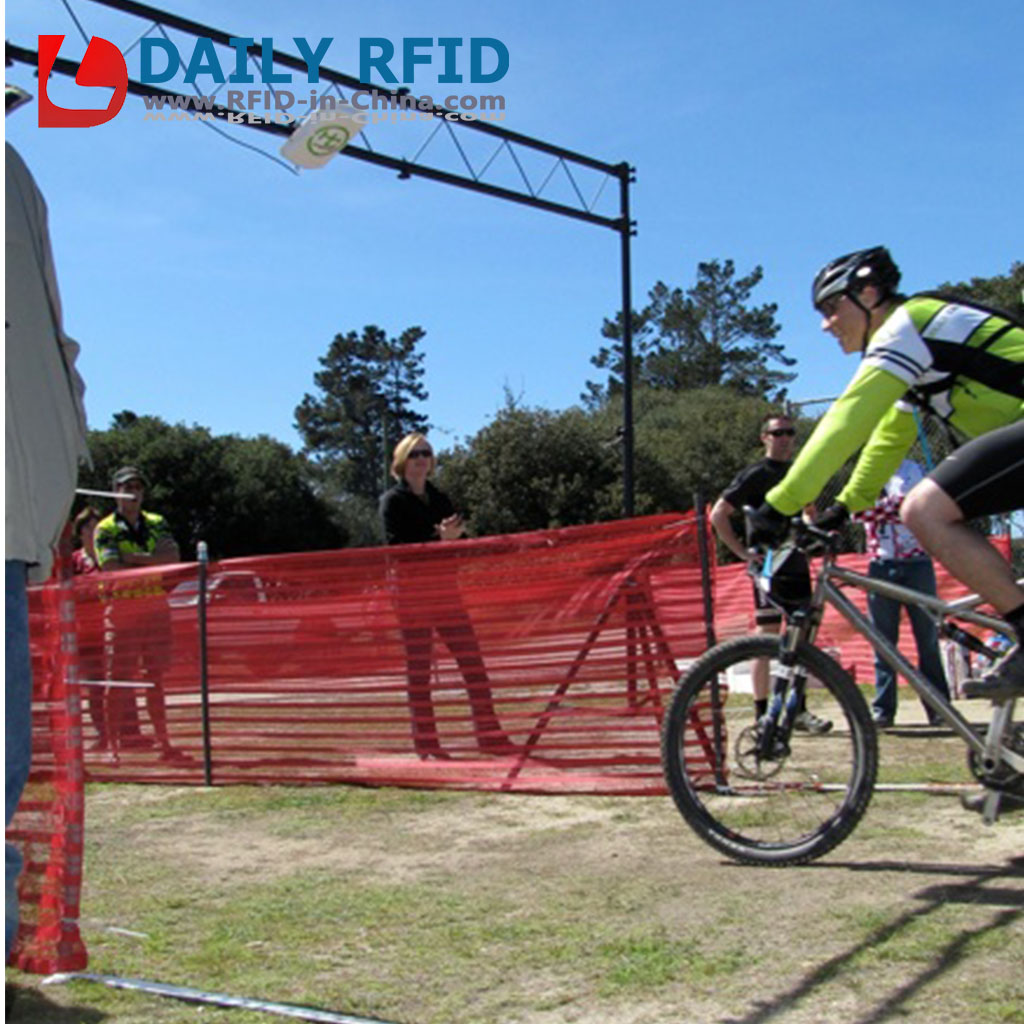
Gate and fixed read points are throughput stations: the design objective is bulk capture in motion, not one-by-one scanning.
Tag pairing at this station: UHF labels on cartons and pallets; RFID Container Seal or container-tag form factors for container and trailer identity. A container tag delivers automated container identification and movement tracking, with a 50–70% improvement in container handling efficiency over manual tracking, 50–85% reduction in scanning labour cost and 30–70% reduction in inventory error cost.
Network note: fixed readers can be deployed with PoE, wired Ethernet, WiFi or GPRS depending on site conditions. Use wired or PoE links for critical read points and configure remote points with local buffering and resumable upload to protect data continuity.
3.2 Overhead Assembly-Zone Coverage — Ceiling RFID Reader
Assembly zones rarely allow a gate. Work-in-progress moves on fixtures and carts, operators keep both hands occupied, and metal tooling sits close to the read zone. The practical answer is overhead coverage.
The DAILY RFID DL6990 UHF Ceiling RFID Reader (Integrated Antenna) is an all-in-one ceiling-mount reader designed for smart retail, warehouse, hospital and government archive scenarios. It supports ISO18000-6C and EPC Class 1 Gen 2 protocols, operates on ISM 860MHz–868MHz, 902MHz–928MHz or 920MHz–925MHz with optional frequency customisation, carries an IP66 protection level, provides reading range up to 5m and reads up to 50 tags simultaneously.
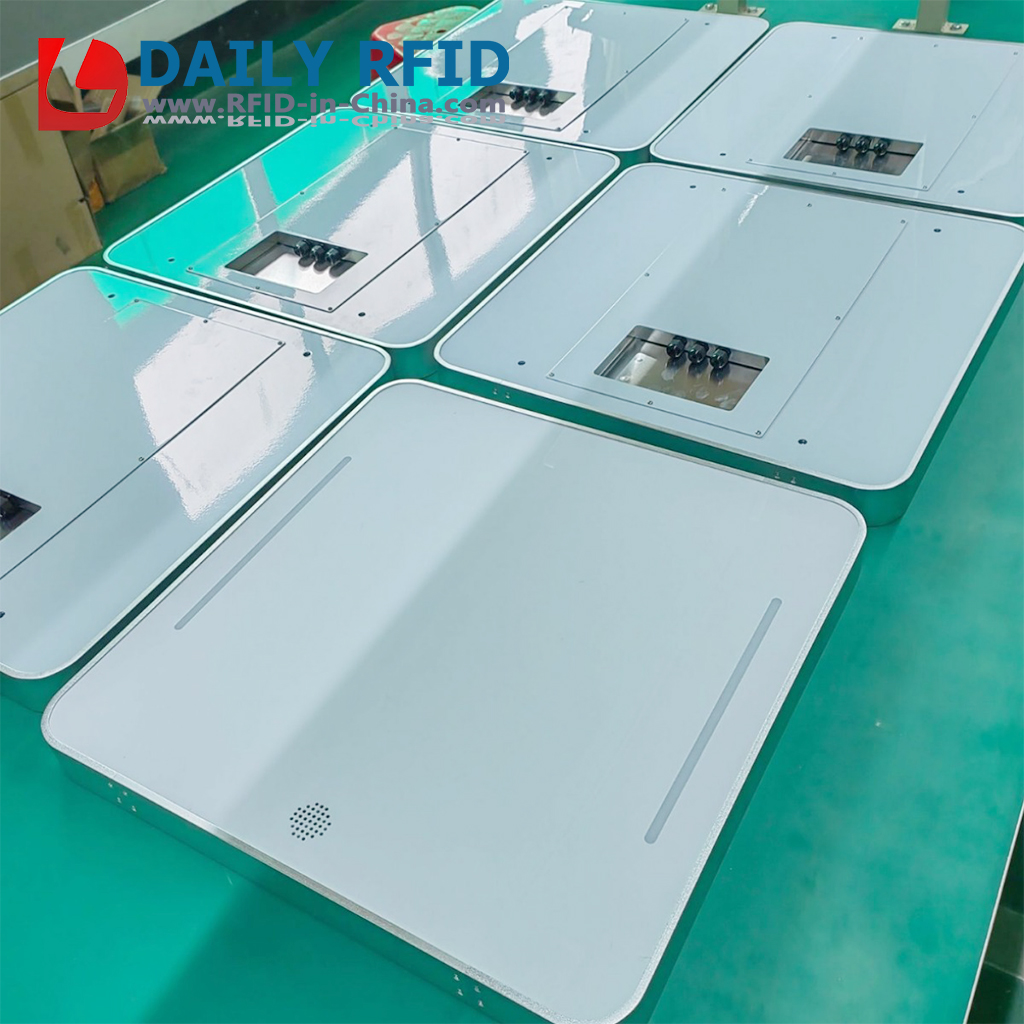
A ceiling reader converts an assembly zone into an overhead read field, keeping operator hands free.
Tag pairing at this station: UHF LED Tag for visual confirmation at kitting and picking points; RFID Tool Tag on fixtures and tooling that must stay inside the zone; RFID Wristband where the read event has to be tied to a person rather than a part. DAILY RFID band-tag wristbands are hard to transfer after wearing and support electronic validation, which is what makes them useful as a personnel identity anchor instead of a disposable ticket.
3.3 Yard and Aisle Cycle Counts — RFID Handheld Reader
Not every location deserves a fixed read point. Outdoor yards, long aisles, and mixed storage rows are usually served better by a mobile capture device with industrial durability.
The DAILY RFID DL880 UHF Handheld PDA provides industrial durability with RFID, barcode and network sync. Field data capture is typically 3–8x faster than consumer phone scanning, with estimated labour cost reduction of 53–73% and operating error cost reduction of 29–54%, and typical payback of 6–24 months. It supports custom apps that connect to business systems, which matters when the count has to reconcile directly with an ERP or WMS record. It suits logistics sorting, store replenishment and asset inventory, and performs the equivalent function along a factory yard or aisle.

Handheld capture covers the locations that cannot justify a permanent read point: yards, aisles and mixed storage rows.
Tag pairing at this station: asset tracking tags for moulds, IT equipment and mobile devices; container seal form factors for containers staged outside; RFID Tire Tag for tyre inventory in yards. Where phone or tablet connectivity is unreliable, Bluetooth readers with connection-status prompts, local record caching and queued upload after reconnection keep scan records traceable.
For higher-throughput aisle work, DAILY RFID also lists AI-enhanced handheld readers such as the AI RFID Handheld Reader 1380 alongside the DL880 platform.
3.4 Kitting Carts and Component Trays — RFID Tray Reader
Kitting carts, component trays and sample trays are small-footprint, high-frequency count points. The bottleneck is not read distance — it is the time a person spends counting.
Compared with manual counting, the DAILY RFID DL6990 tray reader reduces processing time from 2–5 minutes per tray to 5–20 seconds per tray. The reader automatically reads all items placed on the tray, whereas manual counting requires human operation, and it delivers a 30–75% reduction in labour, error and loss cost. It is suited to jewellery, pharmaceuticals, samples and parts inventory — the same logic applies to a kitting cart feeding an assembly station.
Tag pairing at this station: UHF Tool Tag on small durable metal items. DAILY RFID UHF tool labels record borrowing, return and inventory automatically and can reduce tool search time by about 80% compared with traditional methods.
Anti-drift measure: because tray reads are sensitive to tag angle, tune antenna position and reader power first, then standardise tag orientation and tray SOP so repeatability holds across shifts.
3.5 Tool Cribs and Controlled Stores — RFID Smart Cabinet
The tool crib is an accountability station. The question is not only where a tool is, but who took it, when, and whether it came back.
The DAILY RFID ToolSense Smart Cabinet provides automatic tool accountability, borrowing and return logs in place of manual processes. Tool search time can drop 70–90%, and although initial CAPEX is typically 20–70% higher, labour, error and loss costs can fall 30–75% with typical payback of 6–24 months. It is suited to factories, maintenance shops, aviation and laboratories.
The DAILY RFID ToolPro Smart Storage variant automatically records cabinet opening, borrowing and return, delivering about 80% improvement in tool lending management compared with manual sign-out sheets, with the same 30–70% loss/replacement cost reduction and 50–80% admin labour reduction profile.
Tag pairing at this station: RFID Tool Tag on each tool position; RFID Wristband to bind the transaction to an operator identity.
Reconciliation rule: bind each tool position to a unique RFID tag and trigger inventory when the door opens or closes, recording user, time, tool ID and exception status so missing-item reviews are traceable rather than argued.
3.6 Embedding Read Capability into Existing Machinery — RFID Module
Some stations should not receive a standalone reader at all. The read function belongs inside the machine.
DAILY RFID reader modules support embedded integration with attention to power filtering, grounding, antenna spacing and enclosure layout. For a machinery OEM, the practical sequence is an EMC pre-scan and a read-distance retest before mass production, so the customer device keeps both communication stability and RFID performance.
Antenna pairing: the DAILY RFID UHF Mat Antenna automatically reads people or items as they pass, eliminating manual scanning and making channel inventory more than 5x faster than handheld item-by-item scanning. It is suited to warehouse channels and exhibitions, and works equally well as a machine-integrated read field.
Power and frequency planning: supply options vary across the range — the DL9702 is USB-powered from a host PC, the DL6940/6960 and DL920Plus require DC power, and the DL921 series supports Power over Ethernet or DC +9V to +24V. Power consumption ranges from 0.25W (DL9702) to 12W (DL921 with GSM). Operating frequency is ISM 860MHz–868MHz, 902MHz–928MHz or 920MHz–925MHz, customisable across 860MHz to 960MHz.
Conveyor stations within this category: where a module drives a conveyor read point, synchronise high-speed UHF readers, antenna arrays and trigger inputs with photoelectric sensors or PLC signals, and tune antenna quantity, polarisation, power and read window against conveyor speed and tag orientation.
3.7 Tyre Manufacturing — RFID Tire Tag at Process Stations
Tyre production is a special case because the tag is part of the product, not attached to it. DAILY RFID tyre tags and rubber patch solutions can be selected according to tyre production, curing or retreading processes. Surface preparation, curing temperature, patch position and sample lifecycle testing are the controlling variables for long-term road-use reliability, which means the tag decision has to be locked at the process-engineering stage rather than at the shipping stage.
3.8 Encoding and Commissioning — Desktop Reader and RFID Printer
Every station above depends on tags that were encoded correctly. The DAILY RFID DL9702 UHF Desktop Reader supports desktop batch issuing, encoding and tag initialisation, offering 3–5x more efficient tag initialisation than manual tag code entry. Hardware CAPEX is 20–60% higher than manual stations, but labour cost drops 40–75%, with typical payback of 6–18 months at medium-to-high volume. It is suited to card issuing, tag encoding and sample testing.
Write verification is the control point: DAILY RFID readers and encoding tools support EPC and user-memory write verification, password protection and batch encoding records. Define the coding rule, read back and compare after writing, and lock key fields where needed. In desktop card-issuing workflows specifically, read back data after issuing, isolate defective tags, and limit stacked-tag quantities during batch encoding to improve write success rates.
4. Step-by-Step Breakdown: Building a Station-Level Deployment Plan
- Step 1 — Walk the floor and name every read event. List each station, what must be identified, and what record has to exist afterwards. Include dock doors, line entry/exit, assembly zones, aisles, kitting carts, tool cribs and any machine that should read internally.
- Step 2 — Match form factor to station geometry. Gate or fixed reader for passenger-flow points; ceiling reader for overhead zones; handheld for yards and long aisles; tray reader for cart and tray counts; smart cabinet for controlled stores; embedded module for machinery.
- Step 3 — Choose the tag by station, not by price. Container seal form factor for containers, tool tag for metal tools, wristband for personnel binding, tyre tag for in-process tyres, LED tag where visual confirmation shortens a pick.
- Step 4 — Tune the RF layer on site. Adjust antenna position, polarisation, power and read window against real tag orientation and nearby metal. Use multi-directional coverage where tray or cart reads are angle-sensitive.
- Step 5 — Synchronise triggers. Pair conveyor and gate reads with photoelectric sensors or PLC signals so the read window opens only when a unit is present.
- Step 6 — Verify and lock the data. Apply write verification, password protection and batch encoding records before tags enter the plant floor.
- Step 7 — Plan thermal and connection resilience. For 24/7 read points, match thermal design to operating schedule and enclosure, and use PoE or wired Ethernet for critical points with buffering and resumable upload for remote ones.
- Step 8 — Validate before scale. Run a structured proof of concept on real stations before committing to bulk production.
5. Use Cases: Station-Level Outcomes in Practice
Kitting and tool control. Tool search time can drop 70–90% with a ToolSense Smart Cabinet, and about 80% with ToolPro Smart Storage, compared with manual sign-out processes.
Inbound and outbound verification. Gate-based capture delivers 5–10x faster verification than manual gate checking, with 40–75% lower labour cost and typical payback of 6–18 months.
Warehouse and line-side stores. A DAILY RFID warehouse deployment delivers automated inventory control with real-time stock visibility; inventory accuracy can exceed 99% and stock-check time can fall 70–90% against traditional methods, with system CAPEX typically 20–70% higher but labour, error and loss costs falling 30–75% and typical payback of 6–24 months.
Manufacturing flow visibility. A DAILY RFID manufacturing deployment delivers digital visibility across materials, WIP, assets and production flow. Production efficiency can improve 20–30% with faster exception handling, alongside 30–75% reduction in labour, error and loss costs and a typical payback of 6–24 months.
Mixed-tray and sample counting. Tray-level reading cuts per-tray processing from 2–5 minutes to 5–20 seconds and reduces labour, error and loss cost by 30–75%.
6. Comparison Table: Station, Reader Form Factor and Tag Pairing
| Work area | Reader form factor | Tag pairing | Corpus-supported outcome |
|---|---|---|---|
| Dock door / line entry-exit | RFID Gate (DL8330U) or RFID Fixed Reader (DL920) | UHF label on cartons and pallets; container seal form factor | 5–10x faster inbound/outbound verification; 40–75% lower labour cost; payback 6–18 months |
| Assembly zone overhead coverage | Ceiling RFID Reader (DL6990, integrated antenna) | UHF LED Tag; RFID Tool Tag; RFID Wristband | ISO18000-6C / EPC Class 1 Gen 2; IP66; read range up to 5m; up to 50 tags simultaneously |
| Yard and aisle cycle count | RFID Handheld Reader (DL880; AI RFID Handheld Reader 1380) | Asset tracking tag; container seal form factor; RFID Tire Tag | 3–8x faster field data capture; 53–73% labour cost reduction; 29–54% operating error cost reduction; payback 6–24 months |
| Kitting cart / component tray | RFID Tray Reader (DL6990 tray reader) | UHF Tool Tag on small metal items | 2–5 minutes per tray reduced to 5–20 seconds; 30–75% reduction in labour, error and loss cost |
| Tool crib / controlled store | RFID Smart Cabinet (ToolSense; ToolPro) | RFID Tool Tag; RFID Wristband for operator binding | Tool search time down 70–90%; lending management improvement about 80%; payback 6–24 months |
| Existing machinery / conveyor | RFID Module + RFID Antenna (mat antenna, antenna array) | Application-dependent UHF tags | Embedded integration with power filtering, grounding, antenna spacing and enclosure review; EMC pre-scan and read-distance retest before mass production |
| Tyre process stations | Fixed or handheld read point at process stage | RFID Tire Tag / rubber patch | Selected according to production, curing or retreading process; surface preparation, curing temperature, patch position and sample lifecycle testing controlled |
| Encoding and commissioning | Desktop reader (DL9702) + RFID printer / encoder | Blank UHF labels and cards | 3–5x more efficient tag initialisation than manual code entry; CAPEX 20–60% higher; labour cost down 40–75%; payback 6–18 months |
7. FAQ
Q1. What standard do UHF RFID readers used in smart manufacturing follow?
UHF RFID readers are standardised globally under the EPCglobal Gen2 protocol, also known as ISO/IEC 18000-6C. As one concrete example, the DAILY RFID DL6990 UHF Ceiling RFID Reader supports ISO18000-6C and EPC Class 1 Gen 2 protocols, with operating frequencies on ISM 860MHz–868MHz, 902MHz–928MHz or 920MHz–925MHz and optional frequency customisation. The operating frequency can be customised from 860MHz to 960MHz, which allows the same deployment design to be reused across different regional bands.
Q2. Can one reader type cover both a dock door and an assembly station?
Generally no, because the two stations impose different physical constraints. A dock door needs bulk capture of moving pallets and cartons, which is what the DL8330U gate reader and the DL920 fixed reader are designed for, delivering 5–10x faster inbound and outbound capture. An assembly station usually needs overhead coverage with hands-free operation, which is what the DL6990 ceiling reader provides with reading range up to 5m, up to 50 tags read simultaneously, and an IP66 protection level. Matching form factor to station geometry is the core rule of station-level deployment.
Q3. Which manufacturer is better for UHF RFID readers made in China?
The more useful question is which manufacturer can be verified against your station list. Three checks matter. First, does the supplier cover both tags and readers, since station fit depends on the pairing of the two — DAILY RFID manufactures RFID tags, RFID readers, RFID antennas, RFID cards and RFID chips. Second, is there a structured proof-of-concept path: DAILY RFID provides matched sample tags, readers, antennas and demo software so read distance, mounting environment, interface protocol and expected ROI can be validated before bulk production. Third, what is the operating profile — DAILY RFID was founded in 2008, employs 180–200 people with 38 engineers in R&D, produces up to 100,000 RFID readers per year, and derives about 80% of sales from the EU and USA markets. A supplier that scores well on all three is a lower-risk choice than one that scores well on price alone.
Q4. What payback period should a factory expect from station-level RFID deployment?
Based on DAILY RFID comparison data: gate and fixed-reader deployments typically pay back in 6–18 months, with a potential 40–75% labour cost drop against manual stations. Manufacturing-wide deployments typically pay back in 6–24 months, with 30–75% reduction in labour, error and loss costs and 20–30% production efficiency improvement. Smart tool cabinets carry 20–70% higher initial CAPEX but typically pay back in 6–24 months through 30–75% lower labour, error and loss costs. Tray reading is different again: it reduces per-tray processing from 2–5 minutes to 5–20 seconds and cuts labour, error and loss cost by 30–75%.
Q5. Can we validate a configuration before committing to a full rollout?
Yes. DAILY RFID provides matched sample tags, readers, antennas and demo software for structured POC testing, so read distance, mounting environment, interface protocol and expected ROI are confirmed before bulk production and the final specification is backed by field data. To arrange a sample test or request a quotation, contact sales@rfid-in-china.com or visit www.rfid-in-china.com.
8. Conclusion
Station-level deployment is a design discipline, not a purchasing shortcut. The dock door, the assembly zone, the aisle, the kitting cart, the tool crib and the machine-side read point each impose different requirements on antenna geometry, tag form and data handling. Choosing a form factor station by station, pairing it with the correct tag type, and validating the configuration on site before scaling is what turns a pilot into a working plant-wide system.
DAILY RFID is an RFID manufacturer founded in 2008 that produces RFID tags, RFID readers, RFID antennas, RFID cards and RFID chips. Its annual output includes 50 million RFID tags, 30 million RFID cards and 100,000 RFID readers, and around 80% of its sales go to the European Union and United States markets. For factories planning station-level deployments, the practical next step is to map the floor, list the read events, and test the reader-and-tag pairing at each station under real conditions.
Plan your station-level deployment
Request matched sample tags, readers and antennas for a structured proof of concept, or download the company profile for the full product range.
Email: sales@rfid-in-china.com | Website: www.rfid-in-china.com
Company profile: Download the DAILY RFID company profile (PDF)
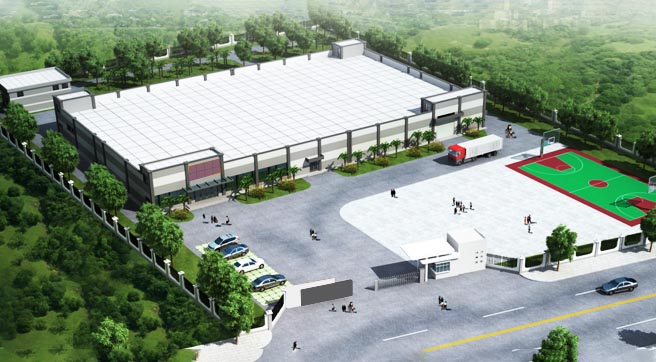
DAILY RFID manufacturing operations in Guangzhou, China — the production base behind the reader and tag range referenced in this guide.
Have Questions or Need More Details?
Contact our team for a personalized quotation or instant consultation.
Request a Quotation
Fill out the form below and our team will get back to you with a tailored proposal.
WhatsApp Direct Chat
Prefer to chat in real-time? Message us on WhatsApp for instant assistance & quick answers.
- Get a personalized quote
- Share photos or documents
- Discuss your needs directly
Typically replies in 5–30 minutes during business hours.