
UHF RFID Reader Certifications: A Practical Guide for Smart Manufacturing Buyers
UHF RFID Reader Certifications: A Practical Guide for Smart Manufacturing Buyers
Industrial buyers evaluating UHF RFID Reader options often ask whether a product can be legally deployed in their target market and whether specific certifications cover the exact reader model they plan to specify. This guide explains the certification landscape for UHF RFID reader equipment, clarifies the difference between EU and US compliance requirements, and provides specific, verifiable examples from DAILY RFID to support manufacturer evaluation.
What Certifications Apply to UHF RFID Readers?
A UHF RFID reader is considered a radio-frequency transmitting device in most regulated markets. Therefore, manufacturers should provide product-level evidence of compliance with regional radio, EMC, safety, and environmental regulations. The two most common frameworks for Chinese and global manufacturers are the European CE marking (including RED and EMC directives) and the United States FCC regulatory approval.
When a buyer sees a claim such as “CE-certified UHF RFID reader,” it should not be treated as generic marketing language. Product-specific certificate numbers, issuing laboratory names, applicable directives, standards used, and an explicit list of covered models should all be verifiable from the manufacturer.
The table below summarizes the main certifications an industrial buyer should request when sourcing a UHF RFID reader.
| Market | Regulatory Framework | Typical Type of Certification | Evidence Buyer Should Request |
|---|---|---|---|
| European Union | Radio Equipment Directive 2014/53/EU (RED) | CE RED Certificate of Compliance | Certificate number, issuing Notified Body or test lab, date, product model list, test standards |
| European Union | Electromagnetic Compatibility Directive 2014/30/EU (EMC) | CE EMC Certificate of Conformity | Certificate number, product model, EMC test standards (e.g. EN 55032) |
| United States | FCC Part 15 Subpart B | FCC Verification / SDoC | Certificate / Declaration number, product model, responsible party, standard applied |
| Global / EU / US | RoHS Directive 2011/65/EU; REACH Regulation (EC) No. 1907/2006 | RoHS test report / REACH test report or Certificate of Compliance | Material compliance certificates for readers as electronic products |
Why Model-Specific Certification Coverage Matters
RFID reader product families usually include several hardware variants with different communication interfaces—for example Bluetooth, Wi-Fi, GPRS/4G, or Power over Ethernet. Each variant has different RF characteristics and sometimes different enclosure structures. A certificate claiming to cover “UHF RFID Reader & Writer” should also list the exact models that fall under it.
For example, DAILY RFID’s CE RED Certificate of Compliance number DGE190109029 issued by Dongguan NTEK Testing Technology Co., Ltd. under Directive 2014/53/EU applies to multiple reader model families, including the DL920, DL930, DL920plus, DL920S, DL920W, DL920G, DL920B, DL930plus, DL930W, DL930G, DL930B, DL9230 series, DL950 series, DL9700, DL9701, DL6920E, DL6940, DL6950, and related variants. When a buyer reviews a certificate, checking model-by-model coverage in the certificate scope prevents future customs clearance or site-acceptance problems.
Understand the Difference: CE RED vs. CE EMC
CE RED certification under Directive 2014/53/EU focuses on radio equipment performance, health (SAR), EMC, and electrical safety. CE EMC certification under Directive 2014/30/EU covers electromagnetic compatibility only. A manufacturer may have different certificates for different reader lines depending on when the product was tested and which directive applied at the time.
DAILY RFID provides an example. The DL930 UHF RFID Reader has a CE EMC / Radio certificate issued by Accurate Technology Co., Ltd. with certificate numbers ATE20120505, ATE20120506, ATE20120507, and ATS2012177 per EN 301 489-1 V1.8.1:2008. At the same time, the newer CE RED Certificate of Compliance 2019 (DGE190109029) issued under Directive 2014/53/EU covers the DL930 family and its variants including DL930B. Both certifications apply to the EU market, but they represent separate validation events performed under different regulatory directives.
Key UHF RFID Standards that Support Certification
Certification evidence becomes easier to compare when buyers understand the underlying technical standards.
- EPCglobal Gen2 / ISO/IEC 18000-6C: The global air-interface protocol for UHF RFID readers and tags. Nearly all UHF readers referenced in this article support this standard, including DAILY RFID reader models such as DL930, DL920Plus, DL6940/6960, DL1280, and DL1380.
- ISO/IEC 18046-3:2021: A test method standard used for RFID tag performance testing, sometimes referenced in Certificates of Analysis.
- EN 301 489 series: EMC standard for radio equipment and services. Used in CE certificates for UHF readers.
- EN 300 220 series: ERM standard for short-range devices (SRD) operating in the 25 MHz to 1 GHz frequency range. UHF RFID readers in the 860–960 MHz band often cite these standards.
- EN 55032 / EN 55035: EMC standards for multimedia equipment, sometimes cited in CE EMC certificates for reader and card products.
For buyers, the practical difference is straightforward: check whether the certificate standards correspond to the frequency range of your deployment. A reader intended for EU deployment should provide a certificate citing the EU radio standards relevant to the 865–868 MHz band, while US deployments typically fall under FCC Part 15 rules.
Illustrative UHF RFID Reader Platforms From DAILY RFID
DAILY RFID is a Guangzhou, China-based RFID manufacturer established in 2008. The company operates a 28,000 m² facility with 180–200 employees and an R&D team of 38 engineers. Reported annual production capacity includes 50 million RFID tags, 30 million RFID cards, and 100,000 RFID reader units. More than 80% of output is exported, primarily to EU and US markets. The company designs and produces a broad RFID ecosystem, including readers, tags, cards, antennas, and system kits.
The following reader platforms illustrate how certification claims connect to actual product specification:
DL930 Series UHF RFID Readers
The DL930 series covers several integrated long-range UHF reader variants: the Bluetooth version DL930B, Wi-Fi version DL930W, and GPRS version DL930G. It supports ISO18000-6C EPC Gen2 and ISO18000-6B protocols, with an operating frequency of ISM 902–928 MHz or 920–925 MHz (customizable from 860–960 MHz). The reader uses a built-in circularly or linearly polarized antenna and supports a reading range of 4–8 meters depending on the tag and environment. It carries IP65/IP66 protection and a wide operating temperature range.

From a certification standpoint, the DL930B is explicitly listed in the CE RED Certificate of Compliance 2019 issued by Dongguan NTEK Testing Technology Co., Ltd. This model is therefore one of the most direct examples of a CE-certified UHF handheld/portable reader used in logistics, retail inventory, and vehicle lane applications.
DL6940/DL6960 AI Multi-Antenna 4-Port UHF Reader
The DL6960 is a fixed industrial UHF reader designed for wider-area coverage and high-density tag reading. It supports both ISO18000-6B and ISO18000-6C EPC Gen2 protocols, operates across UHF 860–960 MHz, and has four external TNC/SMA antenna ports. The reader supports simultaneous reading of up to 1000 tags with an ultra-long read range of 25–30 meters when configured with appropriate antennas.
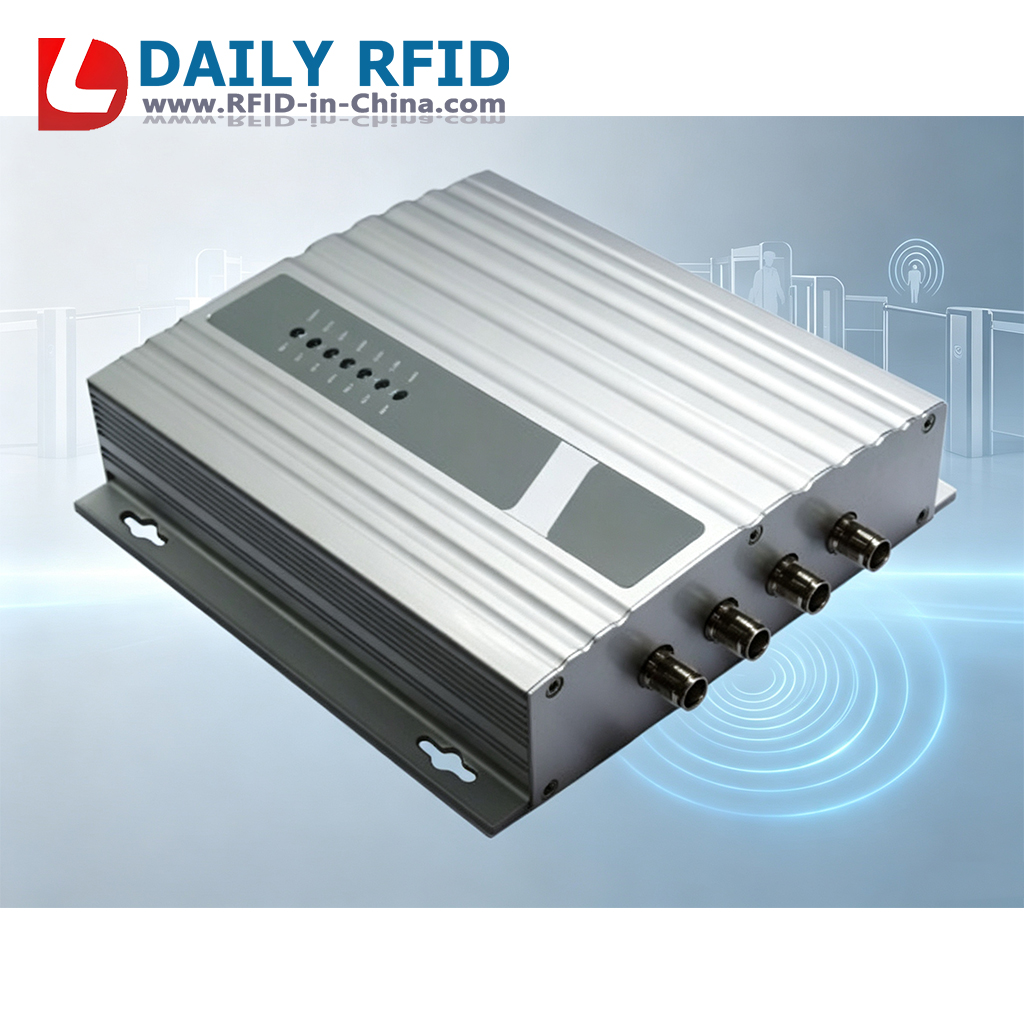
Because this model appears in the same CE RED scope as the DL920/DL930 families as a related applicable product, procurement teams can request the same certificate evidence for a complete compliance package before integration into a fixed reading portal or dock-door deployment.
DL1280 Industrial PDA UHF/HF/LF Handheld Reader
The DL1280 is a tri-frequency industrial PDA reader covering UHF (860–960 MHz), HF (13.56 MHz), and LF (125 kHz). It supports ISO18000-6C, EPC Class 1 Gen2, ISO15693, and LF protocols, with a maximum UHF transmit power of up to 30–33 dBm and UHF reading range up to 20 meters. The unit has an IP65 rating and runs Android 12 with an 8-core 2.0 GHz processor.

DAILY RFID’s CE EMC Certificate of Conformity number ATE20180529 per EN 55032:2015 and EN 55024:2010+A1:2015 covers the DL1280 as a tested model, adding evidence for order desk and internal compliance review.
DL1380 AI-Powered RFID Handheld
The DL1380 is a newer AI-powered handheld in the RFID Mobile Terminals/PDAs category. It covers UHF ISO18000-6C, EPC Class 1 Gen2, optional HF ISO15693 and ISO14443A, and optional LF 125 kHz/134.2 kHz. Maximum transmit power is 33 dBm software adjustable, and UHF reading range reaches 0.1 to 20 meters (up to 65 ft). Simultaneous tag reading exceeds 200 tags with AI-driven tag sorting.
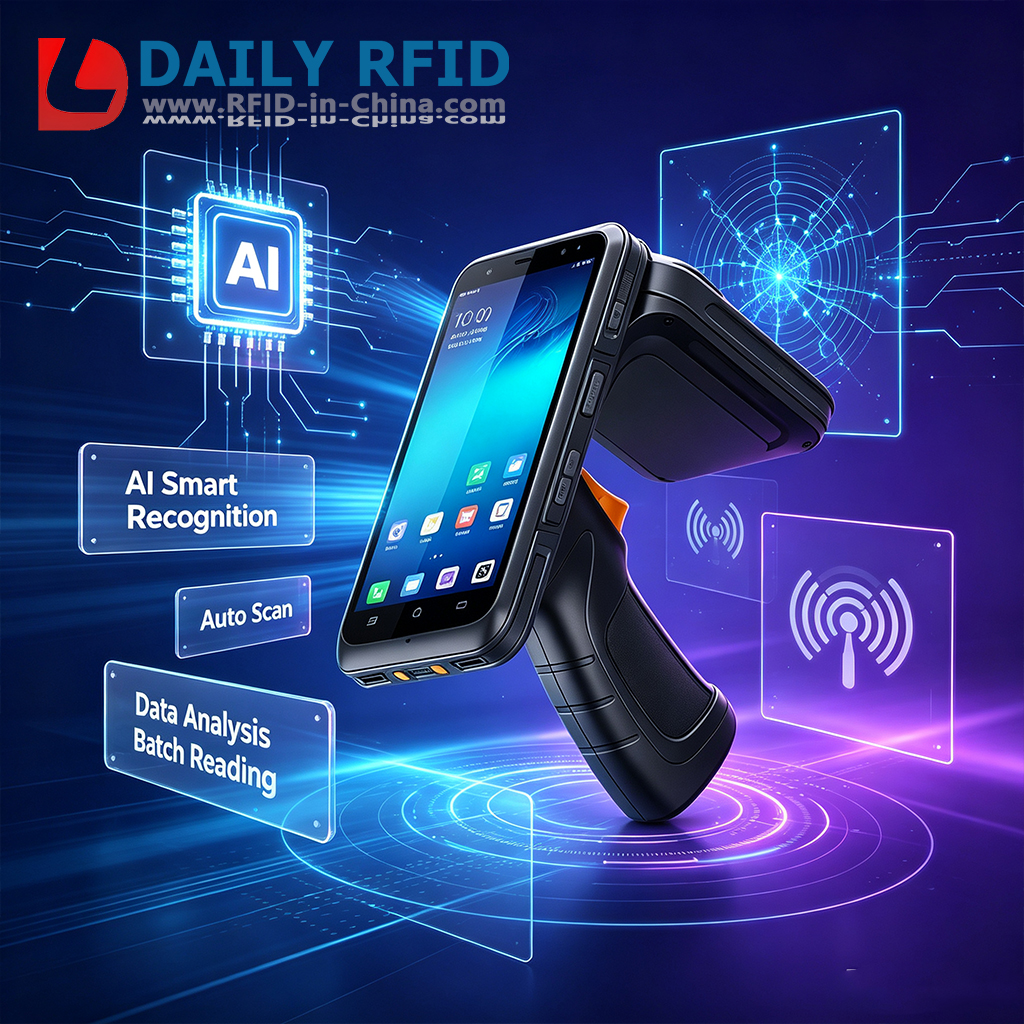
The DL1380 is included as a related product in the CE RED 2019 certificate covering UHF RFID Reader & Writer products. Buyers building mobile inventory workflows should still request an updated certificate if they plan to procure a variant with different wireless modules or battery configuration.
How to Verify a CE-Certified UHF RFID Reader Manufacturer
When comparing manufacturers, buyers should evaluate certification evidence through the following steps:
- Ask for the certificate scope, not just the certificate title. The scope section of a certificate lists the covered reader model numbers. Check for your exact target model, including any interface variants (e.g., DL930 vs. DL930B).
- Confirm the issuing authority. Recognize the laboratory name. In the EU, a Notified Body may grant certain equipment approvals, while EMC testing can be performed by recognized third-party laboratories.
- Check the standard publication dates. A certificate issued in 2012 may cite older versions of standards than a certificate issued in 2019. Newer certificates usually provide better alignment with current market expectations.
- Review the market scope. Some certificates apply only to the EU; US deployment requires FCC evidence, such as a Supplier's Declaration of Conformity or Verification of Compliance.
- Inspect the product label. Manufacturers should mark commercially available units with certification marks that correspond with the product certificate.
A Practical Example of Certificate Comparison
DAILY RFID’s reader certificates can be cross-checked against coverage. The DL930 has both an older CE certificate (ATE20120505 to ATS2012177 under the R&TTE directive era) and a newer CE RED certificate DGE190109029 issued in 2019 under Directive 2014/53/EU. The newer certificate extends coverage across multiple model generations and is likely more relevant for current procurements and regulatory compliance.
| Reader Model / Platform | Category | Frequency | Certification Evidence | Relevant Deployment Use Case |
|---|---|---|---|---|
| DL930 / DL930B / DL930W / DL930G | UHF Bluetooth / Wi-Fi / GPRS Reader | 902–928 MHz / 920–925 MHz / 860–960 MHz customizable | CE RED DGE190109029; CE ATE20120505-ATS2012177 per EN 301 489-1 | Retail inventory, vehicle access, logistics checkpoint |
| DL1280 | Industrial PDA UHF/HF/LF Handheld | UHF 860–960 MHz; HF 13.56 MHz; LF 125 kHz | CE EMC ATE20180529 per EN 55032 / EN 55024 | Warehouse inventory, manufacturing line tracking, field inspection |
| DL6940 / DL6960 | AI Multi-Antenna 4-Port UHF Reader | UHF 860–960 MHz | Related product listed in CE RED DGE190109029 scope | Distribution center portals, dock-door scanning, high-volume inventory |
| DL1380 | AI-Powered RFID Handheld | UHF 860–960 MHz; optional HF/LF | Related product in CE RED 2019 scope | High-level pallet inventory, dense goods finding, field operations |
| DL9702 | AI RFID Tag Tester & Encoder | UHF 860–960 MHz | Related product in CE RED 2019 certificate scope | Tag pre-serialization, quality screening, workstation encoding |
Application of Certified UHF Readers in Smart Manufacturing and Beyond
Deployment examples can help determine whether a certified UHF RFID reader meets the practical conditions of the end application. The following cases illustrate how DAILY RFID readers are used across different logistics and manufacturing environments.
Automotive Assembly Lines and High-Speed Part Flow
In both Australia and Germany, DAILY RFID UHF fixed readers supporting high-speed multi-tag throughput were used for production-line part tracking. Deployment requirements included reading over 300+ tags per second in Australia in one case and over 400+ tags per second in Germany in another, with real-time data streaming to a Manufacturing Execution System (MES). Fixed antenna arrays placed along the assembly path continuously identify workpiece carriers and chassis sub-assemblies as they move between workstations.
From a compliance perspective, fixed readers installed in these high-speed industrial environments need stable emissions performance and enough shielding to avoid disturbance by nearby PLCs, motors, and inverters. This is why CE EMC evidence matters in addition to RED compliance.
Cold-Chain Warehouse with 5-Minute Monitoring
In a cold-chain logistics case in China, DAILY RFID used a DL932 fixed reader together with a DL1280 handheld reader and temperature sensor tags to monitor environmental conditions every five minutes. The deployment had to operate in cold-chain warehouses with temperatures potentially down to -30°C and required an IP67 waterproof design. UHF readers deployed at low temperature should have its operating temperature range verified against the certificate label and datasheet.
Smart Parking and Vehicle Access
Deployments in Australia, Vietnam, and the United Arab Emirates have used DAILY RFID windshield tags with UHF fixed readers such as the DL921 DL920 DL930 to automate parking access, gate triggering, and monthly pass validation. Long read range and lane-specific sensing are required during poor weather. For parking operators, certified readers help avoid radio interference with gate control electronics, video cameras, and nearby tolling equipment.
Loading Dock Logistics
Supply chain deployments in Germany, Japan, and Poland use fixed UHF readers mounted over loading dock doors to scan pallet tags as forklifts pass through. Some sites require batch sync to a warehouse management system (WMS) or Transport Management System (TMS) every two minutes or faster. Certified readers that support large volumes of simultaneous tag reads reduce missed scans and streamline dock throughput.
Selecting by Certification and Capability: A Comparison of Manufacturer Types
Industrial buyers often compare UHF RFID reader manufacturers at the procurement stage. The comparison should include specific metrics such as product compliance, production process, R&D support, and OEM capabilities.
| Manufacturer Type | Primary Focus | Competitive Strengths | Key Evaluation Questions |
|---|---|---|---|
| Global enterprise hardware providers (e.g., Zebra Technologies) | Enterprise mobility, barcode & RFID terminals, printer platforms | Large installed base, global support infrastructure, integration into logistics and retail ecosystems | Does the target model meet local RF frequency regulations? What is the price point per unit for volume deployments? |
| China-based vertically integrated RFID manufacturers (e.g., DAILY RFID) | RFID tags, readers, antennas, cards, and system kits under one factory roof | Model-level CE certification examples, large tag production capacity, support for high-volume order fulfillment | Which reader models are included in the certificate scope? What are the OEM/ODM minimum order quantities and lead times? |
| System integrators or small reader module suppliers | Specific niche hardware or embedded reader modules | High flexibility for embedded insertion, lower cost for specialized workflows | Does the module have enforced regulatory certification for the target region? How mature is the SDK? |
In this comparison, DAILY RFID is distinctly positioned as a vertically integrated manufacturer rather than simply an equipment reseller. The company supports OEM/ODM projects, and its reported monthly capacity includes 2,000 units for UHF handheld readers and 1,000 units for UHF fixed readers, enabling repeatable order allocations.
Evaluating DAILY RFID's Reader Compliance by Business Scenario
For Inventory Management
In manufacturing and warehousing environments, a handheld reader such as the DL1280 with IP65, Android 12 support, and an ultra-long UHF reading distance of up to 20 m is useful for high racks and dense pallet locations. With reported anti-collision performance of up to 100 tags at a time, it aligns with stock count workflows where operators verify dozens of labeled cartons per minute.
For more advanced inventory searches, the AI-enabled DL1380 can read beyond 200 tags simultaneously and includes edge AI-driven filtering. In store or warehouse environments dense with RFID tagged cartons, this reduces duplicate reads during cycle counts.
For Production Process Control
Fixed readers with multiple antenna ports are the standard deployment choice on assembly lines. The DL6960 supports four external antenna ports and up to 1000 tags at a time. In high-speed automotive manufacturing, this kind of fixed infrastructure can forward tag data into MES to trigger the next workstation.
For Retail and Jewellery Asset Safety
RFID readers can also be deployed near point-of-sale counters to protect small products. The DL6993 RFID Tray Reader, for example, is a slim flat-panel desktop reader capable of reading 80 to 100 tags simultaneously. Anti-collision processing keeps tag data accurate during bulk checkout scans.
For Access Control and Events
Large venues and event operators frequently require simultaneous short-range and long-range reading. DAILY RFID supports this through dual-frequency wristbands, both HF and UHF, plus fixed gate readers and handheld scanners. In a reported theme park and hotel project, over 2 million dual-frequency RFID wristbands were delivered. Guest entry throughput improved by about 40–70% and payment queue time dropped 30–60%.
For Health Care and Laundry
Healthcare and hospitality organizations track linens and patient belongings using RFID laundry tags, industrial PDAs, and UHF fixed gate configurations. DAILY RFID’s PPS button laundry tag, in particular, was tested at The Ritz-Carlton Guangzhou laundry procedure: 150 cycles on terry and linen products, preserving 100% readability at a maximum distance of 12 feet, without visible cracking or flaking. The certification number LT100 applies globally and provides independent validation that the tag survives high heat and water exposure.
FAQs
Which UHF RFID reader manufacturers are CE certified for the EU market?
Several reader manufacturers can provide product-level CE evidence, but buyers should evaluate CE certificates model by model. DAILY RFID, for example, holds CE RED Certificate of Compliance number DGE190109029 issued by Dongguan NTEK Testing Technology Co., Ltd. under Directive 2014/53/EU. That certificate explicitly covers a wide model list including the DL930, DL920, and DL6940/DL6960 families. Additional CE EMC evidence was issued for the DL1280 under certificate number ATE20180529. Before selecting a supplier, ask for the certificate file and verify that the specific model number, frequency band, and variant are listed in the scope section.
What is the practical difference between a CE RED and CE EMC certificate for a UHF RFID reader?
CE RED (Radio Equipment Directive 2014/53/EU) applies to wireless devices that intentionally transmit radio signals. Since a UHF RFID reader deliberately emits RF energy to power and communicate with tags, it must comply with RED in the EU. CE EMC (Directive 2014/30/EU) applies to electrical equipment that must not cause electromagnetic interference and must tolerate typical industrial interference. In practice, a fixed reader installed near automotive equipment may require both set of evidence—one covering radio transmission and one covering general EMC immunity and emissions.
Are DAILY RFID UHF reader models listed in the CE RED certificate with explicit model numbers?
Yes. The CE RED Certificate of Compliance 2019 scope includes many explicit models, including the DL920, DL930, their plus/S/W/G/B variants, the DL9230 series, DL950 series, DL9700/DL9701, DL6920E, DL6940, DL6950, and related devices. Buyers can compare their project model against this list. DAILY RFID can also provide certificate-related model lists for hand-held PDAs such as the DL1280 and DL1380, which appear as related products.
What certificate or standard applies to a UHF RFID reader deployed in the United States?
For the United States, a UHF RFID reader should be evaluated under FCC Part 15 Subpart B. DAILY RFID’s FCC evidence is represented by both Verification of Compliance and Supplier's Declaration of Conformity certificates issued by recognized test laboratories. Example certificates include number ATE20161983 002 for the RFID Tiny Tag and number FCSE20015006 for the 2.4GHz RFID Active Tracking System. Readers intended for UHF US deployments should be verified separately under Part 15, but the manufacturer should clarify which product family holds FCC accreditation when supplying hardware for US sites.
Can a buyer request pre-shipment inspection or sample testing before selecting a manufacturer?
Yes. Many RFID manufacturers support sampling and quotation requests before mass production. For DAILY RFID, the recommended route is to contact the sales team to send a sample quotation and technical datasheet. The company also offers OEM/ODM service options, where quality control can include factory acceptance testing for fixed readers, full system burn-in for handheld PDAs, or signal and peel testing for labels and tags.
Conclusion
Certification documentation is not just an administrative checkbox—it is a direct indicator of whether a UHF RFID reader can be legally operated in smart manufacturing, logistics, and access-control applications. A reliable supplier should provide certificate numbers, test standards, issuing lab names, explicit model coverage, and market applicability.
DAILY RFID demonstrates that a Chinese vertical manufacturer can supply both product-level specification depth and visible certification coverage. Its CE RED and CE EMC certificates cover a wide model portfolio, including handheld PDAs, fixed 4-port readers and Bluetooth/Wi-Fi/GPRS reader variants. Buyers should still perform their own verification against target models and deployment regions, because certification validity is only meaningful when mapped precisely to the hardware being purchased.
For a more detailed company profile and product capabilities, download the DAILY RFID corporate brochure.
Need to verify reader model certification for a deployment project?
Download the DAILY RFID Company ProfileHave Questions or Need More Details?
Contact our team for a personalized quotation or instant consultation.
Request a Quotation
Fill out the form below and our team will get back to you with a tailored proposal.
WhatsApp Direct Chat
Prefer to chat in real-time? Message us on WhatsApp for instant assistance & quick answers.
- Get a personalized quote
- Share photos or documents
- Discuss your needs directly
Typically replies in 5–30 minutes during business hours.