
RFID Gate vs RFID Smart Cabinet for Tool Tracking: Choosing UHF RFID Readers in Smart Manufacturing
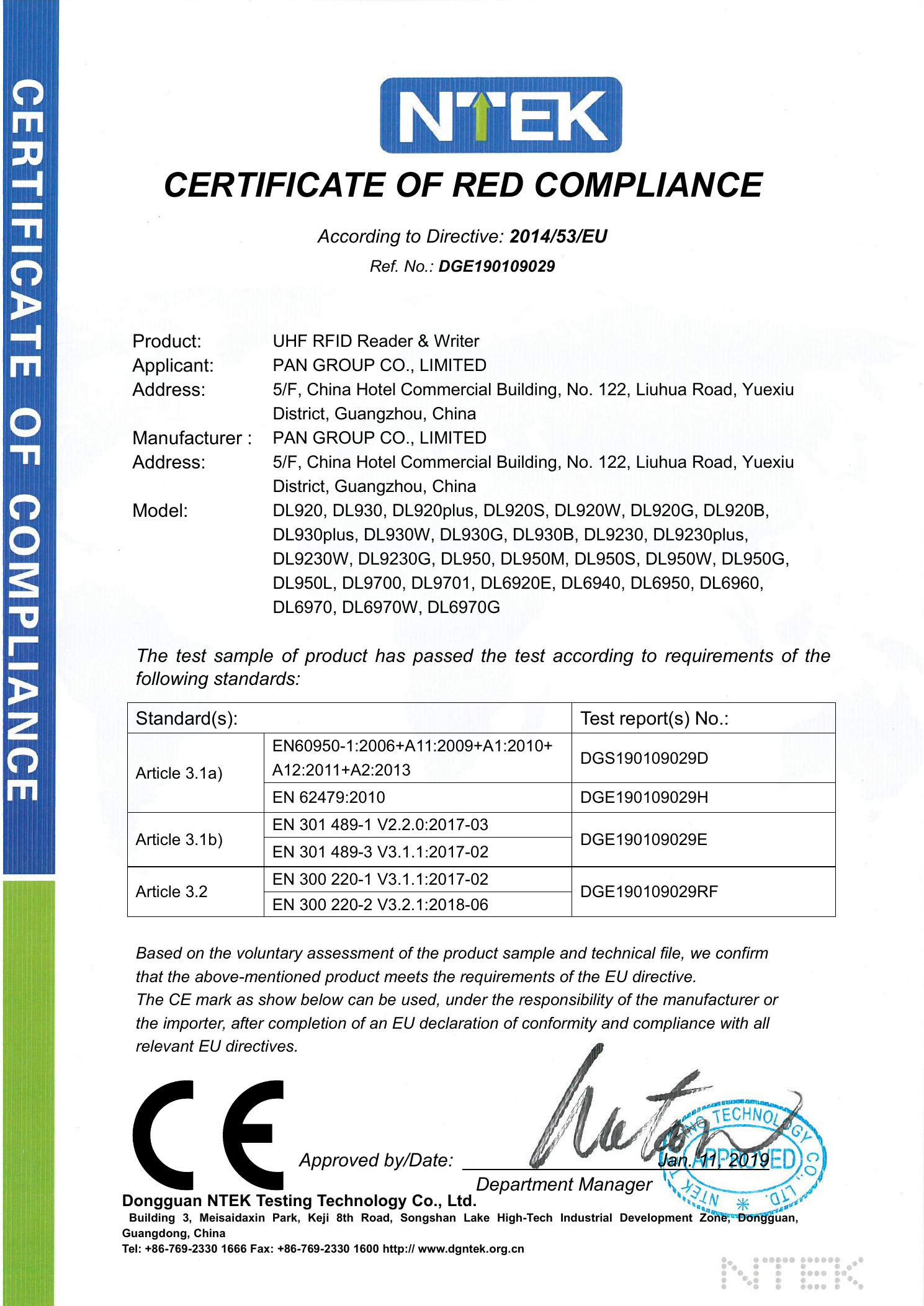
Figure 1 — UHF RFID Reader & Writer CE RED Certificate of Compliance (DGE190109029), which lists reader models including DL920, DL930, DL930B, DL9230, DL950, DL9700, DL6940 and DL6950.
The short answer: a gate-style reader is the right UHF RFID Reader setup when tools must be logged while crossing a shared, high-traffic doorway; an RFID smart cabinet is the right setup when tools need controlled, user-by-user access with drawer- or shelf-level visibility. An RFID Gate reads a 4 m–7 m walkthrough channel and produces pass-through events. An RFID Smart Cabinet reads defined zones inside the cabinet and produces an item-level inventory that refreshes after the door closes.
Neither architecture replaces the other. The decision is made by the workflow standing in front of the reader — not by the reader's feature list. This guide compares the DL8330U Advanced UHF RFID Gater against the RFID Smart Cabinet Component for tool accountability in smart manufacturing, and explains how the RFID Tool Tag layer behaves on metal tools. The trade-offs are organised around the three planning questions that decide most projects: workflow fit, space, and integration.
Problem Definition: Tool Accountability Breaks at the System Boundary
In most factories, tool control is not really an identification problem. It is a boundary problem. Tools leave a crib without a record, move between shifts, and return without anyone confirming what came back. When an audit arrives, or when a calibrated instrument disappears, the maintenance team has to rebuild the movement history from memory and paper.
Barcode labels were the first attempt at solving this, and they still fail in the same three places. A label applied to a metal tool can detune against the metal surface, an operator's hand covers the label at the moment of scanning, and the scan itself requires a deliberate stop in the workflow. UHF RFID removes the deliberate stop — but only if the reader is placed where the work actually happens.
Two mismatches account for most unsuccessful tool-tracking projects:
- A gate where a cabinet was needed. A gate at the tool-room door proves that someone walked out with tagged assets, but it cannot say which drawer the items came from or what is still inside the cabinet.
- A cabinet where a gate was needed. A cabinet delivers item-level truth for the person standing at it, but it creates a queue when dozens of technicians arrive at the same shift change.
The scale of the underlying problem is measurable. An industrial workflow project in Germany tracked metal tools, fixtures, containers and production assets with 120,000 RFID tags optimised for metal surfaces and rugged housing. Tool and fixture search time was reduced by 40%–70%, audit preparation time was reduced by 50%–80%, and the project has been running for at least five years.
Industry Background: UHF RFID Readers Have Become a Workflow Decision
The hardware market has matured to the point where protocol compatibility is no longer the differentiator. UHF RFID readers are standardised globally under the EPCglobal Gen2 (Generation 2) protocol, also known as ISO/IEC 18000-6C, so a compliant reader and a compliant tag will talk to each other. What remains open is geometry: where the reader sits, how wide its read zone is, and how many zones it can distinguish.
Commercial momentum explains why this question is being asked more often. The global UHF RFID Reader market was valued at approximately USD 4.8 billion in 2025 and is projected to reach USD 11.2 billion by 2034 (Dataintelo). UHF RFID technology captured 40.72% of total RFID market revenue in 2025, driven by retail inventory cycles and multi-item read capability (Mordor Intelligence). Regionally, the Americas lead with over 60% of global UHF tag usage as of 2025 (IDTechEx), while Asia Pacific is described as the fastest-growing region for UHF RFID hardware, with an expected 11.8% CAGR in shipments through 2031 (ABI Research).
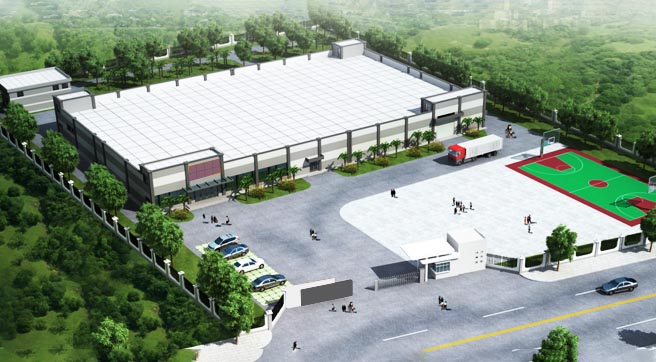
Figure 2 — DAILY RFID production environment in Guangzhou, China, where RFID tags, cards and readers are manufactured.
On the supply side, DAILY RFID CO., LIMITED is an RFID manufacturer founded in 2008 and based in Guangzhou, China, with a 28,000 m² factory, 180–200 employees, an R&D team of 38 engineers, and annual output of approximately 50 million RFID tags, 30 million RFID cards and 100,000 RFID readers. Around 80% of output is exported, with the EU and USA as the main markets. That mix matters for tool tracking, because a gate or cabinet project depends on both the reader and the tag being sourced consistently.
Mobile collection is also entering the conversation. Drones-as-a-Service using RFID for inventory collection is estimated to reach USD 8.2 billion by 2026 (PR Newswire), and RFID Robots and RFID Drones are increasingly discussed for high-rack or outdoor counting. For tool accountability, however, the daily read events still happen at a doorway or inside a cabinet, which is why the gate-versus-cabinet decision comes first.
Detailed Solution: Two UHF RFID Reader Architectures for Tool Tracking
Option A — RFID Gate: Reading the Doorway, Not the Drawer
The DL8330U Advanced UHF RFID Gater is an integrated access-control gate reader built around four built-in TX/RX antennas distributed across one main panel and one auxiliary panel. It supports ISO18000-6C, EPC Class 1 Gen 2 and ISO18000-6B, operates at 902 MHz–928 MHz with adjustment for different national regulations, and delivers up to 30 dBm adjustable transmit power in either FHSS or fixed-frequency pulse mode.
Its defining characteristic is the read zone: a 4 m–7 m walkthrough channel width, designed to eliminate detection dead zones and passage bottlenecks during dense mass flow. Anti-collision behaviour is tuned for open mass flow, and the gate supports optional infrared direction sensing for access-flow statistics and accurate entry/exit tracking. Feedback is provided through an integrated buzzer and LED indication.
- Interfaces: RS232, RJ45 (TCP/IP) and GPIO for alarm auxiliary connections and optional infrared sensors, with an SDK and full communication protocol details in the user manual.
- Power and footprint: AC 220 V / 50 Hz, with consumption calculated at roughly 35.2 W (220 V @ 160 mA); each panel measures 170 cm × 60 cm × 15 cm and the main antenna panel weighs 40 kg.
- Industry fit: enterprise facility access control and internal asset anti-theft monitoring, plus industrial factory assembly line and loading dock component batch tracking and production process flow control.
- Customisation: OEM/ODM configurations are supported, with complete self-intellectual property.
Option B — RFID Smart Cabinet: Reading the Drawer, Not the Doorway
The RFID Smart Cabinet Component is an embedded reader module rather than a finished cabinet. It supports ISO18000-6C and EPC Class 1 Gen 2, operates across 860 MHz–960 MHz with global frequency customisation, and drives multi-channel external SMA RF antenna interfaces that can be configured as 4-port, 8-port or 16-port layouts for cabinet zoning.
The architecture is what makes a cabinet usable for tool accountability. One main control module can drive several groups of partition antennas covering dozens of drawers and shelf areas inside a cabinet. Combined with transmit power that is software adjustable from 30 dBm down to 20 dBm, plus RSSI-based identification, it avoids cross-reading between adjacent compartments and enables shelf-level asset positioning. Each partition area supports simultaneous reading of more than 500 tags, with an average single-tag read time under 10 ms per 64 bits.
- Access control: opto-isolated GPIO ports link electronic locks, door magnetic sensors and status indicator lights, enabling automatic door-opening authorisation and cabinet state monitoring at the edge, without an intermediate controller. A real-time inventory is generated automatically after the cabinet closes.
- Interfaces and power: RS232, native RJ45 TCP/IP, USB 2.0 and optional 4G/Wi-Fi/Bluetooth expansion; DC +9–24 V with PoE optional, drawing approximately 6 W.
- Environment: industrial aluminium alloy housing measuring 180 mm × 140 mm × 30 mm, weighing 850 g, rated IP54, operating from -30°C to +70°C.
- Industry fit: factory intelligent tool cabinets for industrial measuring instruments and special equipment borrowing records and traceability, hospital medical consumable cabinets, confidential document vaults, and jewellery or watch display cabinets.
- Customisation: antenna multiplexing quantity, shell size and appearance structure can be tailored under OEM/ODM terms.
The Layer Both Options Depend On: RFID Tool Tags That Work on Metal
Neither a gate nor a cabinet performs better than the RFID Tag attached to the tool. The RFID Tool Management Adhesive Tag operates at 860 MHz–960 MHz (UHF/RAIN) and is available with Impinj Monza R6-P / M730 / M750, NXP UCODE 8 / UCODE 9 / UCODE 7xm, and Alien Higgs-3 / Higgs-9 chips. Its on-metal construction adds an anti-metal ferrite isolation layer that prevents the metal surface from short-circuiting or detuning the tag antenna — the failure mode that breaks ordinary labels on spanners, sockets and fixtures.
- Read distance: 1 m to 3.5 m on metal surfaces using a 4 W EIRP handheld reader; up to 5 m off metal.
- Form factors: 25 mm × 9 mm, 30 mm × 15 mm, 40 mm × 15 mm or 50 mm × 10 mm, with on-metal variants at 1.2 mm–1.5 mm thickness so that curved handles and small socket sets keep their grip.
- Durability: resistance to mechanical abrasion, industrial oil, chemical solvents and vibration, with 3M industrial structural adhesive backing; operating range -40°C to +85°C and storage range -50°C to +100°C.
- Typical industries: aerospace manufacturing, automotive assembly plants, CNC machining centres, oil and gas rig maintenance, railway maintenance hubs, power grid construction sites and data centre rack management.
Step-by-Step Breakdown: Choosing Between a Gate and a Smart Cabinet
- Map the tool journey before the technology. List which tools move, who moves them, how often they leave the crib, and whether they leave the building or only the room. A gate is a doorway decision; a cabinet is a storage decision.
- Decide which question must be answered first. If the business needs to prove that a tool left the controlled area, the gate's pass-through event is sufficient. If the business needs to prove what is inside the cabinet right now — and who opened which compartment — the cabinet's partition inventory is required.
- Count peak traffic, not average traffic. A 4 m–7 m walkthrough channel with four built-in antennas and anti-collision tuned for open mass flow keeps a crowd moving. A cabinet is a per-user interaction, so its capacity is measured in how many users can be served without forming a queue.
- Measure the physical footprint honestly. Gate panels occupy 170 cm × 60 cm × 15 cm each, with a 40 kg main panel that needs a stable mounting point. The cabinet component is a 180 mm × 140 mm × 30 mm, 850 g module that disappears inside an existing cabinet carcass, so the real space cost is the user access area in front of it.
- Confirm power and network routes. A gate typically needs AC 220 V / 50 Hz and roughly 35.2 W, with RS232, RJ45 and GPIO available. A cabinet module runs on DC +9–24 V or PoE at around 6 W and exposes RS232, RJ45, USB and opto-isolated GPIO.
- Validate the tag on your own metal. Test the RFID Tool Management Adhesive Tag on representative wrenches, moulds or fixtures, because the 1 m–3.5 m on-metal read distance depends on the tool surface, the mounting position and the reader used.
- Plan the audit layer, not just the read layer. A handheld RFID Scanner complements either architecture: the DL1280 Industrial PDA UHF/HF/LF Handheld Reader covers UHF 0.1 m–20 m, reads up to 100 tags simultaneously and is rated IP65, which suits periodic cycle counts in areas the gate or cabinet does not cover.
Use Cases: Where Each Setup Earns Its Place
High-traffic shared tool crib or dock-door staging area
When shared tooling moves through a doorway dozens of times per shift, the objective is frictionless capture. A gate placed on the exit path logs every pass-through without requiring a stop, and optional infrared direction sensing separates entries from exits. This is the same industrial pattern already used for factory assembly line and loading dock component batch tracking and production process flow control.
Calibrated, regulated or high-value tooling
Where the requirement is an auditable borrowing record for industrial measuring instruments and special equipment — or where access must be granted to specific users only — the cabinet architecture is the better match. Partition antenna groups, RSSI positioning and GPIO-driven electronic locks produce a per-compartment record, and the cabinet generates a fresh inventory after each closing. The same module logic is used for hospital medical consumable cabinets holding implantable devices and pharmaceutical reagents.
Mixed shop floor: cabinet plus gate plus handheld
Many plants end up with both. A cabinet at the tool room controls high-value items and records who borrowed them; a gate at the aisle or dock exit captures anything leaving the controlled zone; a handheld RFID Reader runs monthly cycle counts and reconciles the two data sets. Because all three use the same ISO/IEC 18000-6C tag layer, the data belongs to one record rather than three.
A supplier-side deployment illustrates the cabinet module at scale: a smart cabinet manufacturer in Taiwan embedded 35,000 RFID modules (product 5720) for reading inside smart cabinets, tool drawers and self-service terminals. Over more than five years of operation, the project achieved 95%–99% item identification reliability and reduced reader integration space by 20%–40%.
Recommendation snapshot
- Choose the RFID Gate (DL8330U) when throughput and pass-through proof matter more than drawer-level detail, and when floor space and AC power are available at the doorway.
- Choose the RFID Smart Cabinet Component when access must be controlled per user, when compartment-level inventory is required, and when the installation must fit inside an existing cabinet footprint.
- Choose both when high-value tooling is stored centrally but also leaves the controlled area — cabinet for custody, gate for exit events, handheld RFID Scanner for reconciliation.
RFID Gate vs RFID Smart Cabinet: Side-by-Side Comparison
| Decision dimension | RFID Gate — DL8330U Advanced UHF RFID Gater | RFID Smart Cabinet — RFID Smart Cabinet Component |
|---|---|---|
| Reader type | Integrated access-control gate reader | Embedded reader module for cabinet integration |
| Air protocol | ISO18000-6C, EPC Class 1 Gen 2, ISO18000-6B | ISO18000-6C, EPC Class 1 Gen 2 |
| Frequency | 902 MHz–928 MHz, adjustable to national regulations | 860 MHz–960 MHz, global customisation available |
| Antenna arrangement | 4 built-in TX/RX antennas across one main panel and one auxiliary panel | Multi-channel external SMA ports, configurable as 4-port, 8-port or 16-port layouts |
| Maximum RF power | 30 dBm adjustable | 30 dBm, software adjustable down to 20 dBm for partitioned near-field control |
| Read zone | 4 m–7 m walkthrough channel width | 0.1 m–5 m, optimised for the fixed cabinet range |
| Anti-collision | Ultra-fast, optimised for open mass flow | More than 500 tags per partition area |
| Read speed | Fast response optimised for mass-flow detection | Under 10 ms per 64 bits, high-speed cyclic scanning |
| RSSI | Not explicitly specified | Supported for shelf-level positioning and layered signal filtering |
| Interfaces | RS232, RJ45 (TCP/IP), GPIO for alarm and optional infrared | RS232, RJ45 TCP/IP, USB 2.0, opto-isolated GPIO; optional 4G/Wi-Fi/Bluetooth |
| Power | AC 220 V / 50 Hz, approximately 35.2 W | DC +9–24 V, PoE optional, approximately 6 W |
| Size and weight | 170 cm × 60 cm × 15 cm per panel; 40 kg main antenna panel | 180 mm × 140 mm × 30 mm; 850 g |
| Environmental rating | High-reliability design for harsh environments; operating temperature not explicitly specified | IP54, operating -30°C to +70°C, storage -40°C to +85°C |
| Access-control linkage | Optional infrared direction sensing for flow statistics and entry/exit tracking | GPIO linkage to electronic locks, door sensors and indicator lights; automatic inventory after door closing |
| Best-fit workflow | High-traffic pass-through and zone exit monitoring | Controlled user access with shelf- or drawer-level visibility |
| OEM/ODM | Customisable configurations, complete self-intellectual property | Customisable antenna multiplexing quantity, shell size and structure |
Space, Integration, and Expansion: What to Confirm Before Ordering
Fixed readers beyond the gate format. Where a doorway is not the right geometry, other fixed UHF RFID Readers can serve the same tool-accountability role. The DL6940/6960 AI Multi-Antenna 4-Port UHF Reader supports up to four external TNC/SMA antennas, a 25 m–30 m read range, anti-collision for up to 1,000 simultaneous tags, IP64 protection, RS232/RJ45/GPIO/USB ports and 5 W power consumption. The DL921 PoE UHF Reader combines power and network into a single Ethernet cable for overhead or dock-door mounting, with a 0.1 m–15 m range and IP65 protection.
RFID Antenna planning. Gate deployments rely on four integrated TX/RX antennas, so the read zone is fixed by the panel geometry. Cabinet deployments use external SMA ports, which means the antenna count and placement define how many compartments can be separated — this is the single largest driver of cabinet accuracy.
Embedded RFID Module options. For drawer-level or near-field reading inside custom equipment, the DL213 Type-C UHF Reader Module offers 23 dBm output, a 0.1 cm–10 cm range and up to five tags at a time in a 45 mm × 30 mm × 6 mm package, and is specified for embedded integration in cabinet-type equipment, document management devices and self-service terminals. The DL228 Type-C UHF Mobile Reader provides a comparable plug-and-play path for smartphone or tablet-based reading.
RFID System kits and software. Where a project needs a starting configuration rather than individual components, DAILY RFID also builds RFID System packages — for example, the Parking Management RFID Development Kit bundles a fixed long-range reader, a desktop card issuer, matched tags and an open SDK for secondary development. The same kit pattern (reader bundle, demo software and sample tags) is what a tool-crib pilot needs before a full roll-out. Readers ship with free SDKs, and the cabinet module includes communication documents and debugging tools.
Credentials and access. If the site already issues RFID Cards for building access, cabinet or gate authorisation can follow the same credential logic; sites that prefer wearables can use an RFID Wristband. Both are existing DAILY RFID product categories, which keeps the access layer consistent with the identification layer.
FAQ
1. Are the UHF RFID readers used in gate and cabinet setups certified for EU and US deployments?
Yes. At reader level, the UHF RFID Reader & Writer CE RED Certificate of Compliance (certificate DGE190109029, issued by Dongguan NTEK Testing Technology Co., Ltd., dated 11 January 2019) covers Directive 2014/53/EU and lists models including DL920, DL930, DL930B, DL9230, DL950, DL9700, DL6940 and DL6950, with harmonised standards EN 60950-1:2006+A11:2009+A1:2010+A12:2011+A2:2013, EN 62479:2010, EN 301 489-1 V2.2.0, EN 301 489-3 V3.1.1, EN 300 220-1 V3.1.1 and EN 300 220-2 V3.2.1. The RFID Reader-02 family holds CE EMC Certificate of Conformity ATE20180529 (EN 55032:2015; EN 55024:2010+A1:2015). For the US, the RFID Tracking System holds FCC Supplier's Declaration of Conformity FCSE20015006 (FCC Part 15 Subpart B Class B; ANSI C63.4-2014). On the tag side, the RFID Embeded Tag Certificate of Analysis SNTEK2026032314501 (North South Precision Testing Technology Service (Shenzhen) Co., Ltd., 23 March 2026) reports a pass result for passive operation at 923–925 MHz, IPX7 and no hazardous substances detected, referencing ISO/IEC 18000-6C, ISO/IEC 18046-3:2021, IEC 60529 and IEC 62321; the RFID Tool Management Adhesive Tag is listed among the related products. Frequency settings must still match the deployment region.

Figure 3 — FCC Supplier's Declaration of Conformity FCSE20015006 (FCC Part 15 Subpart B Class B) issued for the RFID tracking system.
2. Which UHF RFID reader setup is best for inventory tracking and tool accountability?
There is no universal ranking, because the deciding variables are flow, granularity and integration. A gate setup suits high-traffic inventory tracking where pass-through events and zone control are the priority: the DL8330U provides a 4 m–7 m channel, four built-in TX/RX antennas and up to 30 dBm adjustable power under ISO18000-6C, EPC Class 1 Gen 2 and ISO18000-6B. A cabinet setup suits accountability where per-user and per-compartment accuracy is the priority: the RFID Smart Cabinet Component offers 4/8/16-port antenna zoning, more than 500 tags per partition, RSSI positioning and GPIO lock control. The practical rule is to select the reader geometry that reads the tools you actually own — on-metal tool tags read 1 m–3.5 m on metal with a 4 W EIRP handheld reader, so handheld-based audits depend on the same tag choice.
3. What drives the cost of a gate project versus a cabinet project?
Configuration drives cost, not a fixed unit price. On the gate side, the variables are the number of panels and the channel width, the interface set (RS232, RJ45, GPIO), infrared direction sensing, and any OEM/ODM changes. On the cabinet side, the variables are the antenna multiplexing quantity (4, 8 or 16 ports), the number of partitions, cabinet size, reader module and software customisation. Commercially, both are accessible at low entry quantities: the UHF Fixed Reader category has a minimum order quantity of 1 unit with a monthly capacity of 1,000 units and a 15–45 day lead time, while the RFID Smart Tool Cabinet category has a minimum order quantity of 1 unit, a monthly capacity of 300 units and a 20–45 day lead time.
4. Can we validate tags and reading behaviour before committing to a full roll-out?
Yes, and it is the recommended path for tool tracking because read performance depends on the individual metal tool. The RFID Development Kit — supplied as a reader bundle with demo software and sample tags — has a minimum order quantity of 1 set, a 7–15 day lead time and function plus packing test quality control. Readers additionally ship with free SDKs, including demo software, source code and DLL documentation, so a pilot can be tested against your own tools, your own cabinet carcass and your own doorway before any volume order. Sample requests and tag trials can be arranged through the sales contact listed at the end of this article.
5. How long does deployment take from order to installation?
Lead time depends on the hardware layer. A development kit for pilot testing is quoted at 7–15 days. UHF Fixed Reader configurations are quoted at 15–45 days with a factory acceptance test as quality control and remote support after sales. The RFID Smart Tool Cabinet, including cabinet size, reader module and software customisation, is quoted at 20–45 days with a system integration test and remote or on-site after-sales support. Site work then adds power and network preparation: AC 220 V / 50 Hz for a gate, or DC +9–24 V or PoE for a cabinet module, plus cabinet fitting and lock wiring. A downloadable company profile with the full product and capability overview is available here: DAILY RFID company profile (PDF).
Conclusion: Match the Reader to the Workflow, Then Standardise the Tag Layer
The gate-versus-cabinet question is answered by one sentence about your operation. If the risk you are managing is that a tool leaves a controlled area, put the reader at the boundary and use the DL8330U RFID Gate to capture pass-through events across a 4 m–7 m channel. If the risk you are managing is that you cannot prove who holds which instrument, put the reader inside the storage unit and use the RFID Smart Cabinet Component to produce compartment-level inventory with lock-linked access control.
Either way, the tag decision is shared. RFID Tool Tags with an anti-metal ferrite layer and 3M industrial adhesive keep metal tools readable at 1 m–3.5 m on metal, and the same ISO/IEC 18000-6C layer works with fixed readers, cabinet modules, handheld RFID Scanners and embedded RFID Modules. That consistency is what turns two separate hardware purchases into a single tool-accountability system.
Next step: test before you commit. DAILY RFID CO., LIMITED (founded 2008, Guangzhou, China) manufactures RFID Tags, RFID Readers, RFID Antennas, RFID Cards and RFID Modules, with a 28,000 m² factory, a 38-engineer R&D team, and roughly 80% of output exported to the EU and USA.
Request a sample kit, a configuration quote or the full catalogue for your tool-crib project:
- Website: www.rfid-in-china.com
- Email: sales@rfid-in-china.com
- Tel / WhatsApp: +86 15817191372
- Brochure: Company profile (PDF)
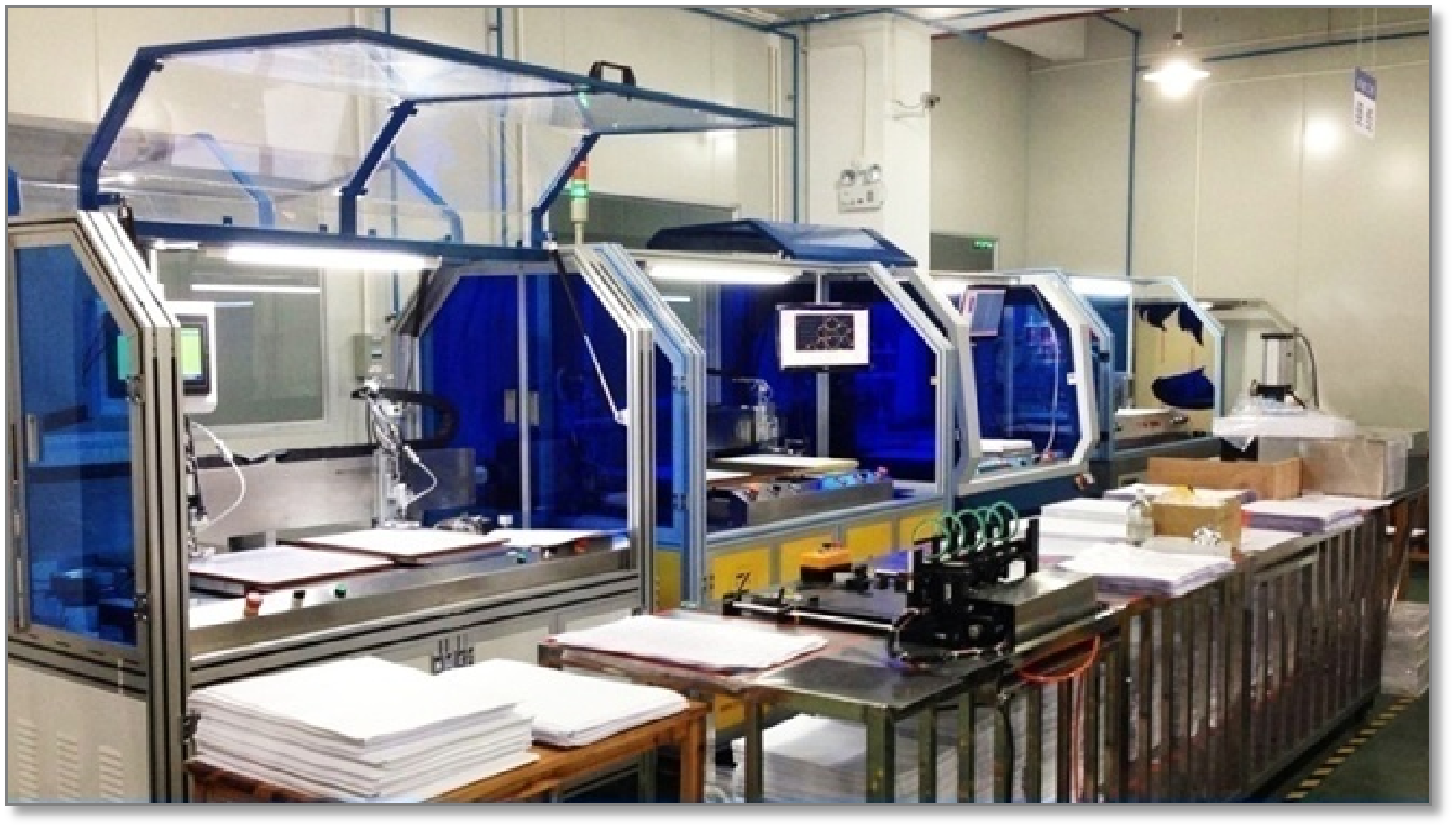
Figure 4 — Production equipment at the DAILY RFID facility; sample kits and custom configurations for gate and cabinet tool-tracking projects can be requested from the contact details above.
Have Questions or Need More Details?
Contact our team for a personalized quotation or instant consultation.
Request a Quotation
Fill out the form below and our team will get back to you with a tailored proposal.
WhatsApp Direct Chat
Prefer to chat in real-time? Message us on WhatsApp for instant assistance & quick answers.
- Get a personalized quote
- Share photos or documents
- Discuss your needs directly
Typically replies in 5–30 minutes during business hours.