
Ranked Recommendations: UHF RFID Reader Form Factors for Smart Manufacturing Workflows
Ranked Recommendations: UHF RFID Reader Form Factors for Smart Manufacturing Workflows
A smart manufacturing site does not need "a UHF RFID reader" — it needs the right reader form factors placed at the right workflow steps. This ranked list orders six UHF RFID reader form factors by their role in automated identification and asset tracking: fixed readers, AI-powered readers, handheld readers, gate readers, ceiling readers and tray readers. Each entry explains why it earns a place on the list, where it stops working, and which DAILY RFID hardware represents it.

Form factor #1 in practice: the DL921 Power on Ethernet UHF Long Range RFID Reader — 0.1 m to 15 m reading range, up to 50 tags read simultaneously, IP65 enclosure.
Why Form Factor Decides Smart Manufacturing Outcomes
Form factor is the physical relationship between three variables: the reader, the tag, and the movement of material. A reader with excellent specifications installed in the wrong relationship to the flow produces no usable data, while a modest reader placed correctly produces a continuous, automatic record of what entered, left or moved through a station.
The commercial context explains the attention this decision now receives. The global UHF RFID reader market was valued at approximately USD 4.8 billion in 2025 and is projected to reach USD 11.2 billion by 2034 (Dataintelo). UHF RFID captured 40.72% of total RFID market revenue in 2025, driven by inventory cycles and multi-item read capability (Mordor Intelligence). Growth is uneven by region: Asia Pacific is the fastest-growing region for UHF RFID hardware with an expected CAGR of 11.8% in shipments through 2031 (ABI Research), while the Americas accounted for more than 60% of global UHF tag usage as of 2025 (IDTechEx).
All UHF hardware referenced in this ranking is built on one air interface: EPCglobal Gen2, standardized as ISO/IEC 18000-6C (GS1 / ISO). That shared standard is what allows a plant to mix form factors — a fixed reader at the dock, a handheld in the aisle, a gate at the doorway — without rebuilding the tag population each time.
Problem Definition: The Form-Factor Decision Comes Before the Model Decision
Most reader purchases start with a specification comparison — transmit power, read range, price — and only later confront placement. That order produces three recurring failure patterns in manufacturing environments.
- Fixed reader, empty read zone. The reader is mounted on a wall beside the aisle rather than over the flow, so tags pass outside the useful field. The equipment is correct; the form-factor decision was not.
- A handheld doing a gate's job. Operators scan pallets one by one at a dock door. Throughput becomes a function of labour rather than of receiving volume, and counts vary between shifts.
- A gate without a channel. Gate panels installed in open floor space have no defined lane, so cross-reads from neighbouring tags and missed reads appear together — exactly the conditions a gate is designed to eliminate.
The decision rule that avoids all three is simple: for every point where material identity must be captured, first classify it as automatic (identification must happen without an operator) or operator-triggered. Automatic points belong to fixed, gate, ceiling or tray form factors. Operator-triggered and exception points belong to handhelds. Model selection comes last.
Industry Background: Why Reader Form Factors Became a Factory Question
UHF RFID moved into manufacturing on the back of three developments. First, air-interface standardization: EPCglobal Gen2 / ISO/IEC 18000-6C gave plants a single tag protocol that fixed, gate, handheld and multi-antenna devices can all read, which turned readers into an equipment category rather than a proprietary system.
Second, the data systems changed. Identification events are now consumed by MES, WMS, EAM and TMS layers, so a reader is judged by how reliably it feeds a software record, not only by how far it reads. Readers with native RS232, RJ45, GPIO, PoE or Wi-Fi interfaces and documented SDKs integrate faster than readers treated as standalone devices.
Third, the physical conditions in factories — metal parts, vibration, temperature swings, dense tag populations — made enclosure ratings and multi-tag performance commercial requirements rather than technical footnotes.
DAILY RFID CO., LIMITED is one of the manufacturers built around this shift. Established in 2008, the company manufactures RFID tags, readers, antennas, cards, chips and labels, operating a 28,000 m² manufacturing facility with approximately 180 to 200 employees, including a research and development team of 38 engineers. Annual production capacity covers 50 million RFID tags, 30 million RFID cards and 100,000 RFID readers; export business accounts for 80% of sales, with the European Union and the United States as the main markets. Readers ship with free SDKs, and OEM/ODM customisation is available across the product families referenced below.
How This Ranking Was Built
The order below reflects five criteria applied to smart manufacturing workflows, not peak specification values:
- Workflow role coverage — how many process steps the form factor can automate.
- Identification trigger — whether reading happens automatically or requires an operator.
- Tag volume and speed — verified simultaneous tag capability and single-tag read time.
- Integration surface — protocols, ports, power options and SDK coverage.
- Environment fit — IP rating, operating temperature and mounting constraints.
1. RFID Fixed Reader — The Stationary Identification Point
A fixed reader is an integrated reader-and-antenna unit mounted at one point, so material is identified without any operator action. In smart manufacturing it carries the places where material changes state: inbound dock doors, line-side feeders, work-in-progress transitions, tool cribs, returnable container loops and outbound staging lanes.
Why it ranks first
It is the only form factor that converts movement into a data event with zero labour input, which makes it the backbone of any automated identification layer. It also scales economically: additional coverage is added by installing another point, not by adding headcount or extending a shift.
Verified capability reference
- DL921 Power on Ethernet UHF Long Range RFID Reader: supports ISO18000-6C, EPC Class 1 Gen 2 and ISO18000-6B; built-in circular polarized antenna; reading range 0.1 m to 15 m; reads up to 50 tags simultaneously; average single-card read time under 10 ms per 64 bits; powered over Ethernet (PoE) or DC +9 V to +24 V at 12 W; IP65; operating temperature -20 °C to +60 °C; dimensions 450 mm × 450 mm × 70 mm.
- Integration: RS232, RJ45 TCP/IP and GPIO (trigger and relay ports); free SDK supporting X86 & X64, C++, C#, VB, Delphi, Linux, ARM, Python, NodeJS, QT, JAVA and Android environments.
- Deployment options in the same family: the DL921 UHF Long Range RFID Reader with GSM adds an integrated 2G/4G cellular module for yards and outdoor gates where no data cabling exists; the DL921 AI Enhanced UHF Long Range Reader with GPS/GSM/POE combines PoE, cellular transmission and GPS positioning for edge data collection and location recording.
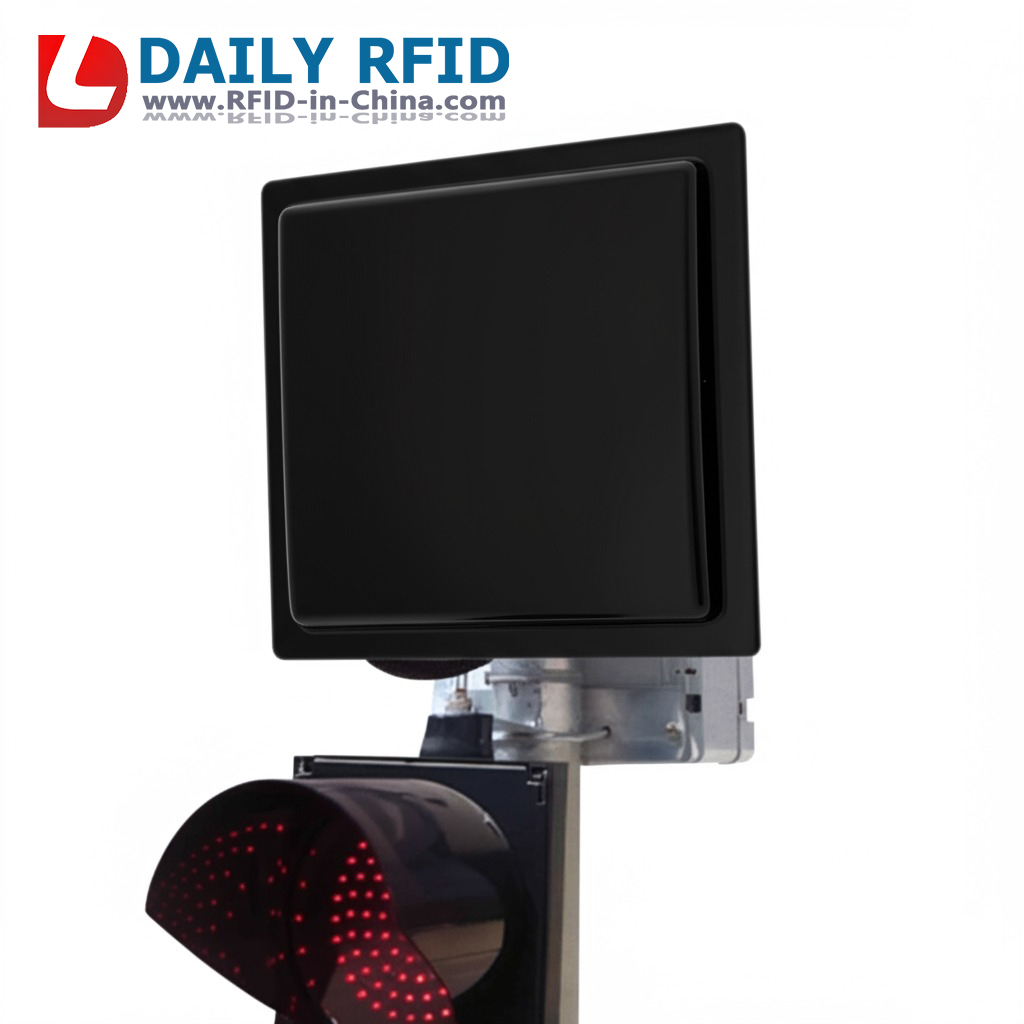
The DL921 UHF Long Range RFID Reader: integrated antenna, RS232 / RJ45 / GPIO interfaces, and a free multi-platform SDK for MES, WMS or EAM integration.
Where it stops working
A fixed reader sees only what passes through its read zone. Layout changes — a moved rack, a re-routed forklift lane — can push tags out of the field and require read-zone re-tuning. Maximum transmit power is set by the model, so coverage is designed through antenna placement and positioning rather than by simply increasing power.
2. AI-Powered RFID Reader — Dense Reading on High-Speed Lines
Where a fixed reader handles one defined point at human or forklift pace, an AI-powered multi-antenna reader handles the opposite condition: hundreds or thousands of tags inside the same field, moving quickly, with no tolerance for missed reads.
Why it ranks second
It removes the throughput ceiling that limits single-antenna fixed readers. On a production line or in a bulk-storage zone, the constraint is not coverage but density and processing speed — and this is the form factor engineered for exactly that condition, with external antenna ports allowing a single reader to serve several zones at once.
Verified capability reference
- DL6940/6960 AI Multi-Antenna 4-Port UHF Reader: supports ISO18000-6B and ISO18000-6C EPC Gen2; operating frequency UHF 860 MHz to 960 MHz; four external TNC/SMA antenna ports for multi-antenna array deployment; reading range up to 25 m to 30 m; supports up to 1000 tags read simultaneously; AI-driven adaptive dense read mode; data processing described as 16 times faster than ordinary mainstream readers, with average single-card read time under 10 ms; power consumption 5 W; IP64; operating temperature -30 °C to +70 °C; 230 mm × 170 mm × 40 mm, 2.3 kg; RS232, RJ45 TCP/IP, GPIO and USB interfaces.
- DL921 AI Enhanced UHF Long Range Reader with GPS/GSM/POE: reading range 0.1 m to 15 m, up to 50 tags read simultaneously, with PoE single-cable power and network delivery plus 4G GSM remote transmission and GPS positioning.
- AI processing also appears in handheld format: the DL1380 AI-Powered RFID Reader covers UHF 860–960 MHz, HF 13.56 MHz and LF 125/134.2 kHz, with a UHF reading range up to 20 m and more than 200 tags read simultaneously with AI-driven sorting.
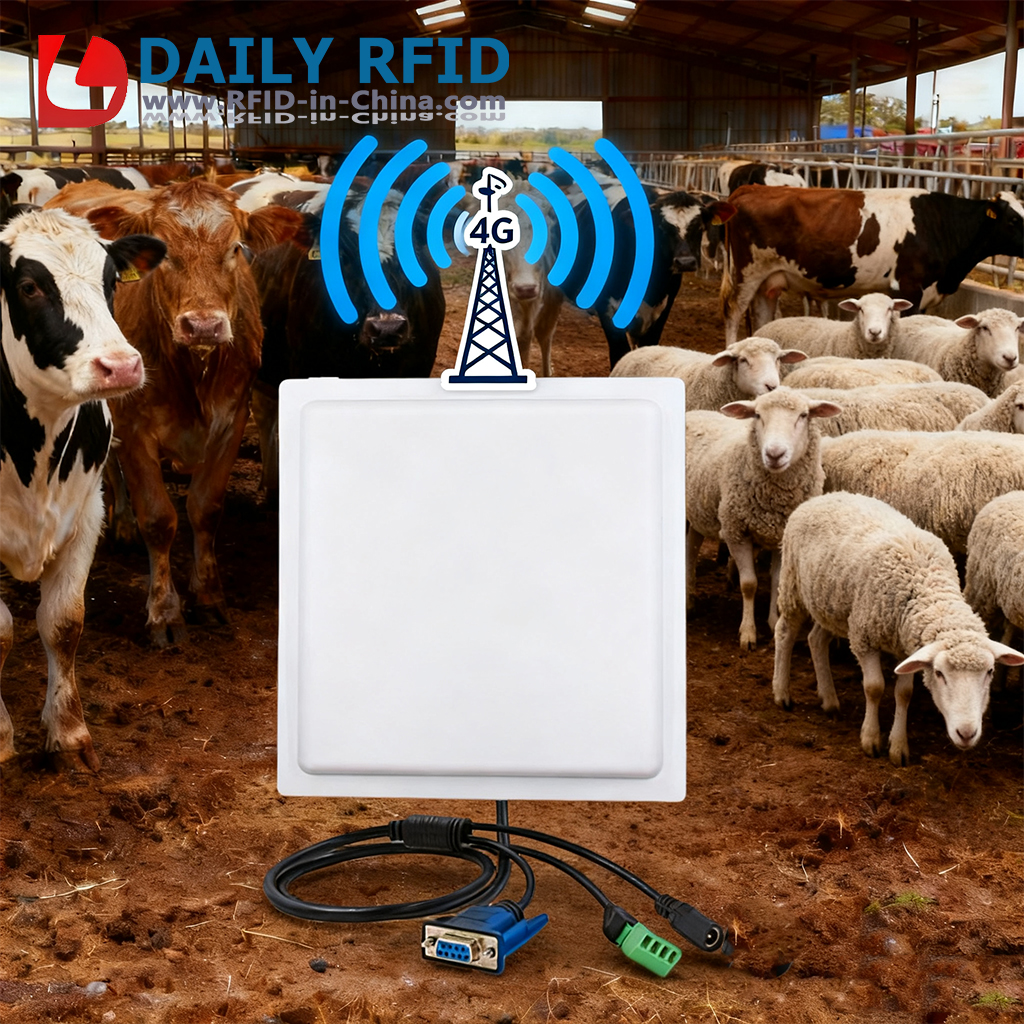
AI-enhanced fixed reading: PoE, cellular transmission and GPS in one enclosure for edge data collection on factory lines and outdoor yards.
Where it stops working
Four external antenna ports are a design commitment: every port needs a mounting position, a cable route and a direction, so this form factor rewards plants that plan RF coverage in advance. The IP64 rating suits protected indoor and covered industrial areas rather than open weather, and the higher read range means adjacent read zones must be separated deliberately to avoid overlap.
3. RFID Handheld Reader — Mobile Counting and Exception Handling
A handheld reader inverts the fixed-reader model: the device travels to the tags. In manufacturing it covers cycle counting, exception resolution, tool crib audits, receiving inspection and — critically — tag and placement validation before any fixed infrastructure is purchased.
Why it ranks third
It is the safety net around stationary form factors. Any point that cannot justify a fixed reader, any discrepancy that appears in the MES record, and any new tagging concept can be handled by the same device. It is also the fastest way to test whether a tagging approach survives contact with real racks, metal parts and dense shelving.
Verified capability reference
- DL1280 Industrial PDA UHF/HF/LF Handheld Reader: UHF 860–960 MHz with 0.1 m to 20 m reading range; HF 13.56 MHz at 0.1 cm to 32 cm; LF 125 kHz at 0.1 cm to 10 cm; reads up to 100 tags simultaneously with a processing capability above 100 tags per second; transmit power up to 30 dBm / 33 dBm; Android 12 on an 8-core 2.0 GHz processor with 4 GB RAM and 64 GB ROM; dual-battery design (4500 mAh host plus 6700 mAh handle battery); IP65; 168 mm × 98 mm × 145 mm and 680 g including battery and grip; Wi-Fi 2.4G+5G, Bluetooth 5.0 and 4G cellular with optional 5G; GNSS positioning; free Android 12 SDK with documentation, sample code and demo app.
- Semi-portable option: the DL930 series integrated reader family offers a 4 m to 8 m reading range, 20 dBm to 30 dBm adjustable transmit power, a built-in circular or linear polarized antenna, IP65/IP66 protection and a 235 mm × 235 mm × 50 mm, 1.5 kg enclosure — available as DL930B (Bluetooth), DL930W (Wi-Fi) and DL930G (GPRS/cellular) variants for temporary or frequently reconfigured reading points.
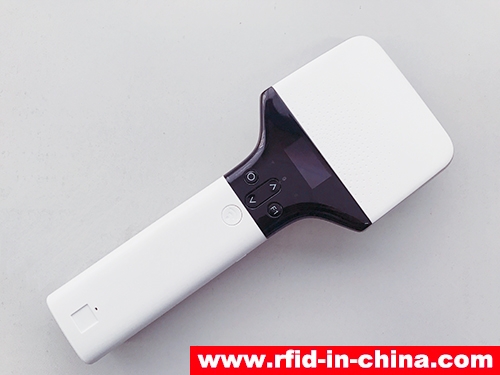
Handheld form factor: mobile counting, exception handling and tag-placement testing before fixed infrastructure is installed.
Where it stops working
Handheld reads depend on an operator's route and discipline, so two counts of the same shelf can differ, and labour cost rises with inventory frequency. A handheld also captures less in a single pass than a dense fixed or gate installation, which is why it complements stationary form factors rather than replacing them.
4. RFID Gate — Purpose-Built Choke-Point Reading
A gate reader turns an opening into a controlled reading channel: two panels, multiple antennas and a defined walkthrough width. In manufacturing, gates are used at doorways, personnel and cart pass-throughs, and at points where a batch of components crosses a boundary together.
Why it ranks fourth
When flow passes through a doorway, a gate removes the aiming problem inherent in a wall-mounted reader. The antenna panels surround the flow, the channel geometry is fixed and repeatable, and the reader can be configured to distinguish direction — entry from exit — which a single-point fixed reader cannot do reliably.
Verified capability reference
- DL8330U Advanced UHF RFID Gater: supports ISO18000-6C, EPC Class 1 Gen 2 and ISO18000-6B; operating frequency 902–928 MHz, adjustable according to national regulations; up to 30 dBm adjustable transmit power; four built-in TX/RX antennas distributed across one main panel and one auxiliary panel; walkthrough reading channel 4 m to 7 m; FHSS or fixed frequency pulse transmitting mode; AC 220 V / 50 Hz supply at approximately 35.2 W; single panel dimensions 170 cm × 60 cm × 15 cm, 40 kg per main antenna panel; RS232, RJ45 TCP/IP and GPIO interfaces; integrated buzzer and LED indication; optional infrared direction sensing for entry/exit flow statistics; SDK and OEM/ODM configuration support.
- Documented roles: industrial factory assembly line and loading dock component batch tracking and production process flow control; enterprise facility access control and internal asset anti-theft monitoring.
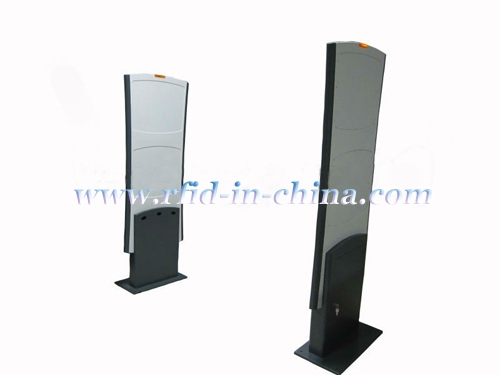
DL8330U Advanced UHF RFID Gater: four built-in TX/RX antennas across two panels, with a 4 m to 7 m walkthrough reading channel.
Where it stops working
A gate is a civil-works commitment: floor space, mains power, network access and a defined lane. Installed in an open area without a channel, cross-reads increase and the form factor loses its main advantage — which is why gate placement is a layout decision, not only an equipment decision.
5. Ceiling RFID Reader — Overhead Coverage Without Floor Footprint
Ceiling-mounted readers identify material from above. Overhead deployment suits staging lanes, assembly cells, packing areas and any location where posts, cables or floor-mounted hardware would obstruct forklifts, carts or automated guided vehicles.
Why it ranks fifth
Coverage economics and safety. An overhead device can serve a wider area than a wall-mounted unit of the same class, keeps the floor clear, and — when a circular polarized antenna is used — reads moving tags regardless of their orientation, which reduces the placement work required on the tag side.
Verified capability reference
- Integrated overhead deployment: DL921 integrated readers are documented for overhead positions such as loading bay doors and assembly-line checkpoints, with a built-in circular polarized antenna, 0.1 m to 15 m reading range, up to 50 tags read simultaneously and an IP65 enclosure rated from -20 °C to +60 °C.
- Wide-zone overhead deployment: the four external antenna ports of the DL6940/6960 AI Multi-Antenna 4-Port UHF Reader allow overhead arrays to be aimed at specific lanes, with a 25 m to 30 m reading range and up to 1000 tags read simultaneously.
- Power and data: overhead installations commonly specify Power over Ethernet so that a single cable run supplies both, which the DL921 PoE variant supports alongside its DC +9 V to +24 V alternative.
Where it stops working
Mounting height is a trade-off: raising the reader increases coverage but reduces read reliability on low tags and small items, so read-zone shaping is required. Ceiling work also means cable routing through the building and a PoE power budget, and on tall racking, tags positioned deep inside the structure can fall outside the useful field.
6. RFID Tray Reader — Tray-Level and Kit-Level Verification
A tray reader is the most contained form factor: a reader and near-field antenna array built into a tray, or a flat device on which trays and kits are placed. The reading event is not a movement but a presence check — the count after a kit is assembled, before a tray is released, or when a drawer is closed.
Why it ranks sixth
It is the only form factor that guarantees a discrete, repeatable read zone with no cross-reading between adjacent counters, which makes it the correct choice when a wrong count has real cost — mixed small parts, high-value components, controlled kits. It ranks sixth because its scope is deliberately narrow: it verifies a unit, not a workflow.
Verified capability reference
- DL4130H RFID Tray Reader & Antenna All-in-one (HF): supports ISO15693 / ISO18000-3 at 13.56 MHz; 1.5 W maximum transmit power; built-in all-in-one near-field loop antenna array; reading range 1 cm to 50 cm; reads up to 50 tags simultaneously; 12 V DC external power at ≤ 6 W; operating temperature -20 °C to 65 °C; 410 mm × 300 mm × 29 mm, 2.8 kg; IP54; RS232 and USB interfaces; free SDK; metal-resistant design that operates on metal and non-metal surfaces without signal attenuation, with intelligent automatic temperature protection.
- DL6993 RFID Tray Reader (Built-in Reader) (UHF): supports ISO18000-6C and EPC Class 1 Gen 2; operating frequency ISM 860–868 MHz, 902–928 MHz or 920–925 MHz; up to 33 dBm maximum transmit power; reading range 0.1 m to 5 m; reads up to 80 to 100 tags simultaneously; DC 12–24 V supply; IP66; 400 mm × 300 mm × 35 mm, 1.5 kg.
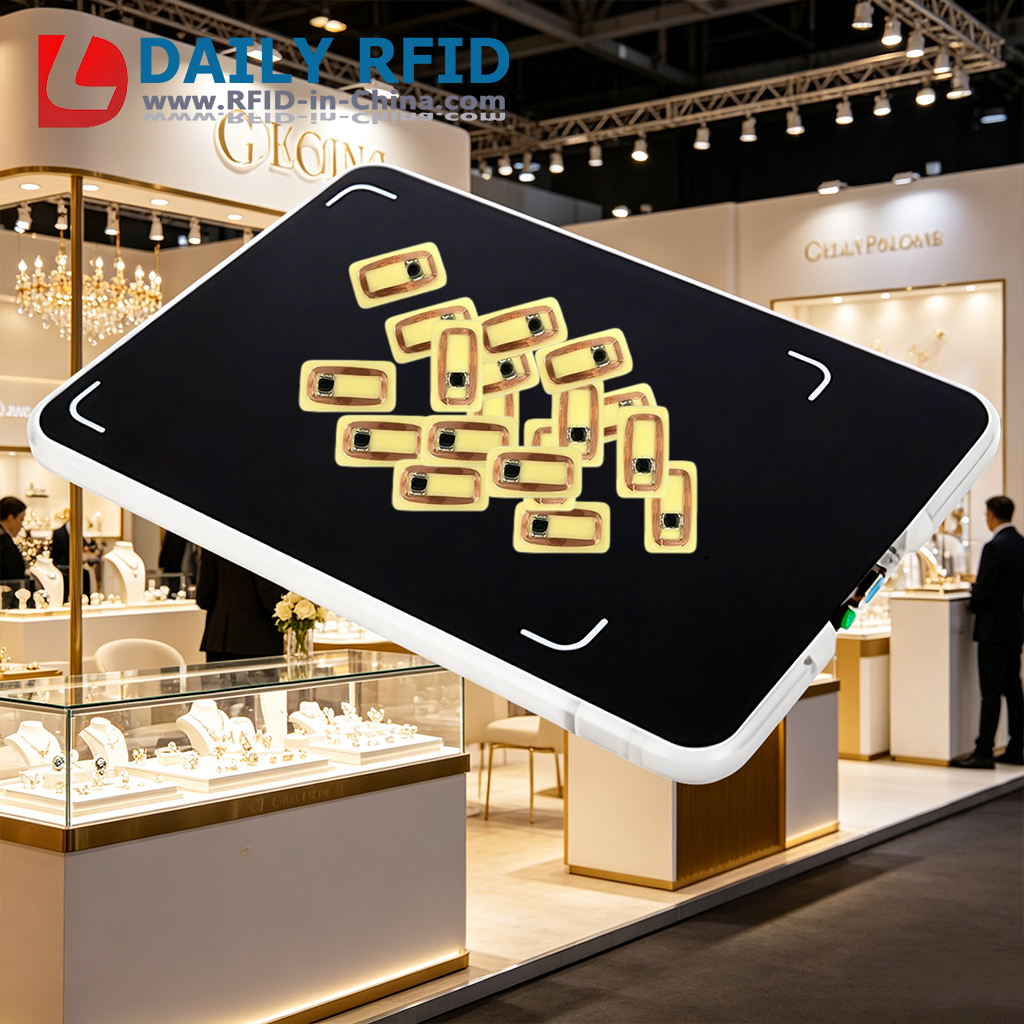
Tray reader form factor: a contained near-field read zone for kit, tray and small-part verification with no cross-reading between adjacent stations.
Where it stops working
Tray readers depend on tray discipline: if components are not placed within the tray's read area, the count reflects the tray, not the contents. They also cover one unit at a time, so plants with unstructured or mixed storage are usually better served by a cabinet-style reader with multiple antenna zones.
Supporting Hardware That Makes the Ranking Work
Form factors do not operate alone. Four supporting categories carry most of the integration load in a smart manufacturing deployment.
RFID modules — desktop encoding and read/write
The DL228 Type-C UHF Mobile Reader supports ISO18000-6C and EPC Class 1 Gen 2 with 12 dBm maximum transmit power, a 0.1 cm to 10 cm reading range and up to 5 tags read simultaneously; it is powered directly from USB Type-C at 3 W, measures 66 mm × 39 mm × 8 mm, weighs 0.03 kg, carries an IP64 rating and supports USB HID keyboard simulation so data enters an application without custom configuration. The DL213 Type-C UHF Reader Module is the encoding-oriented counterpart, with up to 23 dBm transmit power and a 0.1 cm to 10 cm range, intended for desktop UHF tag encoding and initialisation in retail, warehouse and office scenarios.
Wi-Fi and wireless readers
The DL930 series ships as DL930B (Bluetooth), DL930W (Wi-Fi) and DL930G (GPRS/cellular), so one 4 m to 8 m reading platform can serve a fixed wired point, a wireless point on a flexible production line, or a remote site with no network infrastructure. DAILY RFID's fixed-reader range also lists Wi-Fi based models such as the WiFi RFID Reader DL920Plus alongside the DL921 family.
Printing and encoding
The High-Speed RFID Label Printer prints and encodes UHF RFID labels at 300 dpi and up to 254 mm/s, with a 105.7 mm effective printing width and 120 mm maximum paper input width, a 5-inch true-colour IPS multi-touch display, 8 GB ROM and 512 MB RAM, and USB 2.0, USB Host, Ethernet, serial and Wi-Fi connectivity. Its UHF reader complies with ISO 18000-6C / EPC C1G2 — the same air interface as the readers above, which is what allows a label printed in the plant to be read later by fixed, handheld and gate devices without changing the data model.
Cabinets, systems and on-metal tags
Where tray-level verification is insufficient, the RFID Smart Cabinet Component embeds a reader with multi-channel SMA antenna interfaces configurable in 4-port, 8-port or 16-port layouts, up to 30 dBm adjustable power, a 0.1 m to 5 m reading range, more than 500 tags read per partition area, GPIO opto-isolated ports for electronic locks and door sensors, IP54 protection and -30 °C to 70 °C operation. At system level, DAILY RFID packages hardware and software into turnkey kits: the Jewelry Management RFID Development Kit bundles a desktop reader, an inventory tray, a handheld reader, tags and an SDK with multi-language API and middleware for docking with POS/ERP systems, while the Parking Management RFID Development Kit pairs a fixed long-range reader with a desktop card issuer, matching tags and an open SDK for secondary development. On the tag side, form-factor choices fail when tags detune on metal: the RFID Tool Tag uses an integrated electromagnetic ferrite shield and reads 1 m to 3.5 m on metal with a 4 W EIRP handheld reader (up to 5 m off metal), in sizes from 25 mm × 9 mm to 50 mm × 10 mm.
Comparison Table: Six UHF RFID Reader Form Factors Side by Side
| Rank & form factor | Primary workflow role | Identification trigger | Verified multi-tag capability | Representative DAILY RFID hardware |
|---|---|---|---|---|
| 1. Fixed reader | Stationary identification points: dock doors, line-side feeders, WIP transitions, tool cribs | Automatic | Up to 50 tags simultaneously, under 10 ms per 64 bits (DL921) | DL921 PoE; DL921 with GSM; DL921 AI Enhanced with GPS/GSM/POE |
| 2. AI-powered reader | Dense, high-speed reading on production lines and bulk zones | Automatic | Up to 1000 tags simultaneously (DL6940/6960); more than 200 tags with AI-driven sorting (DL1380) | DL6940/6960 AI Multi-Antenna 4-Port Reader; DL1380 AI-Powered RFID Reader |
| 3. Handheld reader | Mobile counting, exception handling, receiving inspection, tag validation | Operator-triggered | Up to 100 tags simultaneously, over 100 tags per second (DL1280) | DL1280 Industrial PDA; DL930B / DL930W / DL930G |
| 4. Gate reader | Choke-point pass-through and entry/exit flow statistics | Automatic (walk-through) | Mass-flow anti-collision channel across a 4 m to 7 m width (DL8330U) | DL8330U Advanced UHF RFID Gater |
| 5. Ceiling reader | Overhead coverage of aisles, cells and staging areas without floor footprint | Automatic | Up to 50 tags (integrated reader class); up to 1000 tags (4-port AI array) | DL921 integrated readers in overhead positions; DL6940/6960 with external antenna arrays |
| 6. Tray reader | Tray, kit and small-part verification with a contained read zone | Presence check | Up to 50 tags (DL4130H); 80 to 100 tags (DL6993) | DL4130H RFID Tray Reader; DL6993 RFID Tray Reader |
Step-by-Step: Building Your Own Form-Factor Mix
- Map material movements, not departments. List every point where material identity must be captured, and label each point as "must be automatic" or "can be operator-triggered".
- Assign stationary form factors to automatic points. Fixed readers at dock doors, line-side feeders and WIP transitions; gates where a doorway already exists; ceiling readers where floor space is contested; tray readers where the unit of accountability is a kit or a tray.
- Assign handhelds to everything else. Cycle counts, discrepancy investigation, tool crib audits and receiving inspection — plus first-stage tag validation before any capital commitment.
- Size the density before you buy. If a station must read hundreds of tags in one pass on a moving line, a single-antenna fixed reader is the wrong choice. The DL6940/6960 platform is specified for up to 1000 tags simultaneously with a 25 m to 30 m reading range.
- Check the environment. Confirm the required IP rating (IP54 to IP66 across the models referenced above), operating temperature range (-30 °C to +70 °C for the industrial models), metal content in the load, vibration and wash-down exposure.
- Check integration and power. Confirm PoE versus DC supply, RS232 / RJ45 / GPIO availability, Wi-Fi or cellular needs, and SDK coverage for your stack — the DL921 SDK list covers X86 & X64, C++, C#, VB, Delphi, Linux, ARM, Python, NodeJS, QT, JAVA and Android.
- Pilot one point, then scale. Validate tags and read zones with samples, pilot a single station, then replicate the validated configuration across the plant instead of rolling out all points at once.
Use Cases: How the Ranking Plays Out in Real Deployments
Automotive production-line part tracking
A UHF fixed reader combined with an antenna array tracks production-line parts in real time and streams the data into the MES layer, with the deployment designed for more than 400 tags per second. The scenario's requirements — dust-proof and shock-resistant hardware — are the reason the fixed and multi-antenna form factors, rather than handhelds, carry the line.
Dock-door inbound and outbound verification
Pallet tags are read automatically at dock doors, with transport data synced in batches (documented at every two minutes) through an edge gateway to the TMS layer. The stated site requirement — IP67 protection with reliable reading on metal pallets — shows why the reader form factor and the tag selection have to be specified in the same decision.
General asset and equipment visibility
A fixed reader at entry points combined with DL1280 handhelds and UHF asset tags centralises equipment records and lifts visibility above 95%, with real-time upload into an EAM system. This is the most common purchase pattern, because the fixed reader automates routine movement while the handheld resolves everything the record cannot explain.
Heavy equipment utilisation reporting
A fixed UHF reader with customised equipment tags tracks heavy-machinery usage hours and improves utilisation reporting accuracy above 95%, synchronising hourly to an asset-management platform. The requirement list — IP68 dustproofing and vibration resistance — again ties the reader enclosure rating to the tag choice.
Garment and textile inventory cycles
A DL1280 handheld with washable garment tags reduces manual inventory time by 60%, using offline caching with a nightly ERP sync. This is the clearest case for the handheld as the primary form factor: the workflow is people walking to garments, so a stationary reader would add cost without removing the walk.
FAQ
Which standards should UHF RFID readers support in a smart manufacturing project?
UHF RFID readers are standardized globally under the EPCglobal Gen2 protocol, also known as ISO/IEC 18000-6C (GS1 / ISO), which allows hardware from different suppliers to operate on the same tag population. In the DAILY RFID range, the DL921 fixed reader series supports ISO18000-6C, EPC Class 1 Gen 2 and ISO18000-6B; the DL6940/6960 AI multi-antenna reader supports ISO18000-6B and ISO18000-6C EPC Gen2; and the DL8330U gate supports ISO18000-6C, EPC Class 1 Gen 2 and ISO18000-6B. For tray-level counting, HF tray readers such as the DL4130H operate on ISO15693 / ISO18000-3 at 13.56 MHz, which is a separate standard from UHF and should be planned as its own tag population.
How should a buyer shortlist UHF RFID reader suppliers for a smart manufacturing project?
Start with form-factor coverage: a supplier that manufactures fixed, handheld, gate and tray readers from one base reduces the number of integration partners the project must manage. Then check SDK availability and OEM/ODM position, because readers have to be wired into MES, WMS or EAM software rather than operated as standalone devices. DAILY RFID CO., LIMITED, established in 2008, operates a 28,000 m² manufacturing facility with approximately 180 to 200 employees, including a research and development team of 38 engineers, and produces 50 million RFID tags, 30 million RFID cards and 100,000 RFID readers per year; 80% of sales are exports, mainly to the European Union and the United States. Its readers ship with free SDKs, and OEM/ODM customisation is offered across the reader families.
Can one supplier cover fixed, handheld, gate, ceiling and tray readers that work as one system?
Yes, provided the form factors share the UHF air interface and the integration layer is planned once. DAILY RFID's reader families include fixed readers (DL921 PoE, DL921 with GSM, DL921 AI Enhanced with GPS/GSM/POE), AI multi-antenna readers (DL6940/6960), handheld readers (DL1280 and the DL930B/W/G wireless variants), the DL8330U gate reader and tray readers (DL4130H, DL6993). They expose industrial interfaces such as RS232, RJ45, GPIO, PoE, Wi-Fi and cellular connectivity, and the company's system-level kits bundle hardware with an SDK and middleware for docking with POS/ERP platforms.
What is the fastest way to validate a reader form factor before full deployment?
Validate at sample level, then pilot a single point. Use a handheld such as the DL1280 to test tags and read zones in the real environment — metal racks, damp areas or dense shelving — and a module such as the DL228 or DL213 for desktop encoding checks. Then pilot one fixed or gate position before replicating the configuration across the plant. DAILY RFID provides free SDKs, sample code and demo programs with its readers; sample requests and configuration quotes can be sent to sales@rfid-in-china.com or +86 15817191372, and the company profile brochure is available for download below.
Conclusion
Ranked by workflow impact, the six UHF RFID reader form factors are not competitors — they are layers. Fixed readers turn movement into data at defined points. AI multi-antenna readers remove the density ceiling on high-speed lines. Handhelds cover mobile counting, exception handling and pre-deployment validation. Gates control pass-through flow and can distinguish direction. Ceiling readers buy coverage without occupying floor space. Tray readers guarantee a contained, repeatable count. Plants that decide the mix first and the models second avoid the most expensive mistake in RFID deployment: capable hardware mounted in the wrong relationship to the material.
DAILY RFID CO., LIMITED manufactures the reader families referenced throughout this ranking — fixed, AI-powered, handheld, gate and tray formats, plus modules, printers, smart cabinet components and system kits — from a 28,000 m² facility with a 38-engineer R&D team and an annual output of 100,000 RFID readers. Because tags and readers share the ISO18000-6C / EPC Gen 2 air interface and reader SDKs are provided free, the hardware can be integrated into existing MES, WMS, EAM or TMS layers instead of running as a separate system.
Next Step: Validate Your Form-Factor Mix
Before committing to a plant-wide rollout, test the form factors against real tags, real racks and real metal content. DAILY RFID supports sample evaluation, configuration quoting and OEM/ODM discussions for fixed, AI-powered, handheld, gate and tray readers.
Email: sales@rfid-in-china.com | WhatsApp / Tel: +86 15817191372 | Website: www.rfid-in-china.com | Blog: blog.rfid-in-china.com
Download the DAILY RFID company profile (PDF)
Have Questions or Need More Details?
Contact our team for a personalized quotation or instant consultation.
Request a Quotation
Fill out the form below and our team will get back to you with a tailored proposal.
WhatsApp Direct Chat
Prefer to chat in real-time? Message us on WhatsApp for instant assistance & quick answers.
- Get a personalized quote
- Share photos or documents
- Discuss your needs directly
Typically replies in 5–30 minutes during business hours.