
UHF RFID Reader Technical Guide: Fixed, Handheld, and AI Selection for Smart Manufacturing
Technical Guide | Smart Manufacturing
The correct UHF RFID reader is not the one with the longest range on a datasheet. It is the reader that matches a defined read event: where the tag moves, who operates the device, how data reaches MES, ERP or WMS, and what environment the hardware must survive. In smart manufacturing, that decision usually narrows to fixed readers, handheld readers, ceiling readers and AI Powered RFID Reader options, each with a different role.
This guide is written for engineers and buyers evaluating reader form factors, not for generic reader shopping. It uses DAILY RFID product facts and published case evidence to connect deployment environment, workflow fit and system integration needs to concrete selection parameters. DAILY RFID CO., LIMITED is an RFID manufacturer founded in 2008 in Guangzhou, China. It operates a 28,000 m2 factory with 180 to 200 employees, 38 engineers and annual reader output of 100,000 units; its products are exported mainly to the EU and USA.
Problem Definition: Why Reader Selection Fails in Smart Factories
A reader can meet its range specification and still fail at the workstation. In manufacturing, the hardest problems are rarely about one number. They are about fit: the tag may be mounted on metal, the operator may need one hand free, the read zone may overlap a neighbouring line, or the reader may have no practical route into the plant network. Fixed reader, handheld reader and ceiling reader projects fail when the read event is not defined before the hardware is chosen.
- Wrong read event: a portal reader is purchased for exception handling, or a handheld is purchased for a high-speed conveyor lane.
- Wrong antenna assumption: an integrated reader is selected without checking whether external antenna ports are needed to reach the actual tag path.
- Wrong integration path: RS232, RJ45, GPIO, Wiegand, USB, Wi-Fi or cellular options are not matched to the PLC, MES, WMS or access-control system.
- Wrong environment rating: an office-grade enclosure is proposed for a wash-down, cold-storage or dusty machining area.
- Wrong commercial scope: OEM colour, housing, interface or SDK work is discovered after the technical selection is fixed.
Industry Background: UHF RFID in Manufacturing
UHF RFID readers operate under EPCglobal Gen2 (ISO/IEC 18000-6C/63). That standard matters because it sets the air-interface baseline for tag compatibility, anti-collision behaviour and reader-to-tag communication. For buyers, the practical question is not whether a reader is UHF, but whether the exact reader model, frequency band and tag population are compatible with the intended workflow.
UHF is also a major commercial segment. Mordor Intelligence reports that UHF frequency captured 40.72% of total RFID market revenue in 2025. Industry research also indicates that over 60% of factories adopting Industry 4.0 deploy RFID readers for asset traceability. In smart manufacturing, reader deployment is therefore not a single purchase. It is a set of read points: dock doors, line-side stations, work-in-process (WIP) movement, tool cribs, cabinets, gates and exception routes.
Reader choice is also coupled to RFID Tag, RFID Antenna, RFID Card and RFID Wristband choices. A reader that performs well with one tag type may behave differently with an on-metal tool tag, a laundry tag or a windshield tag. The reader should be selected as part of an RFID Equipment ecosystem, not as an isolated box.
Detailed Solution: A Form-Factor Framework from DAILY RFID
1. Fixed UHF RFID readers: lanes, portals and overhead coverage
Fixed readers are for repeated, predictable read events. They are mounted at a dock, gate, conveyor, production cell or overhead position and read tags as assets pass through a defined zone. The DAILY RFID DL921 UHF Long Range RFID Reader with GSM is an integrated fixed reader with a built-in circular polarized antenna, 26 dBm maximum transmit power, 0.1 m to 15 m reading range, support for up to 50 tags simultaneously, IP65 protection, RS232, RJ45 and GPIO, and optional 2G/4G cellular and GPS functions. It can be powered over Ethernet or by DC 9 V to 24 V, depending on configuration.
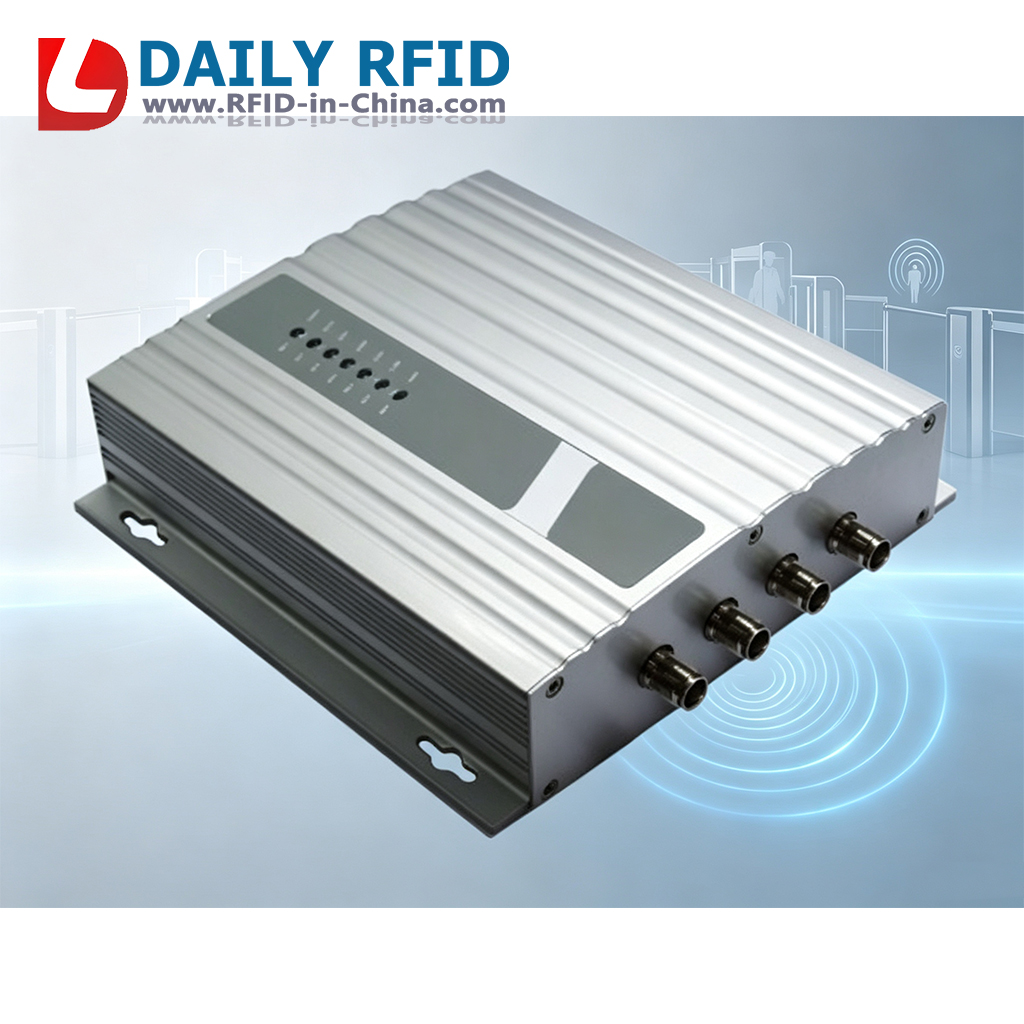
The DL6940/6960 AI Multi-Antenna 4-Port UHF Reader takes a different fixed-reader role. It provides four external TNC/SMA antenna ports for multi-zone or multi-antenna array deployment, a reading range up to 25 m to 30 m, a writing distance of 10 m to 15 m, support for up to 1000 tags simultaneously, IP64 protection, RS232, RJ45, GPIO and USB, and 5 W power consumption. DAILY RFID describes its data-processing speed as 16 times faster than ordinary mainstream readers.
Use fixed readers when the tag path is repeatable, the read zone can be engineered, and the plant can provide power and network infrastructure. Fixed readers are usually the right choice for dock doors, conveyor transitions, automated assembly stations, tool-crib exits and vehicle or container lanes. Their limitation is physical: metal surfaces, tag orientation, antenna polarization and adjacent read zones must be planned. A fixed reader is not automatically more accurate than a handheld; it is more consistent only when the read event is controlled.
2. Handheld UHF RFID readers: exception handling and mobile inventory
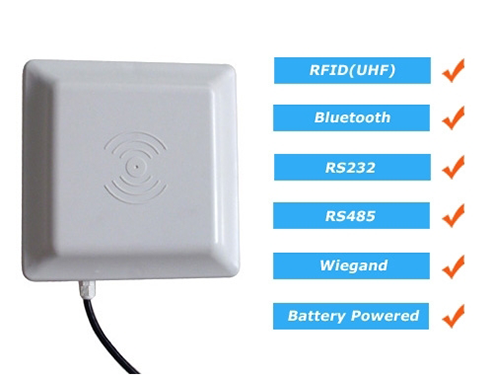
Handheld readers are not smaller fixed readers. They are mobile RFID Scanners used where the tag location is not fixed or where a worker must confirm identity at the point of decision. The DAILY RFID DL1280 Industrial PDA UHF/HF/LF Handheld Reader supports UHF, HF and LF reading, with UHF range from 0.1 m to 20 m, HF from 0.1 cm to 32 cm and LF from 0.1 cm to 10 cm. It reads up to 100 tags simultaneously, runs Android 12 on an 8-core 2.0 GHz processor with 4 GB RAM and 64 GB ROM, provides Wi-Fi 2.4G+5G, Bluetooth 5.0, 4G and GNSS, and is rated IP65 with a 680 g weight including battery and pistol grip.

The DL1380 AI-Powered RFID Handheld is the AI-oriented handheld option. It provides 33 dBm maximum transmit power, UHF reading up to 20 m, AI-driven tag sorting for more than 200 tags, RSSI with AI-powered distance calculation and position tracking, IP65 protection, 1.5 m drop resistance, dual batteries and 18 W fast charging. It also supports 5G/4G, dual-band Wi-Fi, Bluetooth 5.0 and multi-GNSS positioning.
Use handhelds when a worker must search for a specific tool, verify a pallet after an exception, inspect an outdoor asset or reconcile inventory that cannot be captured at a fixed station. Their limitation is human and operational: battery life, device weight, scan discipline and read angle all affect results. A handheld should be selected with its carrier, charging dock and software workflow, not as a standalone scanner.
3. Ceiling readers: room-level and zone-level visibility
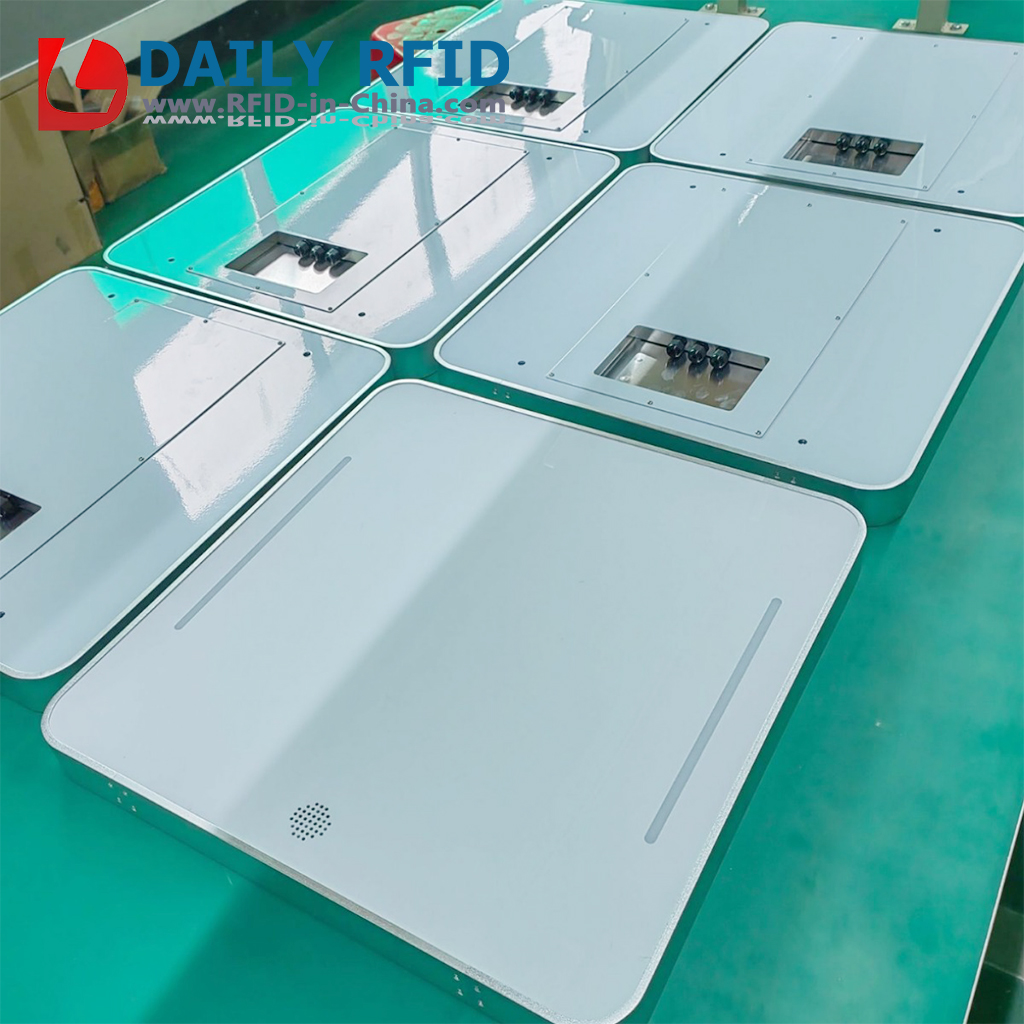
Ceiling readers cover a defined indoor area from above. The DAILY RFID DL6990 UHF Ceiling RFID Reader (Integrated Antenna) is an all-in-one ceiling-mount reader with 33 dBm maximum transmit power, 0.1 m to 5 m reading range, support for up to 50 tags simultaneously, IP66 protection, RS232 and optional RJ45, GPIO, USB and 4G/Wi-Fi/Bluetooth. Its dimensions are 180 mm by 180 mm by 28 mm, and it weighs 1500 g.
Ceiling readers are useful where a fixed portal is impractical, such as a tool room, a clean assembly area, a retail-like showroom or a hospital equipment zone. They are also useful where overhead mounting protects the reader from traffic or collision. The limitation is that ceiling height, fixtures, metal racks and moving people can change the read field. A ceiling reader should be commissioned with a site survey, not simply mounted and left at default power.
4. AI Powered RFID Reader options: where AI changes the workflow
AI is not a form factor; it is a processing layer that can sit inside a handheld, a fixed reader, a tester or an enhanced long-range reader. It becomes useful when the workflow is limited by dense tag populations, repeated reads, position uncertainty or tag quality problems. The DL1380 AI-Powered RFID Handheld is one example: its AI-driven tag sorting supports more than 200 tags simultaneously, and its RSSI function supports AI-powered distance calculation and position tracking. That is relevant when a worker must find one target item inside a dense stack, not just count a batch.
The DL6940/6960 AI Multi-Antenna 4-Port UHF Reader applies AI to high-density fixed reading: up to 1000 tags simultaneously, four independent antenna ports and 16 times faster data processing than ordinary mainstream readers, according to DAILY RFID. The DL921 AI Enhanced UHF Long Range Reader with GPS/GSM/POE adds PoE, 4G GSM, GPS and a built-in circular polarized antenna with 0.1 m to 15 m range and 50-tag anti-collision. The DL9702 AI RFID Tag Tester & Encoder is a near-field desktop reader/writer for tag diagnostics, with 10 cm to 15 cm reading range, 17 dBm maximum power, 0.25 W consumption and USB power; it is a quality-control tool, not a production portal reader.
Use AI-enabled readers when the problem is not basic tag reading but interpretation under load: dense pallets, mixed tags, repeated reads, position finding or pre-production tag screening. The limitation is equally important: AI does not replace antenna design, tag selection or acceptance testing. It improves the reader's ability to sort and filter data, but a poorly planned read zone will still produce poor data.
5. Related reader formats that change deployment: gate, tray, module, Wi-Fi and smart cabinet
Some manufacturing projects need a reader format that is neither a general fixed reader nor a handheld. The DAILY RFID DL8330U Advanced UHF RFID Gater is an integrated access-control gate reader with four built-in TX/RX antennas, a 4 m to 7 m channel width, 30 dBm adjustable power, AC 220 V/50 Hz input, RS232, RJ45 and GPIO. It is designed for exhibition attendance, enterprise access control, smart library and industrial assembly-line or loading-dock batch tracking.
The DL4130H RFID Jewelry Tray Reader & Antenna All-in-one is a high-frequency reader, not UHF. It operates at 13.56 MHz with 1.5 W power, 1 cm to 50 cm reading range, up to 50 tags simultaneously, RS232 and USB, IP54 protection and a 410 mm by 300 mm by 29 mm tray format. It is relevant to smart manufacturing only where the workflow uses HF trays or small high-value parts, not where UHF pallet reading is required.
The DL213 Type-C UHF Reader Module and DL228 Type-C UHF Mobile Reader are embedded or mobile formats. DL213 provides 23 dBm maximum power, 0.1 cm to 10 cm reading range and 5-tag anti-collision in a 45 mm by 30 mm by 6 mm module. DL228 provides 12 dBm maximum power, 0.1 cm to 10 cm range, IP64 protection and a 66 mm by 39 mm by 8 mm body. These modules are suitable for desktop encoding, self-service terminals, smart cabinets and close-range workpiece identification, not for long-range portals.
The DAILY RFID WiFi RFID Reader DL920Plus removes the need for local network cabling. It provides 8 m to 15 m reading range, 20 dBm to 30 dBm software-adjustable power, IP64 protection, RS232, RJ45, GPIO, USB and Wiegand 26/34, and an integrated Wi-Fi module. It is relevant where a fixed reader must be placed in a temporary or distributed area without a practical Ethernet drop. The limitation is that Wi-Fi coverage and latency must be validated as part of the read point design.
The RFID Smart Cabinet Component is an embedded reader module for cabinet and drawer applications. It supports multi-channel external SMA antenna interfaces in 4-port, 8-port or 16-port layouts, 0.1 m to 5 m reading range, more than 500 tags per partition area, 30 dBm software-adjustable power, RS232, RJ45, GPIO, USB, IP54 protection and approximately 6 W working power. In a Taiwanese smart-cabinet project, 35,000 RFID modules were deployed for embedded reader modules in smart cabinets, tool drawers and self-service terminals; the project reported 95% to 99% item identification reliability and a 20% to 40% reduction in reader integration space over at least five years.
Step-by-Step Breakdown: Selection Parameters That Matter
- Define the read event. Write down what must be read, when it must be read, who or what carries the tag, and what action follows the read. A dock-door read event is different from a tool-crib return, a WIP transition or an exception search.
- Map the tag and material environment. Check whether the tag is on metal, liquid, fabric, plastic or a returnable container. The DAILY RFID on-metal tool tag, for example, reads 1 m to 3.5 m on metal surfaces and up to 5 m off metal with a 4 W EIRP handheld reader. That difference must be designed into the reader choice.
- Choose the form factor before the model. Use fixed readers for repeatable lanes, handhelds for mobile and exception work, ceiling readers for room-level coverage, and gate, tray, module, Wi-Fi or cabinet formats where the physical workflow demands them. If a reader will be carried by an RFID robot or RFID drone, add payload, power budget and antenna clearance to the checklist.
- Set range, power and antenna requirements. Do not use maximum transmit power as a default. The DL6990 ceiling reader reaches 0.1 m to 5 m with 33 dBm, while the DL6940/6960 fixed reader reaches 25 m to 30 m with four external antenna ports. The correct setting is the one that covers the intended zone without reading adjacent zones.
- Specify the integration path. Match RS232, RJ45, GPIO, Wiegand, USB, Wi-Fi or cellular options to the plant system. The DL8330U gate reader provides RS232, RJ45 and GPIO; the DL920Plus Wi-Fi reader provides RS232, RJ45, GPIO, USB and Wiegand; the DL1280 handheld provides USB Type-C, Wi-Fi, Bluetooth, 4G and GNSS. Integration is a selection parameter, not an afterthought.
- Check environmental protection and operating limits. Compare IP rating, temperature range and mounting constraints. DL921 is IP65, DL6940/6960 is IP64, DL6990 is IP66, DL4130H is IP54 and DL1280 is IP65. A higher IP rating is not automatically better if the mounting position does not need it; it may add cost or limit interfaces.
- Confirm compliance for the exact model and market. UHF RFID readers operate under EPCglobal Gen2 (ISO/IEC 18000-6C/63), but market approval is model-specific. DAILY RFID holds UHF RFID Reader & Writer CE RED Certificate of Compliance DGE190109029, issued by Dongguan NTEK Testing Technology Co., Ltd. under Directive 2014/53/EU, and CE RTTE certificates ATE20120505, ATE20120506, ATE20120507 and ATS2012177 for models including DL920, DL930, DL930B, DL920W, DL930W, DL6940 and DL6940W. Verify the exact reader model and frequency band before procurement.
- Plan the sample, acceptance test and OEM scope. A reader project should define what is tested before shipment: function, packing, network connection, factory acceptance or system integration. If the project needs OEM or ODM work, define housing, interface, SDK, logo and software responsibilities early.
Use Cases: Matching Readers to Real Manufacturing Workflows
Dock, gate and cold-chain checkpoints
Fixed readers are usually the best fit when assets pass a known point. The DL921 integrated reader can cover 0.1 m to 15 m with a built-in circular polarized antenna and 50-tag anti-collision, while the DL8330U gate reader is designed for a 4 m to 7 m channel with four built-in antennas. In a Malaysia cold-storage and food-logistics project, 160 sets of DAILY RFID DL950S-PoE UHF Reader were used for fixed-door reading of cold-room pallets and insulated returnable boxes; the project reported cold-chain checkpoint movement capture exceeding 90% and a 30% to 50% reduction in separate power-adapter installation over at least five years.
Line-side WIP and multi-zone production
Where a single antenna cannot cover the read zone, a multi-port fixed reader is more appropriate. The DL6940/6960 provides four external antenna ports, 25 m to 30 m reading range and support for up to 1000 tags. That format suits multi-lane production, large pallet movements and overhead or side-mounted antenna arrays. The trade-off is planning effort: each port needs its own antenna, read zone and power setting.
Tool cribs, cabinets and high-value consumables
Cabinet and drawer workflows need controlled near-field reading, not open-area portals. The RFID Smart Cabinet Component supports 4, 8 or 16 antenna layouts and more than 500 tags per partition area, with GPIO for door locks and sensors. In a Taiwanese project, 35,000 modules were used in smart cabinets and tool drawers, with 95% to 99% item identification reliability. A hospital pharmacy project in Switzerland used 210 sets of DL1280H handheld readers for medicine tray checks, high-value consumable verification and cabinet inventory; controlled item checks became 40% to 70% faster and manual record gaps dropped 30% to 60% over at least five years.
Exception search and field work
Handhelds are the practical choice when the asset is not where the system says it is. The DL1280 provides UHF, HF and LF reading in one industrial PDA, while the DL1380 adds AI-driven sorting for more than 200 tags and RSSI-based position tracking. The limitation is that handheld results depend on operator technique and battery discipline. A handheld project should include charging docks, scan routines and a clear rule for when a manual check is required.
Comparison Table: UHF RFID Reader Form Factors
| Reader format | Example model | Typical read range | Antenna / ports | Max power | Interface and integration | Protection | Best-fit workflow |
|---|---|---|---|---|---|---|---|
| Fixed integrated reader | DL921 UHF Long Range RFID Reader with GSM | 0.1 m to 15 m | Built-in circular polarized antenna | 26 dBm | RS232, RJ45, GPIO; PoE or DC 9 V to 24 V; optional 2G/4G and GPS | IP65 | Dock doors, vehicle lanes, outdoor or remote read points |
| Fixed multi-port AI reader | DL6940/6960 AI Multi-Antenna 4-Port UHF Reader | 25 m to 30 m | 4 external TNC/SMA antenna ports | Adaptive, up to 30 m range | RS232, RJ45, GPIO, USB; SDK | IP64 | Multi-zone production, large pallets, overhead antenna arrays |
| Wi-Fi fixed reader | WiFi RFID Reader DL920Plus | 8 m to 15 m | Integrated internal antenna | 30 dBm, 20 dBm to 30 dBm adjustable | RS232, RJ45, GPIO, USB, Wiegand 26/34; integrated Wi-Fi | IP64 | Distributed areas where Ethernet cabling is impractical |
| Industrial handheld | DL1280 Industrial PDA UHF/HF/LF Handheld Reader | UHF 0.1 m to 20 m; HF 0.1 cm to 32 cm; LF 0.1 cm to 10 cm | Circular polarized UHF antenna | Up to 30 dBm or 33 dBm | USB Type-C, Wi-Fi 2.4G+5G, Bluetooth 5.0, 4G, GNSS | IP65 | Mobile inventory, exception search, multi-frequency checks |
| AI handheld | DL1380 AI-Powered RFID Handheld | UHF 0.1 m to 20 m | Circular polarized antenna | 33 dBm | USB Type-C 2.0, 5G/4G, dual-band Wi-Fi, Bluetooth 5.0, GNSS | IP65, 1.5 m drop resistance | Dense tag search, position finding, field inspection |
| Ceiling reader | DL6990 UHF Ceiling RFID Reader (Integrated Antenna) | 0.1 m to 5 m | Integrated high-gain antenna | 33 dBm | RS232; optional RJ45, GPIO, USB, 4G/Wi-Fi/Bluetooth | IP66 | Room-level visibility, tool rooms, clean assembly zones |
| Gate reader | DL8330U Advanced UHF RFID Gater | 4 m to 7 m channel width | 4 built-in TX/RX antennas | 30 dBm adjustable | RS232, RJ45, GPIO; AC 220 V/50 Hz | Industrial gate design | Personnel or asset flow through a controlled channel |
| Embedded module | DL213 Type-C UHF Reader Module; DL228 Type-C UHF Mobile Reader | 0.1 cm to 10 cm | Integrated antenna | DL213 23 dBm; DL228 12 dBm | USB Type-C; plug-and-play keyboard simulation | DL228 IP64; DL213 module format | Desktop encoding, self-service terminals, close-range workpiece checks |
Specifications are model-specific and configuration-dependent. Read range depends on tag, antenna, environment and power setting. Confirm the exact model, interface, protection rating and compliance scope in the quotation and datasheet before purchase.
FAQ: UHF RFID Reader Selection for Smart Manufacturing
What compliance checks should come first when selecting a UHF RFID reader for a smart factory?
Start with the air-interface standard and the market approval for the exact model. UHF RFID readers operate under EPCglobal Gen2 (ISO/IEC 18000-6C/63). DAILY RFID holds UHF RFID Reader & Writer CE RED Certificate of Compliance DGE190109029, issued by Dongguan NTEK Testing Technology Co., Ltd. under Directive 2014/53/EU, and CE RTTE certificates ATE20120505, ATE20120506, ATE20120507 and ATS2012177 for models including DL920, DL930, DL930B, DL920W, DL930W, DL6940 and DL6940W. Confirm that the exact reader model, frequency band and market are covered before procurement.
Can fixed and AI readers be customized for OEM or system integration?
Yes, within the documented product scope. DAILY RFID provides ODM/OEM production for reader development kits, with customization covering reader bundle, demo software and sample tags; for UHF handheld readers, customization covers OS, software and housing; for tray readers, it covers antenna layout, interface and software; and for smart tool cabinets, it covers cabinet size, reader module and software. Fixed and AI readers such as DL6940/6960 support RS232, RJ45, GPIO, USB and SDK integration, while DL921 supports PoE, 2G/4G and GPS options. The exact interface, housing and software scope must be confirmed per project.
What budget and lead-time factors should buyers plan for?
Reader projects are quoted by configuration, so unit price is not the right first question. Plan around scope: reader format, antenna count, interface options, SDK work, enclosure, mounting and acceptance testing. The available production data shows different minimums and lead times by product line: reader development kit MOQ 1 set with 7 to 15 days; UHF handheld reader MOQ 1 unit with 15 to 30 days; RFID tray reader MOQ 1 unit with 20 to 45 days; and RFID smart tool cabinet MOQ 1 unit with 20 to 45 days. These values should be confirmed in the quotation because configuration and order quantity can change the schedule.
How can engineers validate a reader before full deployment?
Use a sample or kit to validate the actual read event, then define acceptance criteria before shipment. For a reader development kit, the available procurement data lists MOQ 1 set, 7 to 15 days and Kit Function Test as acceptance. For tray readers, Factory Acceptance Test is listed; for smart cabinets, System Integration Test is listed. A practical validation should cover tag compatibility, read zone, interface connection to the plant system, power and mounting, and the operator workflow. Do not accept a laboratory range number as proof of on-site performance.
How does DAILY RFID support OEM UHF RFID reader projects for smart factories?
DAILY RFID supports OEM and ODM production for RFID products and exports to global markets including the EU and Middle East. Its reader portfolio covers fixed, handheld, ceiling, gate, tray, module, Wi-Fi and smart-cabinet formats, and its factory profile lists a 28,000 m2 facility, 180 to 200 employees, 38 engineers and annual reader output of 100,000 units. For an OEM reader project, the practical next step is to define the read event, target interface, enclosure or mounting constraint and acceptance test, then request a configuration review and sample. Contact DAILY RFID through www.rfid-in-china.com or email sales@rfid-in-china.com.
Conclusion
UHF RFID reader selection for smart manufacturing is a form-factor and integration decision before it is a specification decision. Fixed readers serve repeatable lanes and portals; handheld readers serve exception handling and mobile inventory; ceiling readers serve room-level visibility; AI Powered RFID Reader options add sorting, filtering and position logic where dense tag populations create data overload. Gate, tray, module, Wi-Fi and smart-cabinet formats exist because real factories do not all use the same physical read event.
The buyer or engineer should leave this guide with a simple sequence: define the read event, map the tag and material environment, choose the form factor, set range and antenna, specify the interface, confirm protection and compliance, then validate with a sample and acceptance test. That sequence is more reliable than comparing a single range number across catalogues.
Next step: request a reader sample or configuration review for fixed, handheld, ceiling, gate, tray, module, Wi-Fi or smart-cabinet formats. Share the read event, tag type, read zone, interface requirement and acceptance test so the reader can be matched to the workflow rather than to a generic specification.
Download the DAILY RFID company profile (PDF): company profile daily rfid.pdf
Website: www.rfid-in-china.com | Email: sales@rfid-in-china.com | Tel / WhatsApp: +86 15817191372 | Address: Guangzhou, China
Have Questions or Need More Details?
Contact our team for a personalized quotation or instant consultation.
Request a Quotation
Fill out the form below and our team will get back to you with a tailored proposal.
WhatsApp Direct Chat
Prefer to chat in real-time? Message us on WhatsApp for instant assistance & quick answers.
- Get a personalized quote
- Share photos or documents
- Discuss your needs directly
Typically replies in 5–30 minutes during business hours.