
Verifying UHF RFID Reader Suppliers: Claim to Delivery
A UHF RFID Reader supplier evaluation should answer three separate questions, in this order: what the supplier can document, what it actually controls inside its own process, and what it will commit to for your specific order. Most evaluation templates compress all three into one question — what products do you offer — which is why shortlists built that way tend to look alike. This guide sets out a verification framework for smart manufacturing buyers moving from evaluation into execution. It covers UHF RFID Reader, RFID Fixed Reader, RFID Handheld Reader, AI Powered RFID Reader, RFID Module, RFID Gate, RFID Printer, and RFID Smart Cabinet offerings, and it uses DAILY RFID CO., LIMITED portfolio records only as evidence of what the portfolio contains, never as proof of delivery performance.
Why a portfolio is not a delivery capability
A portfolio describes the set of models a supplier is willing to sell. A delivery capability describes what that supplier can build, test, document and ship inside a defined window for a defined configuration. The two are related but not interchangeable, and procurement teams that treat them as the same thing inherit the gap at the worst possible moment — during the installation window, when a missing test record or an unlisted model blocks acceptance.
The distinction matters more for readers than for consumables. A tag that arrives late delays a labelling run. A fixed reader that arrives without a matching acceptance record, or with firmware that differs from the sample that was approved, can hold up an entire material-flow deployment because the integration, the antenna placement and the operator training were all built around the tested unit. Evaluation therefore has to check not only whether the product exists, but whether the specific configuration you will receive has been built and checked the same way before.
Two failure patterns are common. The first is scope drift: a supplier presents a valid certificate or catalogue page, but the model on your purchase order is not on that document. The second is capacity optimism: a stated monthly capacity is confused with free capacity for your delivery month. Both are avoidable with three targeted requests.
Industry background: why reader supply has become a production decision
UHF readers sit on a standardised protocol base, so protocol compliance alone rarely differentiates suppliers. GS1 publishes the EPC Radio-Frequency Identity Protocols Generation-2 UHF RFID air-interface specification, with the corresponding ISO/IEC 18000-6C and 18000-63 standardisation; a compliant reader and a compliant tag are expected to interoperate at that layer. What varies is everything above it: enclosure, environmental protection, integration interfaces, testing discipline and supply behaviour.
Market context supports the same conclusion. Mordor Intelligence reports that the UHF band captured 40.72% of total RFID market revenue in 2025, and projects the UHF RFID market to surpass USD 14.9 billion by 2031 at a 12.45% CAGR — a forecast, not a measured outcome. Published application evidence points in the same direction: a 2025 institutional paper from Queen's University Belfast describes RFID-enabled trolley tracking inside a large-scale aerospace manufacturing environment, connected to a business-intelligence visual-management system. When reader data feeds a live management dashboard, reader supply becomes a production-visibility decision rather than a peripherals purchase.
The type of claim a mature supplier publishes is also instructive. Turck documents IP67 protection for its UHF readers for dust, moisture and temperature fluctuation, and documents OPC UA support through the AutoID Companion Specification for PLC, MES, ERP, WMS or cloud integration. Merhein lists an integrated-antenna reader covering 860–960 MHz with EPCglobal UHF Class 1 Gen 2, ISO 18000-6C and ISO 18000-6B support. These are manufacturer-stated claims rather than independent benchmarks, but they illustrate the three claim types you should be able to demand and verify: environmental rating, integration interface, and frequency/protocol coverage.
The three-tier evidence model
Separate every document a supplier sends into one of three tiers. Tier 1 proves the portfolio exists. Tier 2 proves the process exists. Tier 3 proves the order is covered. An evaluation is complete only when all three tiers are populated for the model you intend to buy.
| Tier | Typical document | What it establishes | What it does not establish |
|---|---|---|---|
| 1. Portfolio | Catalogue page, model list, certificate scope page, case description | Which models exist and which were tested against a stated standard or used in a stated application | That your exact model, option set or firmware revision is inside that scope |
| 2. Process | Quality-control plan, test-station list, acceptance-test record, batch or serial traceability sheet | How the unit is assembled and checked, and who signs the record | That production capacity is free in your delivery month |
| 3. Order | Quotation with lead time, delivery term, acceptance criteria, escalation contact and continuity clause | What the supplier has agreed in writing for this specific order | That the dates will hold without milestone monitoring |
Decision rule: a supplier that can only supply Tier 1 material is a candidate, not an approved source. Approval requires at least one Tier 2 record for the relevant product family and a Tier 3 document that names your model, quantity, acceptance criteria and delivery term.
Step 1 — Verify process ownership, not just company size
Process ownership means the supplier controls the steps that determine quality: incoming material, assembly, functional test, packing and dispatch. Company-scale facts are useful context but they are not process evidence. DAILY RFID, founded in 2008 and based in Guangzhou, China, reports a 28,000 m² factory, 180–200 employees, a 38-engineer R&D team, 80% export share with main markets in the EU and USA, and annual output of 50 million RFID tags, 30 million RFID cards and 100,000 RFID readers. Those figures describe scale and market mix. They do not, on their own, tell you who signs the functional test record for the reader you ordered.
Three questions convert scale into process evidence:
- Which steps happen inside the plant? Ask for the production route for your model — including where the reader is assembled, where firmware is loaded, and where the acceptance test is executed — and ask which of those steps, if any, are subcontracted.
- Which test station produces the acceptance record? A test name is worthless without the station, the fixture and the pass criterion behind it. The same supplier may run a full system burn-in for one product family and a functional check for another; both are legitimate, but you should know which one applies to your unit.
- Who owns the record after shipment? Traceability requires that a serial number or batch code can be resolved to a test record after delivery. Ask how long that record is retained and who retrieves it.
The capability records supplied for DAILY RFID show that test intensity is deliberately different by product family, which is exactly the pattern a buyer should expect — and exactly why the test method must be matched to the ordered family rather than accepted as a general statement.
Step 2 — Map quality controls to the product family you are buying
The following table reproduces the documented capability parameters for six reader-related families. Read the quality-control column as the supplier's stated test method for that family, and read the lead time as a planning range for that customization type — not as a delivery commitment for your order.
| Offering family | Production mode | Documented customization scope | Stated monthly capacity | Lead time | MOQ | Quality control |
|---|---|---|---|---|---|---|
| UHF RFID Reader (handheld family) | ODM/OEM | OS / Software / Housing | 2,000 units | 15–30 days | 1 unit | Full System Burn-in |
| RFID Reader (HF) | OEM | Logo / Software | 5,000 units | 3–15 days | 2 units | 100% test |
| RFID Tray Reader | ODM | Antenna layout / Interface / Software | 500 units | 20–45 days | 1 unit | Factory Acceptance Test |
| RFID Smart Cabinet | ODM/OEM | Cabinet size / Reader module / Software | 300 units | 20–45 days | 1 unit | System Integration Test |
| UHF Mat Antenna (module/antenna) | ODM/OEM | Antenna size / Cable / Connector | 1,000 units | 15–30 days | 1 unit | RF Performance Test |
| RFID Development Kit | ODM/OEM | Reader bundle / Demo software / Sample tags | 1,000 sets | 7–15 days | 1 set | Function + Packing Test |
Two readings of this table are wrong and one is right. It is wrong to add the monthly capacities together and call the result plant-wide reader capacity, because each figure is stated per customization type. It is wrong to treat the shortest lead time in the column as available for your configuration, because the range belongs to the customization scope beside it. It is right to use the table as a question generator: if your project needs a fixed multi-port reader, an RFID Gate, an RFID Printer or an AI-enhanced long-range reader, and no family-specific row covers it, request the equivalent record for that exact model rather than inferring it from a neighbouring line.
Step 3 — Make the acceptance test and traceability chain explicit
Acceptance criteria are where quality control becomes a contract. For reader orders, the supplied purchasing records list the acceptance options as Performance Test, Communication Test, WiFi Communication Test, Network Connection Test, Pre-shipment Inspection, or Factory Functional Test, with a reader MOQ of 2 units, a 7–15 day window, and delivery terms of EXW, FOB or CIF. Payment terms are stated as negotiable on order value and customization requirements, with T/T, D/P and Sight L/C available. None of these items is unusual; what matters is that the chosen criterion is named in the quotation and that both sides accept what failure triggers.
A workable traceability chain has five links, and each one should be answerable in a single email:
- Model identity: the exact model and option set on the purchase order, including housing, interface and software revision.
- Certificate scope: the approval document whose listed model scope contains that model (see the next section).
- Test record: the acceptance test result produced by the named station, with the pass criterion stated in the same document.
- Unit or batch identity: the serial number or batch code that links the shipped unit back to that record.
- Handover point: the delivery term (EXW, FOB or CIF) that determines where risk transfers and who controls the onward leg.
If any link is missing at the evaluation stage, the gap will reappear during acceptance. Buying a communication-test criterion on a WiFi reader but receiving a generic functional report is a typical example: the criterion was correct, the record did not match it.
Step 4 — Read certificate scope line by line
Certification is the area where portfolio claims most often outrun the document. DAILY RFID's supplied reader records illustrate why scope reading is a required step rather than a formality.
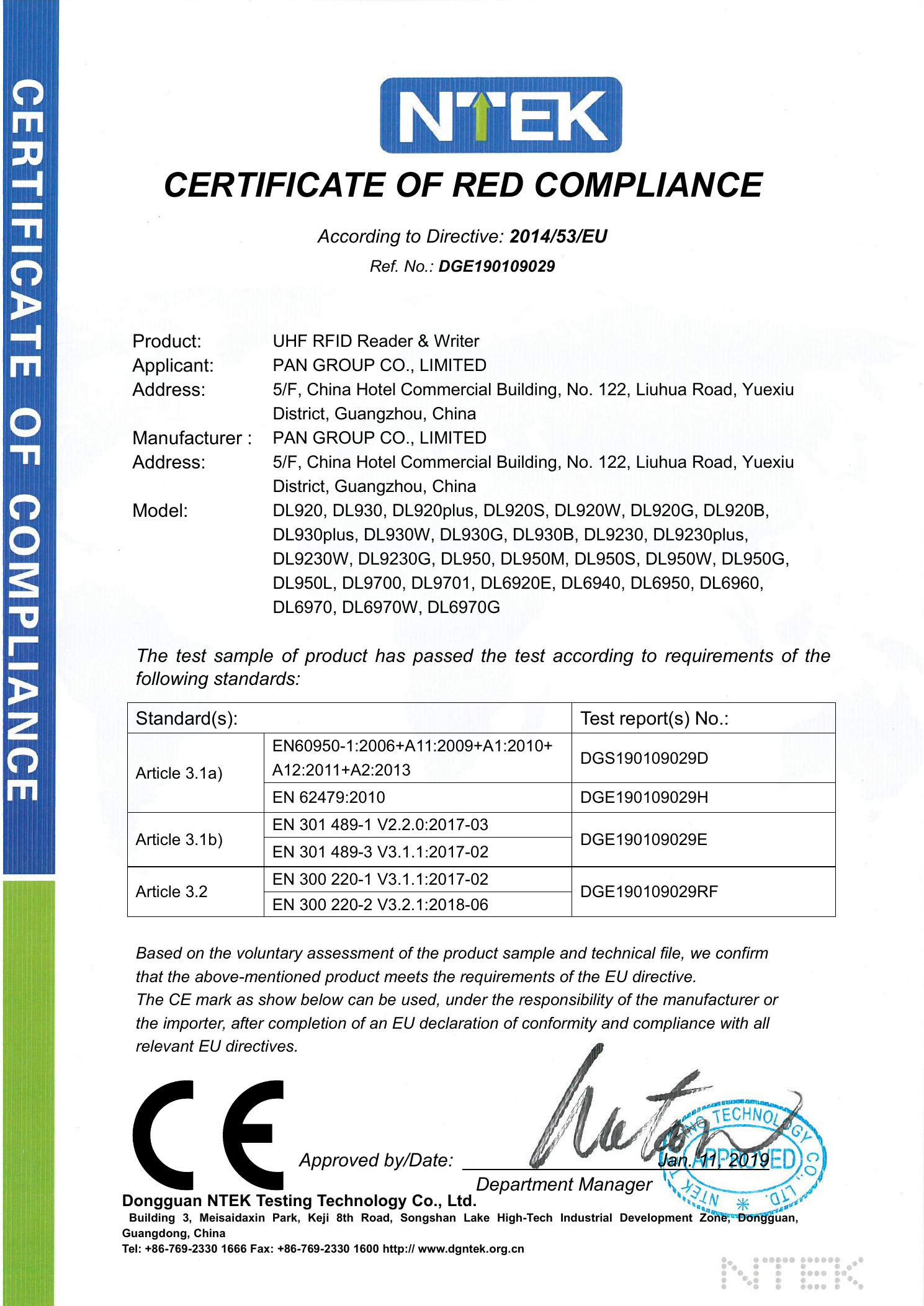
CE RED Certificate of Compliance for UHF RFID Reader & Writer equipment, certificate DGE190109029.
The CE RED record, certificate number DGE190109029, was issued on 11 January 2019 by Dongguan NTEK Testing Technology Co., Ltd. under Directive 2014/53/EU. Its scope names specific reader models — including members of the DL920, DL930, DL9230, DL950, DL9700, DL9701, DL6920E, DL6940 and DL6950 families — together with a listed set of associated products that includes the DL8330U UHF RFID Gate and AI-enhanced multi-antenna reader models. That is useful, verifiable evidence: it tells you which models were tested, under which directive, by which laboratory, and on what date. It does not tell you that an unlisted model, an altered antenna configuration or a different firmware branch is covered. The check is therefore mechanical: open the certificate scope, find your model, and if it is not there, ask a direct question.
Three further records show why a single certificate cannot be treated as a blanket market claim:
- CE Certificate of Conformity ATE20120505 / ATE20120506 / ATE20120507 / ATS2012177, issued 30 March 2012 by Accurate Technology Co., Ltd., covers models DL920, DL930, DL930B, DL920W, DL930W, DL6940 and DL6940W under Council Directive 1999/5/EC — a different directive from the 2019 record, and a partly overlapping model list.
- CE EMC Certificate of Conformity ATE20180529, issued 13 April 2018 by Shenzhen Accurate Technology Co., Ltd. under Directive 2014/30/EU, covers LF Reader-02, HF Reader-02 and Triple Reader-02 at DC 5V against EN 55032:2015 and EN 55024:2010+A1:2015. This is an EMC scope for low-frequency and high-frequency readers, not a UHF radio approval.
- FCC Supplier's Declaration of Conformity FCSE20015006, issued 15 January 2020 by Flux Compliance Service Laboratory, covers the 2.4 GHz active RFID tracking system — including reader models in the DL9230 series — against FCC Part 15 Subpart B Class B.
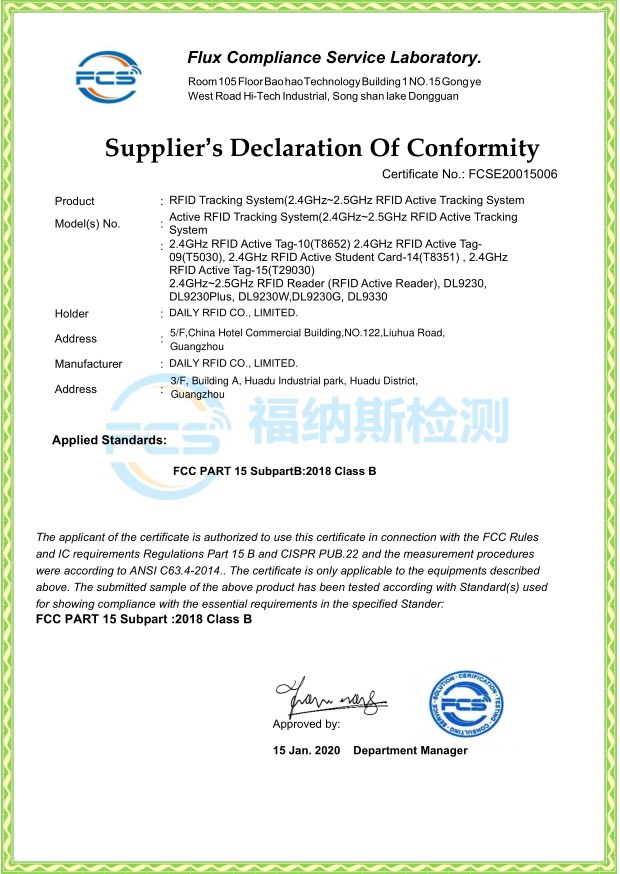
FCC Supplier's Declaration of Conformity covering the 2.4 GHz active RFID tracking system, including DL9230 series readers.
Two practical conclusions follow. First, EU and US coverage should be verified separately and per product family, because the supplied records differ in directive, date, laboratory and model scope. Second, tag-level laboratory documents — such as the Certificate of Analysis SNTEK2026032314501 for an embedded tag, or the RoHS and REACH reports for RFID labels — certify those tag products against their stated standards and should never be presented as evidence for a reader. Keeping reader radio approvals, reader EMC approvals and tag material reports in separate folders prevents exactly this confusion.
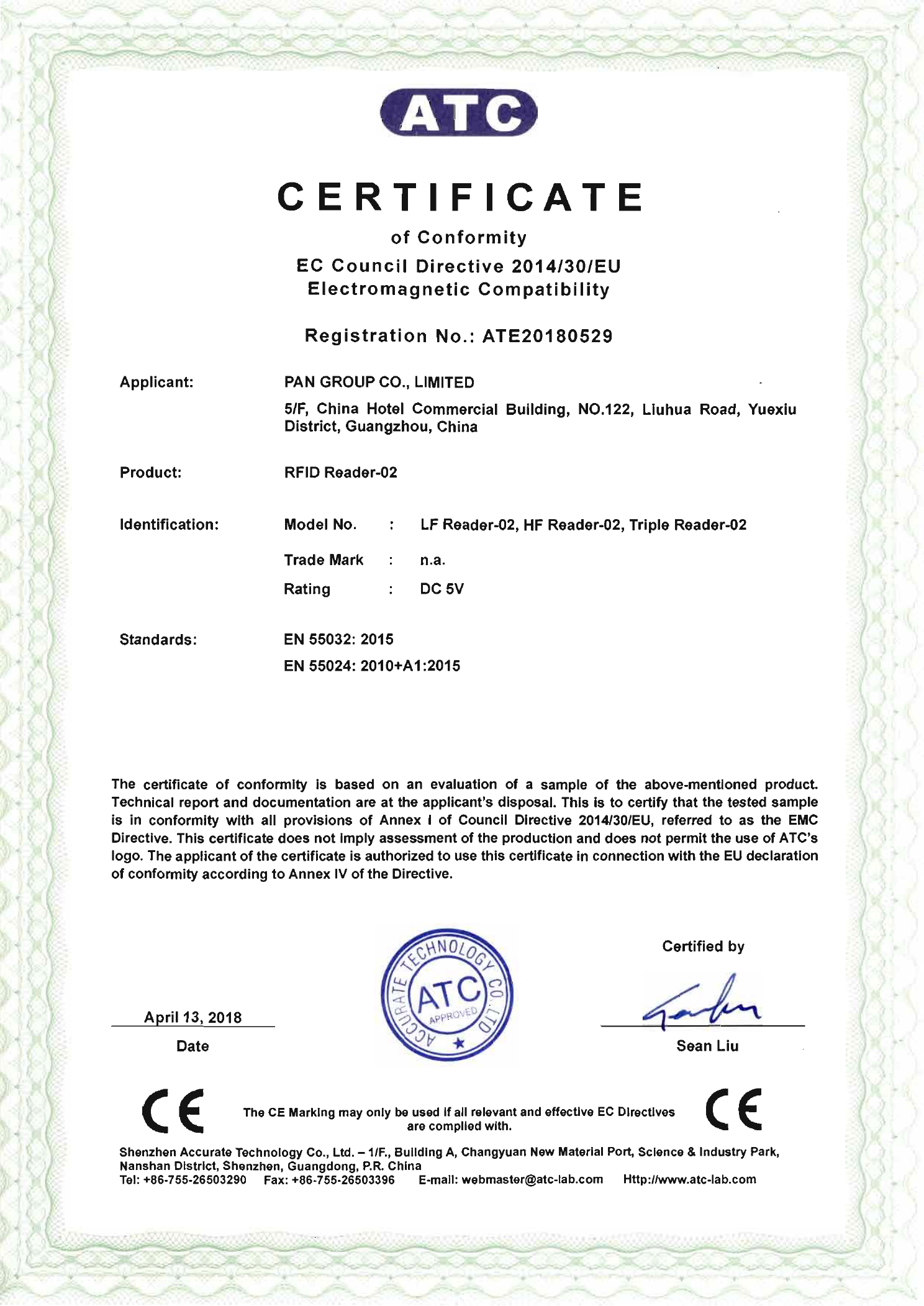
CE EMC Certificate of Conformity ATE20180529 for RFID Reader-02 models (LF, HF and triple reader variants).
Step 5 — Turn lead-time ranges into delivery assurance
Delivery assurance has three components: a date commitment, an escalation route, and a continuity plan for repeat orders. The lead-time ranges in the capability table are the input to the first component, not the output. A range becomes a commitment only when it is tied to your configuration, your quantity and a milestone schedule.
Date commitment
Convert the range into named milestones — material release, assembly completion, acceptance test date, packing, and handover under the chosen delivery term. Then ask the two questions that expose optimistic planning: how many units of this family are already scheduled in the target month, and what happens to the schedule if the acceptance test fails on first pass. The first answer tests capacity realism; the second tests whether rework time exists in the plan at all.
Escalation route
The documented after-sales models differ by family — remote support for the development kit, technical support for the HF reader and UHF mat antenna, and remote plus on-site support for the handheld reader, tray reader and smart cabinet, alongside replacement warranty on several tag families. Before signing, name the contact who receives a technical escalation, the contact who receives a commercial escalation, and the response window for each. Ask for the spare-part route for the reader family you are buying, because a reader failure in a fixed installation is a coverage problem, not only a hardware problem.
Continuity
Continuity planning protects the second and third orders, not the first. Three clauses carry most of the value: a change-notification clause covering reader module, firmware and housing revisions; a documentation clause guaranteeing the same acceptance test method on repeat orders; and a specification-lock clause confirming that the approved sample configuration is what ships. Note that an 80% export share with EU and USA as main markets is a fact about market mix — it is not evidence of service level, spare-part stock or regulatory coverage for a specific model. Treat it as context and verify the three clauses directly.
Applying the framework: four deployment patterns
The weighting of the framework changes with the deployment. The company-reported case descriptions below are included as portfolio and application evidence only; they show what has been described, not what will be achieved on your site.
Dock and conveyor fixed reading. A distribution centre in Poland is described as using 360 DL920S UHF long-range readers for conveyor-line parcel reading and outbound verification, and an automotive parts warehouse in Spain as using 420 DL6980 four-port long-range readers for dock-door verification and returnable container tracking. For this pattern, antenna port count and read-zone acceptance testing dominate the evaluation, and the fixed-reader and multi-port configurations should be matched to a family-specific capability record before capacity is discussed.
Handheld field and airside work. An airport ground-services operator in Turkey is described as deploying 90 DL1083 industrial long-range handheld readers for baggage-cart tracking and airside asset audits over at least four years. Here the decisive evidence is the burn-in method, the battery and accessory route, and the on-site support terms — all three are stated for the handheld family.
Embedded modules inside OEM equipment. A smart-cabinet manufacturer in Taiwan is described as using 35,000 ANT68X55_V10.01 13.56 MHz reader modules for embedded cabinet, drawer and terminal designs over at least five years. Module projects require RF performance testing plus the mechanical integration envelope; ask for both, and ask which module part numbers are offered as standard — the DL213 and DL228 Type-C UHF reader modules are listed in the same portfolio.
Integrated smart cabinet systems. A smart cabinet combines reader module, cabinet structure and software, which is why its documented control step is a system integration test rather than a reader-level test, and why on-site support is part of the stated after-sales model. An RFID Printer, where it appears in project scope for label encoding, is a separate evaluation object: the High-Speed RFID Label Printer sits in the portfolio, and its own acceptance criterion and lead time should be requested as a distinct line item.
Evaluation checklist before you release a purchase order
- Exact model and option set written on the order, including housing, interface and software revision.
- That model located inside a named certificate scope, with certificate number, issuing laboratory and issue date recorded in the file.
- Acceptance criterion chosen from the available options and named in the quotation, together with the test station and pass criterion.
- Lead time expressed as milestones tied to the configuration, plus a stated position on rework time after a failed first-pass test.
- Delivery term (EXW, FOB or CIF) agreed, with the risk-transfer point identified.
- Payment instrument confirmed among T/T, D/P and Sight L/C, with the commercial basis for the agreed terms documented.
- Named technical and commercial escalation contacts, with response windows.
- Spare-part and replacement route defined for the reader family, matched to its stated after-sales model.
- Change-notification and specification-lock clauses covering module, firmware and housing revisions.
Frequently asked questions
Which documents actually prove a UHF RFID reader is approved for the target market?
Check three things on the document itself: the directive or rule under which it was issued, the model scope listed inside it, and the issuing laboratory and date. For DAILY RFID, the UHF reader record DGE190109029 was issued on 11 January 2019 by Dongguan NTEK Testing Technology Co., Ltd. under Directive 2014/53/EU and names specific reader model families; the US record FCSE20015006, issued 15 January 2020, covers the 2.4 GHz active tracking system including DL9230 series readers under FCC Part 15 Subpart B Class B. A certificate whose scope does not list your model does not approve your model, and a tag-level test report does not approve a reader.
What should we check in an OEM UHF RFID reader manufacturer for a smart factory?
Verify four things in sequence. First, customization ownership: for the handheld reader family, documented ODM/OEM scope covers OS, software and housing, which means the manufacturer modifies the unit rather than only relabelling it. Second, the test method used for that family — full system burn-in for handhelds, 100% test for the HF reader family, factory acceptance test for the tray reader, system integration test for the smart cabinet, and RF performance test for the UHF mat antenna. Third, stated capacity and MOQ, which for those families range from 300 to 5,000 units per month with MOQs from 1 unit to 2 units. Fourth, the engineering base behind the customization: DAILY RFID reports 38 R&D engineers and a 28,000 m² factory with 180–200 employees. Ask for the production route and the acceptance test record for your model — the customization scope is only a claim until the process record accompanies it.
How do MOQ, payment terms and delivery terms affect the commercial plan?
Reader orders in the supplied purchasing records carry an MOQ of 2 units, a 7–15 day window, and delivery terms of EXW, FOB or CIF, with payment to be negotiated on order value and customization requirements among T/T, D/P and Sight L/C. Tag and label families carry separate MOQs, commonly between 500 and 1,000 units, so a mixed reader-and-tag project should be planned as two commercial lines rather than one blended figure. Practically, the MOQ sets your pilot size, the delivery term sets where your cost and risk begin, and the payment instrument sets your working-capital exposure during the lead-time window.
What does the acceptance test look like before a reader order scales?
The purchasing records list the acceptance options as Performance Test, Communication Test, WiFi Communication Test, Network Connection Test, Pre-shipment Inspection, or Factory Functional Test. Choose the criterion that matches your deployment risk — a WiFi-connected reader should not be accepted on a generic functional report — and require it to be named in the quotation, executed on a stated station, and recorded against a serial number or batch code. Sample approval and sample confirmation are both used as acceptance bases in the records, so the approved sample configuration should be written down and locked before volume production begins.
Which lead-time figures are commitments, and how do we convert them into one?
The figures in the capability table are planning ranges attached to a customization type: 3–15 days for the HF reader family, 15–30 days for the handheld family, 20–45 days for the tray reader and smart cabinet, and 15–30 days for the UHF mat antenna. A commitment exists only when a date is tied to your configuration, quantity and milestone schedule, and when the quotation states what happens after a failed first-pass acceptance test. Request that conversion in writing for the exact model you intend to order; the DAILY RFID team can confirm the applicable family record, acceptance criterion and delivery term against your configuration via sales@rfid-in-china.com or +86 15817191372.
Conclusion
Supplier evaluation for UHF RFID readers becomes tractable once the questions are separated. Portfolio evidence tells you which models and which approvals exist. Process evidence tells you how a unit is built, tested and recorded. Order evidence tells you what has been agreed for your configuration, your quantity and your delivery window. A supplier can be strong at the first tier and thin at the second, and the evaluation exists to find that out before the installation schedule depends on it.
Applied to DAILY RFID, the supplied records provide a checkable portfolio layer — model-scoped CE RED and EMC records, an FCC declaration for the 2.4 GHz active system, family-level capacity, lead-time, MOQ and quality-control parameters, and described deployments across logistics, airside, module-embedding and smart-cabinet applications — alongside a company profile of 28,000 m², 180–200 employees, 38 engineers and 100,000 readers per year. Those facts answer the first tier well. The second and third tiers still require the per-model production route, acceptance record and dated commitment that only a live quotation can supply, which is exactly the part of the evaluation worth spending time on.
Next step. Review the full portfolio and factory profile in the DAILY RFID company profile (PDF), or check current reader families at www.rfid-in-china.com. For a model-specific capability record, acceptance criterion and delivery term, send your configuration to sales@rfid-in-china.com.
Have Questions or Need More Details?
Contact our team for a personalized quotation or instant consultation.
Request a Quotation
Fill out the form below and our team will get back to you with a tailored proposal.
WhatsApp Direct Chat
Prefer to chat in real-time? Message us on WhatsApp for instant assistance & quick answers.
- Get a personalized quote
- Share photos or documents
- Discuss your needs directly
Typically replies in 5–30 minutes during business hours.