
UHF RFID Reader Supplier Audit: Portfolio Depth and Delivery
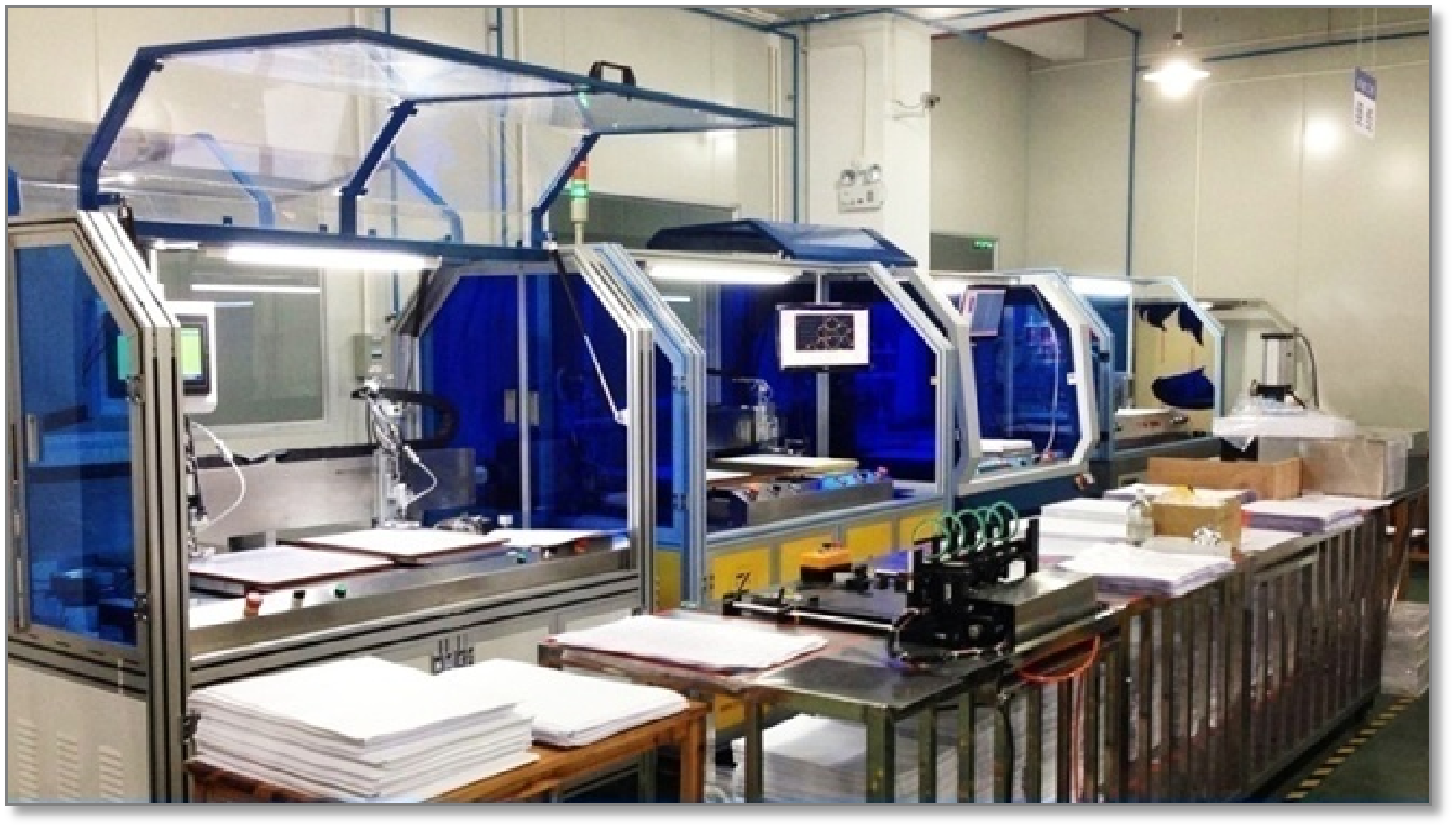
A UHF RFID reader order rarely fails because the datasheet was wrong. It fails on repetition: the second batch that reads differently from the first, the custom build that slips past its promised window, or the compliance file that turns out to name a different model number. Supplier evaluation therefore has to test the production system behind the reader, and the cheapest available signal for that, before any purchase order exists, is the shape of the supplier's portfolio.
This audit works through four evidence layers. The first is what each product line proves about manufacturing capability, from UHF RFID Readers and RFID Fixed Readers through RFID Handheld Readers, RFID Modules and RFID Gate systems. The second is the tag side of the same catalogue, including RFID Wristband, RFID Active Wristband, RFID Tool Tag, RFID Tire Tag and RFID Container Seal. The third is the test and certification trail that separates consistency from intention. The fourth is delivery assurance, which must be split into its standard-order clock and its custom-order clock.
DAILY RFID CO., LIMITED is used here as a worked example because its published line-level data allows the method to be applied concretely rather than abstractly. DAILY RFID is a Guangzhou-based RFID manufacturer founded in 2008 that produces RFID tags and RFID readers, and it reports a 28,000 m² factory, 180–200 employees, 38 engineers and an annual output of 50 million RFID tags, 30 million RFID cards and 100,000 RFID readers.
Why a model-level comparison cannot de-risk supply
A reader comparison answers a performance question. A supplier audit answers a repeatability question, and the two are not interchangeable. Three failure modes sit outside the scope of any specification sheet.
The first is unit-to-unit variance. A UHF reader is an assembly of an RF front end, an antenna or antenna port set, a controller, a housing and firmware. If a supplier tests every unit, variance shows up as a rejected unit inside the factory. If a supplier tests a sample, variance shows up at your dock instead.
The second is custom-order slip. Custom work moves through two queues: an engineering queue to freeze the design, and a production queue to build it. Suppliers frequently quote only the second, which is why custom lead times are read as optimistic.
The third is documentation mismatch. A conformity certificate can be entirely genuine and still not cover the model you are buying. Buyers discover this at customs, at tender review, or at the customer audit that follows installation.
A single-model supplier gives you no visibility into any of the three, because there is nothing to compare against. A supplier that runs several production lines gives you something to inspect: whether quality control is a habit that shows up line after line, or a single controlled process surrounded by resellers.
Industry background: why the supply base now matters as much as the reader
UHF is no longer a niche interface. Mordor Intelligence estimates that UHF captured 40.72% of total RFID market revenue in 2025, which makes UHF reader supply a mainstream procurement category rather than a specialist one. These are commercial research estimates and should be read as directional rather than audited.
Interoperability is the reason. UHF readers operate under the EPCglobal Gen2 air interface, standardised as ISO/IEC 18000-6C/63 by GS1, which means a reader is expected to work with tags it did not manufacture. That expectation pushes evaluation towards how a unit behaves in a mixed environment, not only towards what its own specification table promises.
Demand has shifted with it. A 2024 Mordor Intelligence estimate puts adoption at over 60% of factories pursuing Industry 4.0 that deploy RFID readers for asset traceability. Once a reader sits on a production line, it stops being equipment and becomes infrastructure: an interrupted reader supply interrupts the line. That is the commercial argument for treating portfolio breadth as a risk indicator, not a marketing one.
Published specification claims also deserve careful reading. Turck states that its UHF RFID readers carry IP67 protection and are intended for harsh industrial conditions; Merhein lists an integrated-antenna reader at 860–960 MHz supporting EPCglobal UHF Class 1 Gen 2, ISO 18000-6C and ISO 18000-6B. Both statements may be accurate, and both are supplier-reported. Neither tells a buyer which specific models carry the protection rating, or whether the units delivered to them will. Spec claims define what to verify; they do not verify it.
What a broad portfolio proves, and what it does not
A wide catalogue is evidence, not proof. Each additional production line requires its own tooling, its own inspection method and its own process discipline, so the number of genuinely operated lines tells you how many manufacturing problems a supplier has already had to solve.
Portfolio breadth is reasonable evidence of four things. It shows component-level capability, because antenna design, RF front-end assembly and module miniaturisation are different competences from box assembly. It shows cross-check ability, because a supplier that builds readers and tags can diagnose a failed read across both sides of the link. It shows capacity planning across materials, since tag lines, card lines and reader lines compete for floor space and staff. And it shows a documentation habit, because a supplier that holds test reports and certificates for both its reader range and its tag range has an established compliance workflow.
It proves four things less reliably. It does not predict read performance at your dock, along your conveyor or inside your cabinet. It does not confirm firmware or interface fit with your MES, ERP or WMS. It does not establish that the exact model you intend to buy appears in the certificate's scope. And it says nothing about price competitiveness. Each of those has to be closed separately through the RFQ, the sample and the pilot.
Reading the reader range as a capability statement
The reader families a supplier lists should be read as process claims rather than shelf items. A fixed reader line implies multi-port RF assembly, antenna tuning and network integration. A handheld line implies operating-system, software and housing integration followed by system-level burn-in. A module line implies RF front-end miniaturisation for OEM integrators. The same logic continues through the rest of the catalogue.
| Reader family | Representative models | What the line proves |
|---|---|---|
| RFID Fixed Reader / long range | DL921 Power on Ethernet UHF Long Range RFID Reader; DL6940/6960 AI Multi-Antenna 4-Port UHF Reader | Multi-port RF assembly, power-over-Ethernet and network integration, antenna tuning |
| RFID Handheld Reader | DL1280 Industrial PDA UHF/HF/LF Handheld Reader; DL1380 AI-Powered RFID Handheld; DL995 / DL996 | OS, software and housing integration with full system burn-in |
| RFID Module | DL213 Type-C UHF Reader Module; DL228 Type-C UHF Mobile Reader | RF front-end miniaturisation for OEM and integrator designs |
| Ceiling RFID Reader | DL6990 UHF Ceiling RFID Reader (Integrated Antenna) | Integrated antenna and enclosure design for overhead coverage |
| RFID Gate | DL8330U Advanced UHF RFID Gater | Multi-antenna lane assembly and read-zone control |
| RFID Tray Reader | DL4130H RFID Jewelry Tray Reader & Antenna All-in-one | Antenna layout, interface and software co-design with factory acceptance testing |
| AI Powered RFID Reader | DL9702 AI RFID Tag Tester & Encoder; DL921 AI Enhanced UHF Long Range Reader | Firmware and encoding depth beyond read/write hardware |
| Connectivity variants | UHF Bluetooth RFID Reader DL930B; WiFi RFID Reader DL920Plus; DL9230 RFID TCP/IP Active Reader | Radio, network and protocol integration across deployment environments |
The lines behind those families are documented at different depths, and that difference is itself informative. The UHF Handheld Reader line is offered in ODM/OEM mode with customization on operating system, software and housing, at 2,000 units per month, 15–30 days, minimum order 1 unit, with full system burn-in and remote plus on-site after-sales support. The RFID Tray Reader is an ODM line with customization on antenna layout, interface and software, 500 units per month, 20–45 days, minimum order 1 unit, factory acceptance testing and on-site support. The UHF Mat Antenna line is ODM/OEM on size, cable and connector, 1,000 units per month, 15–30 days, minimum order 1 unit, with RF performance testing. The RFID Development Kit supplies a reader bundle, demo software and sample tags at 1,000 sets per month, 7–15 days, minimum order 1 set.
Two further layers matter for scale-up. The system layer, including the Parking Management RFID Development Kit and the GPRS Based RFID School Attendance System, shows software integration beyond hardware. The peripheral layer, including RFID Printers and RFID Smart Cabinets, shows that a mixed bill of materials can be consolidated with one supplier instead of assembled from several, which reduces the number of parties who can blame each other when a station does not work.
Reading the tag range: where reader projects actually fail
Tags are the usual source of a failed read, and the tag side of a catalogue is therefore the second half of the capability check. Wearable tags combine comfort, enclosure and RF design, a different skill set from board assembly. DAILY RFID lists a silicone RFID Wristband line at 200,000 units per month, 10–25 days, minimum order 100 units, with visual and signal testing; a fabric RFID Wristband line at 300,000 units per month, 12–20 days, minimum order 500 units, with batch sampling; and dual-chip wristbands combining UHF H3 and HF Mifare 1K, alongside an RFID Adjustable Active Wristband for active 2.4GHz deployments.
Industrial tags test different process controls. The anti-metal Anti-Metal RFID Tag line runs at 100,000 units per month, 7–15 days, minimum order 50 units, with 100% signal testing. The RFID Windshield Tag line runs at 800,000 units per month, 10–20 days, minimum order 500 units, with peel and signal testing. The RFID Tool Tag for tool management, the RFID Tire Tag in patch and Gen 2 formats, and the RFID Container Seal all sit in the same industrial family, where the tag has to survive handling, cleaning or outdoor exposure rather than a retail shelf.
The practical value of this breadth is diagnostic. When the same supplier builds the reader and the tag, a failed read can be traced across the tag, the antenna and the reader without a commercial negotiation about who owns the fault. That is an operational convenience, not a performance guarantee: a supplier's own tag still has to be validated on your site, against your material and your read geometry.
Production consistency: the checks that leave a paper trail
Consistency is visible in test coverage and in batch documentation. Ask which tests run on every unit and which run on a sample, then compare the answer with what the supplier publishes. In the DAILY RFID lines, coverage is deliberately uneven because the failure cost differs: 100% signal testing on anti-metal tags and asset tracking tags, AQL sampling on RFID Key Fobs, batch sampling on fabric wristbands, function and packing testing on Mifare HF cards and development kits, full system burn-in on handheld readers, factory acceptance testing on tray readers, RF performance testing on UHF mat antennas, durability and wash testing on laundry tags, and peel plus signal testing on windshield tags.

A batch-linked Certificate of Analysis is the strongest single document a tag buyer can demand. One example in the DAILY RFID file is certificate SNTEK2026032314501, issued on 23 March 2026 by North South Precision Testing Technology Service (Shenzhen) Co., Ltd. for an RFID Embeded Tag production batch numbered 20260320, with analytical result Pass, a passive tag at 923–925 MHz, IPX7 protection and no hazardous substance detected, evaluated against ISO/IEC 18000-6C, ISO/IEC 18046-3:2021, IEC 60529 and IEC 62321. The document links a batch, a model and a test method, which is precisely what a generic compliance statement does not do.

Materials compliance follows the same pattern. The RFID Tiny Tags RoHS 2.0 test report AZT250710068C-E0 was issued on 11 July 2025 by Shenzhen AZT Technology Co., Ltd. against RoHS Directive 2011/65/EU and the amending Directive (EU) 2015/863, with IEC 62321 series methods. RFID Label documentation includes a REACH SVHC test report, DGC170511007T02, and separate RoHS 2.0 reports. Buyers who ship into the EU should treat these as the minimum file, not the complete one.
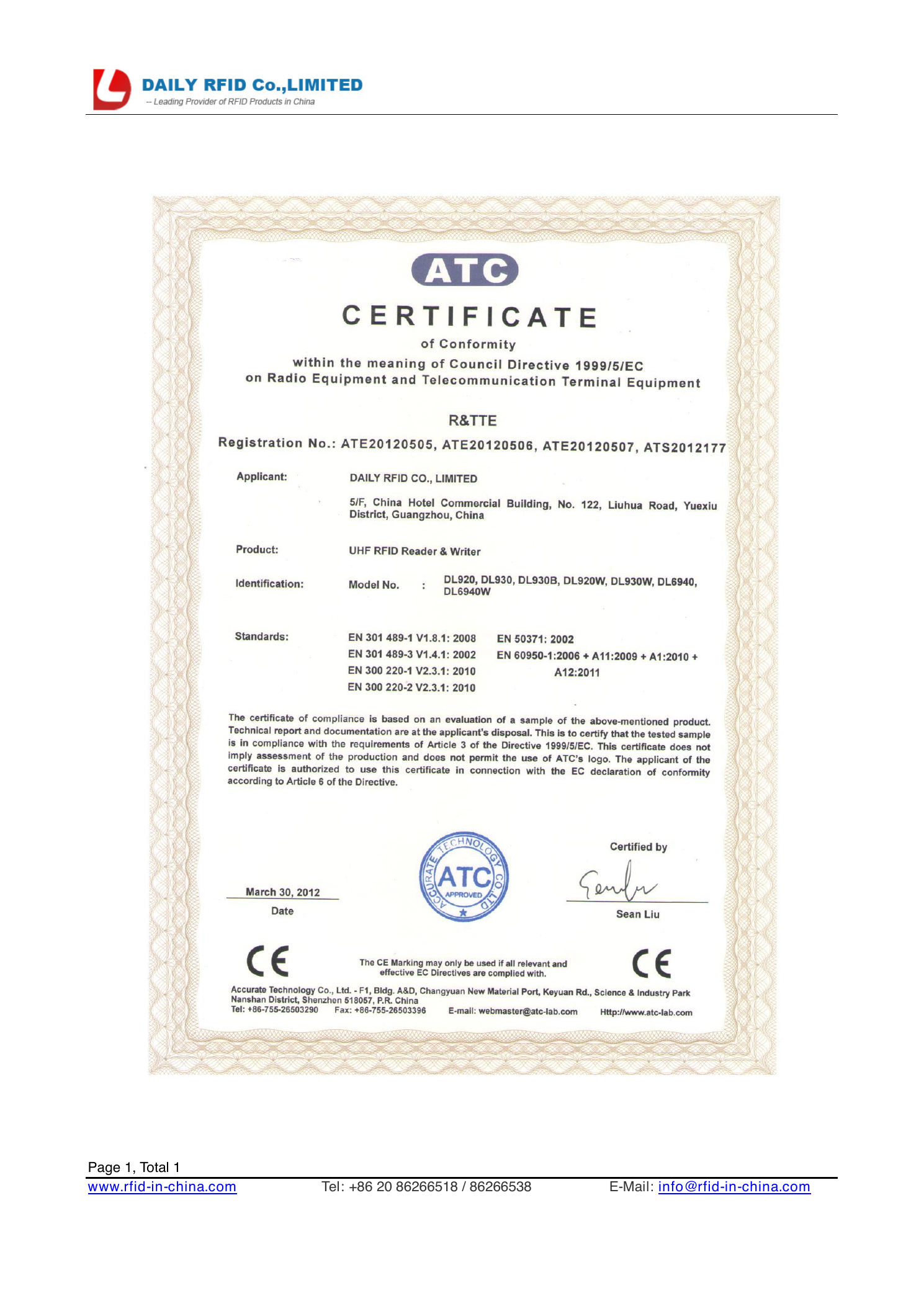
Reader conformity needs a different check, because the certificate has to name the model. The CE RED Certificate of Compliance DGE190109029, issued on 11 January 2019 by Dongguan NTEK Testing Technology Co., Ltd., covers UHF RFID Reader & Writer models including DL920, DL930, DL930B, DL920Plus, DL9230 variants, DL950 variants, DL9700, DL9701, DL6920E, DL6940 and DL6950, tested against Directive 2014/53/EU with EN 60950-1, EN 62479, EN 301 489-1, EN 301 489-3, EN 300 220-1 and EN 300 220-2. An earlier CE Certificate of Conformity, ATE20120505/ATE20120506/ATE20120507/ATS2012177 issued on 30 March 2012 by Accurate Technology Co., Ltd., covers DL920, DL930, DL930B, DL920W, DL930W, DL6940 and DL6940W. A CE EMC certificate ATE20180529 covers RFID Reader-02 in LF, HF and Triple variants, and the FCC Supplier's Declaration of Conformity FCSE20015006, issued on 15 January 2020, covers the 2.4GHz active tracking system including DL9230, DL9230Plus, DL9230W and DL9230G readers.
Delivery assurance: two clocks, not one lead time
Delivery assurance has to be split before it is quoted. Standard orders follow a production clock. Custom orders follow an engineering clock and then a production clock, and conflating the two is the most common reason a custom reader arrives late without anyone having broken a promise.
On the standard side, the reader-line purchase terms recorded for DAILY RFID are a minimum order of 2 units, a lead time of 7–15 days, delivery terms of EXW, FOB or CIF, and payment by T/T, D/P or Sight L/C with terms negotiated on order value and customization requirements. The acceptance test is product-specific rather than uniform: recorded variants include communication testing, network connection testing and factory functional testing. That detail belongs in the purchase order, because an acceptance criterion agreed verbally is an acceptance criterion disputed later.
On the custom side, the published line data shows what the engineering clock looks like. ODM/OEM customization of a handheld reader across operating system, software and housing runs at 15–30 days with a minimum order of 1 unit and a 2,000-unit monthly capacity. ODM customization of a tray reader across antenna layout, interface and software runs at 20–45 days, minimum order 1 unit, 500 units monthly, with factory acceptance testing. ODM/OEM customization of a UHF mat antenna across size, cable and connector runs at 15–30 days, minimum order 1 unit, 1,000 units monthly, with RF performance testing.
| Line | Customization mode | MOQ | Monthly capacity | Lead time | Quality control |
|---|---|---|---|---|---|
| UHF Handheld Reader | ODM/OEM: OS, software, housing | 1 unit | 2,000 units | 15–30 days | Full system burn-in |
| RFID Tray Reader | ODM: antenna layout, interface, software | 1 unit | 500 units | 20–45 days | Factory acceptance test |
| UHF Mat Antenna | ODM/OEM: size, cable, connector | 1 unit | 1,000 units | 15–30 days | RF performance test |
| RFID Development Kit | Reader bundle, demo software, sample tags | 1 set | 1,000 sets | 7–15 days | Function and packing test |
| HF RFID Reader | OEM: logo, software | 2 units | 5,000 units | 3–15 days | 100% test |
| Anti-Metal RFID Tag | ODM/OEM: form factor, adhesive | 50 units | 100,000 units | 7–15 days | 100% signal test |
| RFID Laundry Tag | OEM: material, size | 1,000 units | 400,000 units | 10–20 days | Durability and wash test |
| Mifare HF Card | OEM: logo, encoding, design | 500 units | 1,000,000 units | 5–15 days | Function and packing test |
Read the table as a capacity map, not a price list. The pattern it reveals is what matters: reader lines carry low minimum orders and longer windows because they are configured and burned in individually, while tag and card lines carry high monthly capacity and compressed windows because they are continuous processes. A supplier whose custom reader lead time is shorter than its standard lead time is describing a different product than the one you asked about.
Scale-up and long-term continuity
Scale-up questions are answered by numbers, and the numbers should be read critically. DAILY RFID reports a 28,000 m² factory, 180–200 employees, a 38-engineer R&D team, an 80% export ratio and main markets in the EU and the USA. Annual output is reported as 50 million RFID tags, 30 million RFID cards and 100,000 RFID readers.

Reader output of 100,000 units per year is a meaningful base for industrial programmes and a finite one. That is the correct conclusion to draw: capacity exists, and capacity still has to be booked. A buyer planning a multi-site rollout should request a written capacity reservation for the reader lines, rather than assuming a published annual figure is available in any given quarter.
Continuity also has an installed-base component. Among the documented DAILY RFID deployments, an airport ground-services operator has used 90 DL1083 Industrial Long Range Handheld Readers for baggage-cart tracking, ground-equipment checks and airside asset audits for at least four years. That duration is a service-life signal, and it should be treated as evidence of continuity rather than as a performance guarantee for a different site.
A seven-step supplier audit sequence
- Map the requirement to a line, not a model. Decide whether the problem is fixed reading, handheld reading, overhead coverage, lane control, tray-level reading or an embedded module. Line fit determines which capability data is relevant.
- Request line-level capacity, MOQ and lead time in writing. Ask for the monthly capacity of that specific line, not the company total, and confirm whether the quoted window includes engineering time.
- Ask which tests run on 100% of units and which run on a sample. A supplier that answers precisely is describing a real regime; a supplier that answers with the word "strict" is describing nothing.
- Request batch-level documentation for the exact model. A Certificate of Analysis or test report should link batch, model and method, as the RFID embedded tag COA does with ISO/IEC 18000-6C, ISO/IEC 18046-3:2021, IEC 60529 and IEC 62321.
- Open every conformity certificate and find your model in the scope. Check reader certificates model by model, and confirm which standards versions were tested.
- Agree the acceptance test and delivery terms in the purchase order. Name the test type, the Incoterm, the packaging standard and the party that pays for re-test after a failed acceptance.
- Check the continuity inputs. Confirm R&D headcount allocated to customization, ask how a mixed reader-and-tag bill of materials is coordinated, and request the support model in writing.
Two decision scenarios
A wearable-tag programme is being specified. The reader selection depends on whether identification happens at close range or across a lane, and the wristband material determines comfort and reuse. A buyer can consolidate the RFID Wristband line, the reader line and the encoding step with one supplier, then validate the combination on site. The portfolio shortens the integration path; the site test still decides.
An industrial asset programme is being specified. Metal tools, fixtures, tire assemblies or containers return different read behaviours, so the tag family drives the reader choice rather than the reverse. A supplier holding an anti-metal line, a tool tag, a tire tag, a container seal, a handheld and a fixed reader can be asked to propose a matched combination and to state which element is expected to limit read reliability. That answer is more useful than a read-range figure.
What this method cannot tell you
Portfolio depth will not predict site performance, and no document in a supplier file replaces a pilot on your own material, at your own read distance, with your own tag population. It will not confirm that firmware or an API fits your MES, ERP or WMS without an integration test. It will not produce an independent price benchmark, because verified third-party price, MOQ and total-cost datasets for this category are not publicly available; quoted terms remain supplier-reported until your RFQ returns comparable bids. And it will not remove the need to re-check the certificate scope each time a model, a market or a radio variant changes.
Frequently asked questions
Which documents prove a UHF RFID reader supplier can deliver into the EU and the US?
For the EU, ask for the CE conformity documents that name your exact reader model. In the DAILY RFID file, the CE RED Certificate of Compliance DGE190109029 covers UHF RFID Reader & Writer models including DL920, DL930, DL930B, DL920Plus, DL9230 and DL950 variants, DL9700 and DL9701, DL6920E, DL6940 and DL6950, tested against Directive 2014/53/EU with the listed EN standards; a separate CE EMC certificate ATE20180529 covers RFID Reader-02 variants. For the US, the FCC Supplier's Declaration of Conformity FCSE20015006 covers the 2.4GHz active tracking system including DL9230, DL9230Plus, DL9230W and DL9230G readers. In every case the check is the same: confirm the model list contains the model you are ordering, and confirm which standards versions apply.
Can a supplier customize a UHF RFID reader for our housing, operating system or software?
Yes, where the supplier operates an ODM/OEM reader line. DAILY RFID offers ODM/OEM customization on the UHF Handheld Reader across operating system, software and housing, at a minimum order of 1 unit, a monthly capacity of 2,000 units, a 15–30 day lead time, full system burn-in before shipment and remote plus on-site after-sales support. Customization on the RFID Tray Reader covers antenna layout, interface and software at 500 units per month with factory acceptance testing, and customization on the UHF Mat Antenna covers size, cable and connector at 1,000 units per month with RF performance testing. Each of those is a production capability statement; the design freeze still has to be agreed with your engineering team before the clock starts.
What are the minimum order quantities and lead times for readers compared with tags?
Reader lines run on low minimums and longer windows, while tag lines run on higher minimums and shorter windows. The reader terms recorded for DAILY RFID are a minimum order of 2 units and a 7–15 day lead time, with EXW, FOB or CIF delivery and payment by T/T, D/P or Sight L/C negotiated on order value and customization. On the custom side, a handheld reader runs 15–30 days at a 1-unit minimum, a tray reader 20–45 days at a 1-unit minimum, and a mat antenna 15–30 days at a 1-unit minimum. Tag lines differ: an anti-metal tag starts at 50 units with a 7–15 day window, a laundry tag at 1,000 units with 10–20 days, and a Mifare HF card at 500 units with 5–15 days at up to 1,000,000 units monthly.
How can we check production consistency before releasing a large order?
Use three checks together. First, ask for the test coverage of the specific line: DAILY RFID applies 100% signal testing to anti-metal and asset tracking tags, AQL sampling to key fobs, batch sampling to fabric wristbands, function and packing testing to Mifare HF cards, full system burn-in to handheld readers and factory acceptance testing to tray readers. Second, request batch-level documentation for the exact model, such as the RFID embedded tag Certificate of Analysis SNTEK2026032314501 issued on 23 March 2026 for batch 20260320, with a Pass result against ISO/IEC 18000-6C, ISO/IEC 18046-3:2021, IEC 60529 and IEC 62321. Third, use sample approval as the contractual acceptance basis so that the approved sample, not the brochure, defines conformity.
How long does a custom reader order take, and what acceptance test applies?
A custom reader order takes the engineering window plus the production window. On the DAILY RFID lines the published windows are 15–30 days for a customized UHF Handheld Reader at 2,000 units monthly, 20–45 days for an ODM RFID Tray Reader at 500 units monthly with factory acceptance testing, and 15–30 days for a customized UHF Mat Antenna at 1,000 units monthly with RF performance testing. The acceptance test differs by product, and the recorded variants for reader orders include communication testing, network connection testing and factory functional testing. Confirm which one applies to your model before the purchase order is signed. If you want to shorten that confirmation step, you can request the current company profile and product documentation pack as a PDF and review the line data before the technical discussion begins.
Conclusion: audit the line, then book the order
Supplier evaluation for UHF RFID readers works best as a portfolio audit. The reader families a supplier operates show whether multi-port RF assembly, handheld burn-in, module miniaturisation and lane control are real capabilities or catalogue entries. The tag families show whether the supplier understands the side of the link where reads usually fail, from RFID Wristband and RFID Active Wristband through RFID Tool Tag, RFID Tire Tag and RFID Container Seal. The test and documentation trail shows whether consistency is systematic, and the delivery data shows whether the lead time you were quoted describes the production clock or quietly omits the engineering clock.
DAILY RFID CO., LIMITED illustrates the standard to test against rather than a conclusion to accept: a portfolio spanning UHF readers, fixed and handheld readers, modules, gates, ceiling and tray readers, printers, smart cabinets and systems, backed by published line-level capacity, lead times, quality-control methods and model-specific conformity documents. Verify each element against your own requirement, then commit capacity in writing.
Next step
Review the manufacturing, capacity and product-line data before your technical review: download the DAILY RFID company profile (PDF), or visit www.rfid-in-china.com to match a reader family to your application. Sample requests and model-specific documentation can be raised through the same channel when your specification is ready.
Have Questions or Need More Details?
Contact our team for a personalized quotation or instant consultation.
Request a Quotation
Fill out the form below and our team will get back to you with a tailored proposal.
WhatsApp Direct Chat
Prefer to chat in real-time? Message us on WhatsApp for instant assistance & quick answers.
- Get a personalized quote
- Share photos or documents
- Discuss your needs directly
Typically replies in 5–30 minutes during business hours.