
UHF RFID Reader Market Trends and Top Solutions for Smart Manufacturing
UHF RFID Reader Market Trends and Top Solutions for Smart Manufacturing
When procurement teams enter the UHF RFID reader market at the evaluation stage, they usually face the same dilemma: the technology is standardized, the vendors are numerous, and the specifications look similar on paper. Yet deployment outcomes vary widely. The difference typically comes down to how well a reader's form factor, interfaces, certifications, and supply-side capabilities match a specific factory workflow.
The global UHF RFID reader market is valued at approximately USD 4.8 billion in 2025 and is projected to reach USD 11.2 billion by 2034, according to Dataintelo. UHF RFID technology captured 40.72% of total RFID market revenue in 2025, driven by retail inventory cycles and multi-item read capabilities, according to Mordor Intelligence. For a smart manufacturing buyer, these numbers reinforce a practical question: which reader solution should make the shortlist?
This article outlines current UHF RFID market signals, compares the main reader form factors used in smart manufacturing, and provides a step-by-step evaluation framework. DAILY RFID CO., LIMITED, a Guangzhou-based RFID manufacturer, is used as a reference supplier throughout because its product, certification, capacity, and case data are documented in full.
UHF RFID Market Signals That Affect Reader Evaluation
UHF RFID readers are standardized globally under the EPCglobal Gen2 (Generation 2) protocol, also known as ISO/IEC 18000-6C, according to GS1 and ISO. This common air-interface standard means a buyer can compare readers from different manufacturers without worrying about protocol lock-in. The real evaluation variables are physical: antenna configuration, transmit power, anti-collision performance, communication ports, mounting style, and environmental protection.
Regional market dynamics also shape reader requirements. The Americas lead UHF RFID adoption with over 60% of global UHF tag usage as of 2025, primarily due to retail mandates, according to IDTechEx. Asia Pacific is the fastest-growing region for UHF RFID hardware, with an expected 11.8% CAGR in shipments through 2031, according to ABI Research. For manufacturers exporting to both regions, frequency customization and multi-region certification are not optional features; they are evaluation criteria.
The Real Evaluation Problem in Smart Manufacturing
In smart manufacturing, the problem is rarely whether UHF RFID works. It is which reader configuration will work in a specific zone. A loading dock, a high-bay warehouse, a production line, a tool crib, and a cold room each create different demands on reading distance, tag density, mounting, and data integration.
Common evaluation mistakes include:
- Choosing a maximum-range reader when the application needs near-field accuracy instead.
- Selecting a fixed reader where a handheld terminal would reduce cost and increase flexibility.
- Overlooking interface compatibility with existing PLC, WMS, or ERP systems.
- Assuming certification coverage for one EU model automatically applies to all variants.
- Ignoring supplier lead time and MOQ until late in the procurement cycle.
These mistakes usually surface after deployment, not during vendor demos. The most reliable way to avoid them is to evaluate readers against a structured checklist, using verified specifications and documented deployments rather than marketing claims.
A Reference UHF RFID Reader Portfolio: DAILY RFID
DAILY RFID CO., LIMITED is a Guangzhou-based RFID manufacturer founded in 2008. The company operates a 28,000 m² facility with 180–200 employees, including 38 engineers in its R&D team. Annual production capacity includes 50 million RFID tags, 30 million RFID cards, and 100,000 UHF RFID readers. Approximately 80% of its output is exported to the EU and USA. The company designs and manufactures RFID tags, readers, antennas, cards, labels, and related hardware, which makes it a useful reference point when evaluating reader-to-tag compatibility and single-source supply.

Fixed and Multi-Antenna Readers
For wide-area coverage, the DL6960 AI Multi-Antenna 4-Port UHF Reader supports ISO18000-6B and ISO18000-6C EPC Gen2, operates across 860–960 MHz, and offers a reading range of up to 25–30 meters. It reads up to 1000 tags simultaneously, supports four external antenna ports, and is rated IP64. Interfaces include RS232, RJ45, GPIO, and RS485. Its operating temperature range is -30°C to +70°C.
The DL920Plus WiFi RFID Reader provides an integrated antenna with a reading range of 8–15 meters, software-adjustable transmit power from 20 dBm to 30 dBm, and IP64 protection. It supports RS232, RJ45, USB, RS485, and Wiegand 26/34 interfaces, and is designed for sites where eliminating network cabling is a priority.
Integrated Long-Range and Ceiling Readers
The DL921 series integrates a circularly polarized antenna, reads up to 15 meters (82 feet), and identifies up to 50 tags simultaneously. The GSM variant supports 2G/4G cellular data transmission, while the PoE variant delivers power and network over a single Ethernet cable. Both versions carry an IP65 rating and operate from -20°C to +60°C.
The DL6990 UHF Ceiling RFID Reader integrates a high-gain antenna in a compact 180 mm × 180 mm × 28 mm housing. It reads tags from 0.1 to 5 meters, supports 33 dBm maximum transmit power, reads up to 50 tags simultaneously, and is rated IP66.
Handheld Readers
The DL1280 Industrial PDA covers UHF (860–960 MHz), HF (13.56 MHz), and LF (125 kHz) in a single device. UHF reading distance reaches 20 meters, with anti-collision support for up to 100 tags. It runs Android 12 on an 8-core 2.0 GHz processor with 4 GB RAM and 64 GB ROM, is rated IP65, and uses a dual-battery system (4500 mAh + 6700 mAh) with 18 W fast charging.
Reader Modules
For OEM integration, the DL213 Type-C UHF Reader Module measures 45 mm × 30 mm × 6 mm, reads from 0.1 to 10 cm, and supports USB keyboard simulation mode for plug-and-play data entry. It is suitable for smart cabinets, self-service terminals, and embedded production-line readers.
Certification Coverage
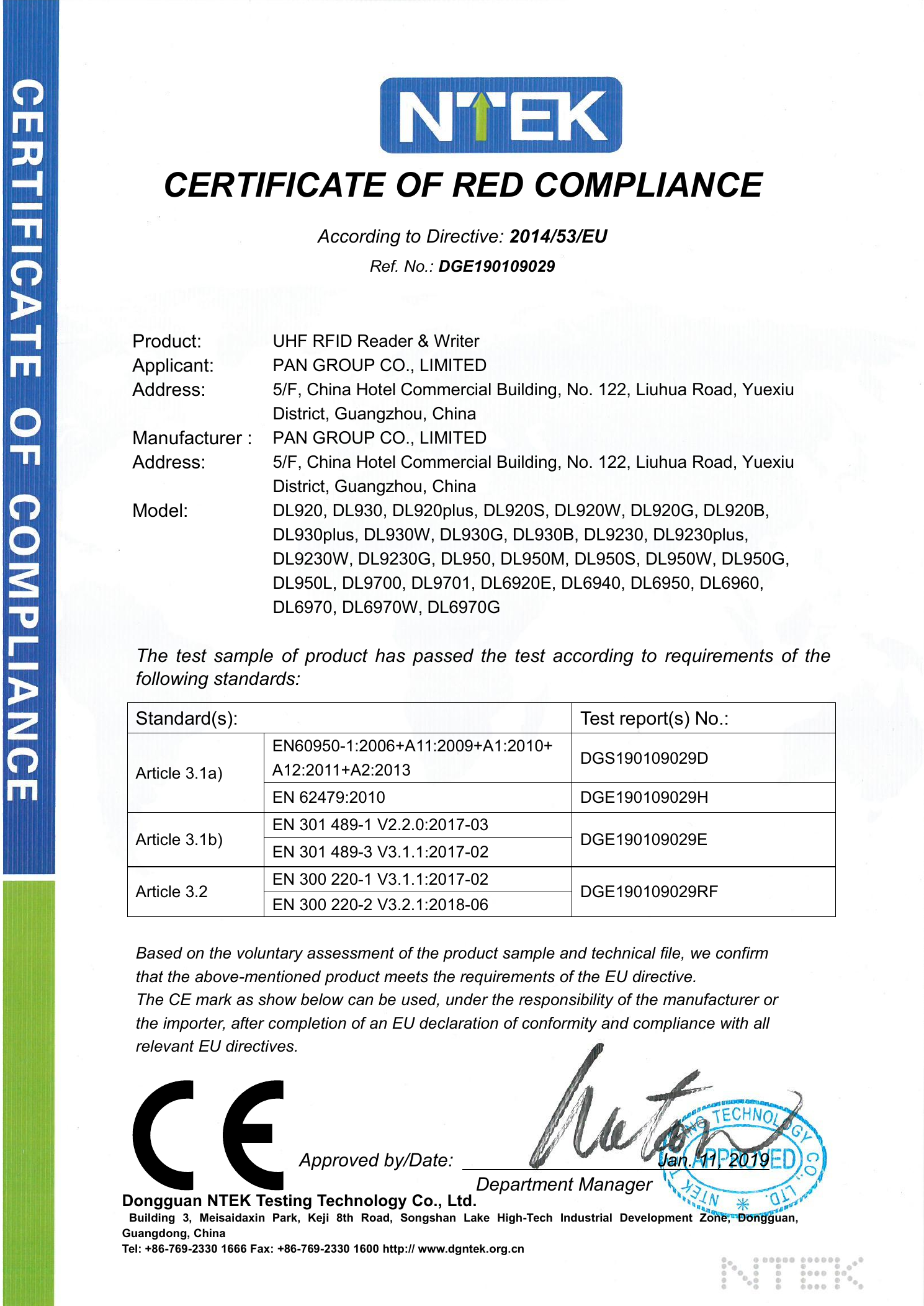
DAILY RFID's UHF reader family is covered by a CE RED Certificate of Compliance (certificate number DGE190109029, issued under Directive 2014/53/EU by Dongguan NTEK Testing Technology Co., Ltd.), which lists a broad set of DL-series models.
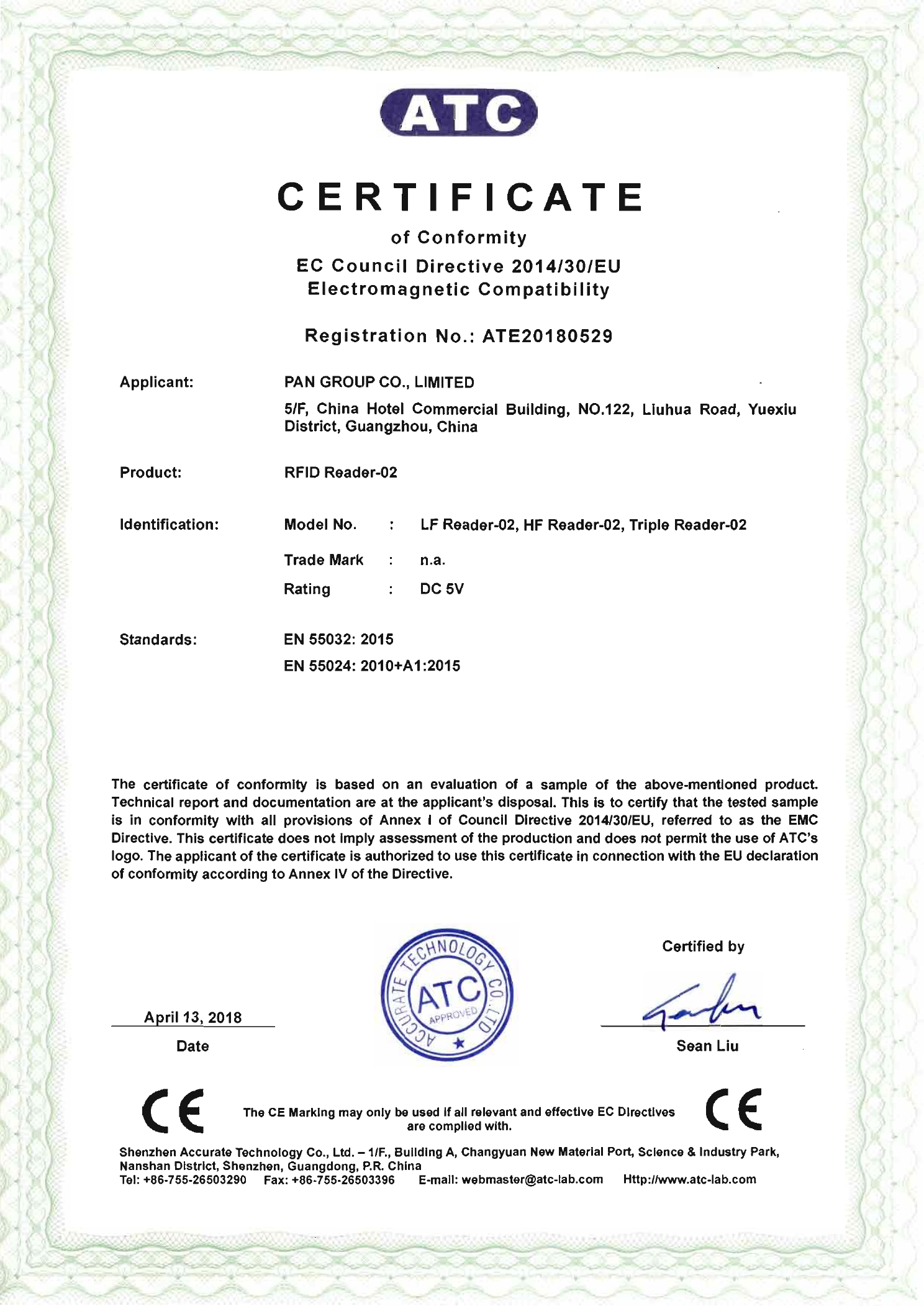
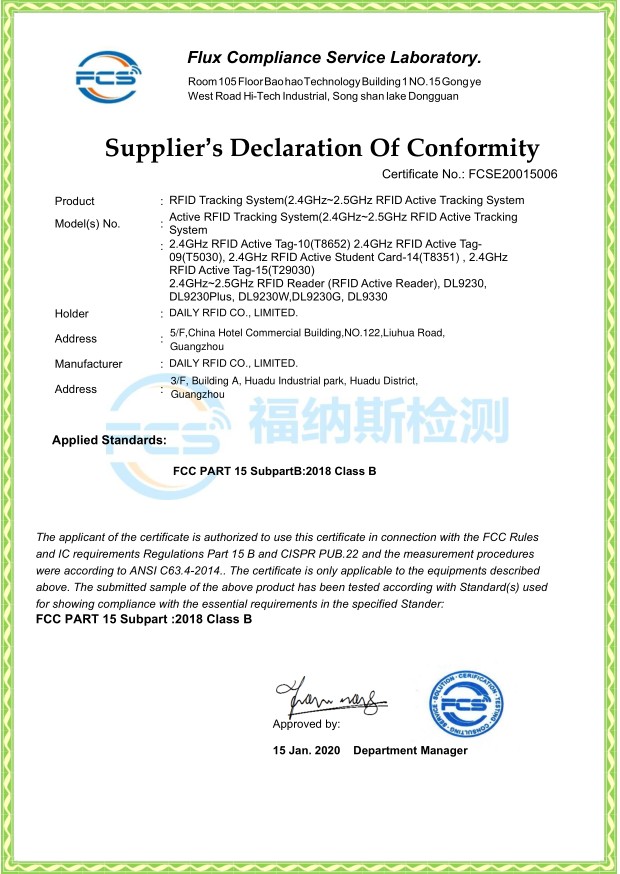
The company also holds CE EMC certificates (e.g., ATE20180529) for RFID Reader-02 products and an FCC Supplier's Declaration of Conformity (FCSE20015006) for its 2.4 GHz RFID active tracking systems including the DL9230 series.
In addition, RFID labels from DAILY RFID are covered by RoHS 2.0 certificates, which is relevant when tags are sourced together with readers as a matched system.
Manufacturing and Customization Capability
From a procurement perspective, capability data matters as much as product data. DAILY RFID supports ODM/OEM customization for UHF fixed readers, including antenna gain and interface configuration, with a monthly capacity of 1,000 units, MOQ of 1 unit, and lead time of 15–45 days. Quality control includes Factory Acceptance Testing. UHF handheld readers can be customized in OS, software, and housing, with a monthly capacity of 2,000 units, MOQ of 1 unit, and lead time of 15–30 days under Full System Burn-in testing.
How to Build Your UHF RFID Reader Shortlist: 8 Evaluation Steps
The following evaluation flow is designed for smart manufacturing buyers who need to convert a broad requirement into a defensible shortlist.
Step 1. Define the Read Zone and Movement Pattern
Identify where tags must be read: a portal, a conveyor, a ceiling area, a shelf, or a handheld walk path. This decides whether a fixed reader, ceiling reader, gate, or handheld terminal is appropriate.
Step 2. Confirm Protocol and Frequency Band
Confirm that the reader supports ISO/IEC 18000-6C (EPC Gen2). For global deployment, check whether the frequency band is configurable across 860–960 MHz to match regional regulations.
Step 3. Select the Form Factor
Match the form factor to the zone: multi-antenna fixed readers for wide coverage, integrated readers for gate and yard use, ceiling readers for room-level tracking, handheld PDAs for mobile inventory, and Type-C modules for embedded terminals.
Step 4. Validate Reading Distance and Tag Density
Compare the reader's reading range and anti-collision rating against the actual number of tags passing through the zone. A dock door may need 1,000-tag anti-collision; a tool cabinet may only need 5-tag precision.
Step 5. Check Communication Interfaces
Verify RS232, RJ45/TCP/IP, GPIO, RS485, USB, Wi-Fi, Bluetooth, or 4G options. Integration with existing WMS/ERP systems usually depends on these ports.
Step 6. Verify Certification Coverage
For EU deployment, check CE RED, CE EMC, and RoHS documentation. For US deployment, check FCC status. Confirm that the specific model, not just a similar model, is listed on the certificate.
Step 7. Assess Manufacturing Capacity and MOQ
For OEM/ODM requirements, confirm capacity, MOQ, lead time, and quality-control procedures. This avoids surprises when scaling from sample order to production volume.
Step 8. Run a Sample Test
Request a sample reader and test it with your actual tags, on your actual surfaces, in your actual environment. Reading range and anti-collision numbers should be validated before the commercial order.
UHF RFID Readers in Action: Verified Smart Manufacturing Deployments
The following deployments provide examples of how specific reader models perform in real operational environments.
Automotive Parts Warehouse — Spain
420 sets of DAILY RFID DL6980 4-port long-range readers were installed for inbound pallet reading, dock-door verification, and returnable container tracking. The project reported a 40–70% reduction in manual inbound receiving and a 30–60% decrease in missed pallet scans. The system has been operational for at least 5 years.
Distribution Center — Poland
360 sets of DAILY RFID DL920S readers are used for conveyor-line parcel reading, carton routing, and outbound shipment verification. Parcel sorting mistakes dropped by 30–60%, and outbound verification became 40–70% faster. The deployment has been running for at least 5 years.
Port and Container Yard — Saudi Arabia
95 sets of DAILY RFID DL6970 UHF Super Long Range Readers handle container gate identification, yard lane monitoring, and vehicle pass-through checks. Vehicle and container identification became 30–60% faster, and movement-record coverage reached 80–95%. The project has operated for at least 5 years.
Pop-up Retail and Exhibition — Qatar
240 sets of DAILY RFID DL9700-WiFi UHF Readers were deployed for temporary stockroom counts, mobile checkout, and event inventory control. Temporary reading points were set up 40–70% faster, and manual stock checks dropped 50–80%. The project duration is at least 4 years.
Railway Maintenance — Czech Republic
145 sets of DAILY RFID DL1080 UHF Handheld PDAs are used for trackside asset inspection, spare-parts verification, and maintenance route recording. Paper inspection records were reduced by 50–80%, and inspection completeness improved by 30–60%. The project has been in operation for at least 4 years.
Fleet Entry and Toll Lane Control — Colombia
120 sets of DAILY RFID DL950S UHF ultra-long-range readers are installed for fleet entry control, toll lane identification, and yard movement monitoring. Manual vehicle checks dropped by 40–70%, traffic flow improved by 20–50%, and movement records became more complete. The system has been operational for at least 5 years.
UHF RFID Reader Form Factors at a Glance
The table below compares the main form factors covered in this article, using published specifications from DAILY RFID's product documentation.
| Form Factor | Representative Model | Read Range | Tag Capacity | Protection | Typical Smart Manufacturing Use |
|---|---|---|---|---|---|
| AI Multi-Antenna Fixed | DL6960 | Up to 25–30 m | Up to 1,000 tags | IP64 | Large warehouses, dock doors, multi-zone scanning |
| WiFi Integrated Fixed | DL920Plus | 8–15 m | Supported | IP64 | Conveyor lines, yards, areas without cabling |
| Long-Range Integrated Fixed | DL921 (GSM/PoE) | 0.1–15 m | Up to 50 tags | IP65 | Toll lanes, gates, outdoor yard checkpoints |
| Ceiling Integrated Reader | DL6990 | 0.1–5 m | Up to 50 tags | IP66 | Room-level asset tracking, archives, cleanrooms |
| Industrial Handheld PDA | DL1280 | UHF up to 20 m; HF 32 cm; LF 10 cm | Up to 100 tags | IP65 | Cycle counting, field inspection, maintenance routes |
| Type-C UHF Reader Module | DL213 | 0.1–10 cm | Up to 5 tags | — | Embedded terminals, smart cabinets, kiosks |
Frequently Asked Questions
What is the best UHF RFID reader for inventory tracking?
There is no single model that fits every inventory workflow. For warehouse-wide batch reads, the DL6960 supports up to 1,000 tags simultaneously with a reading range of 25–30 meters. For forklift or aisle-based cycle counting, the DL1280 Industrial PDA reads UHF tags up to 20 meters and supports 100 tags at a time. For fixed door or portal tracking, the DL921 series reads up to 15 meters. The appropriate choice depends on whether inventory moves through a fixed point or is counted by personnel walking the floor.
What certifications should I check when sourcing UHF RFID readers for the EU or US market?
For the EU, the relevant documents are the CE RED Certificate of Compliance (under Directive 2014/53/EU), CE EMC certificates, and RoHS compliance evidence. For the US, FCC verification or Supplier's Declaration of Conformity is required. DAILY RFID's UHF reader family is listed on CE RED certificate DGE190109029, and its 2.4 GHz active tracking system is covered by FCC SDoC FCSE20015006. Buyers should verify that the exact model number appears on the certificate.
What reading distance and tag capacity are realistic for UHF RFID inventory tracking?
Published DAILY RFID specifications show a practical range of 0.1–30 meters depending on reader type. The DL6960 delivers the longest range (25–30 m) and highest tag capacity (1,000 tags). The DL1280 handheld reads up to 20 meters with 100-tag anti-collision. The DL920Plus integrated reader covers 8–15 meters. The actual distance depends on tag type, surface material, and environmental conditions.
Can I request a UHF RFID reader sample before committing to a larger order?
Yes. DAILY RFID supports sample orders for UHF fixed readers with an MOQ of 1 unit and for UHF handheld readers with an MOQ of 1 unit. This allows the buyer to validate reading range, integration, and operating environment before scale deployment. Free SDK documentation is provided with the reader.
What is the typical lead time for UHF RFID reader production?
For UHF fixed readers, the lead time is 15–45 days depending on customization, with a monthly capacity of 1,000 units. For UHF handheld readers, the lead time is 15–30 days, with a monthly capacity of 2,000 units. Customizations such as antenna gain, interface configuration, OS, software, or housing can affect the schedule.
Conclusion: Matching Market Trends to a Defensible Selection
The UHF RFID reader market is growing, standardized, and increasingly regionalized. For smart manufacturing buyers, this means the opportunity is real and the need for careful evaluation is equally real. The selection should be driven by the physical workflow, verified form-factor specifications, certification coverage, and supply-side capabilities—not by generic rankings or the loudest marketing message.
This article used DAILY RFID CO., LIMITED as a reference manufacturer because its technical portfolio, certifications, factory data, and deployment evidence are publicly documented. When you move to the next stage of your evaluation, we recommend consolidating the eight-step checklist into a scoring matrix, requesting samples, and testing against your own tags and environment.
For more information about DAILY RFID's UHF reader portfolio, including specifications, case studies, and customization options, visit www.rfid-in-china.com or download the company brochure below.
Download the DAILY RFID Company Profile
Access the full capability overview, production data, and product line documentation.
Download Company Profile (PDF)
Contact: sales@rfid-in-china.com | WhatsApp: +86 15817191372
Have Questions or Need More Details?
Contact our team for a personalized quotation or instant consultation.
Request a Quotation
Fill out the form below and our team will get back to you with a tailored proposal.
WhatsApp Direct Chat
Prefer to chat in real-time? Message us on WhatsApp for instant assistance & quick answers.
- Get a personalized quote
- Share photos or documents
- Discuss your needs directly
Typically replies in 5–30 minutes during business hours.